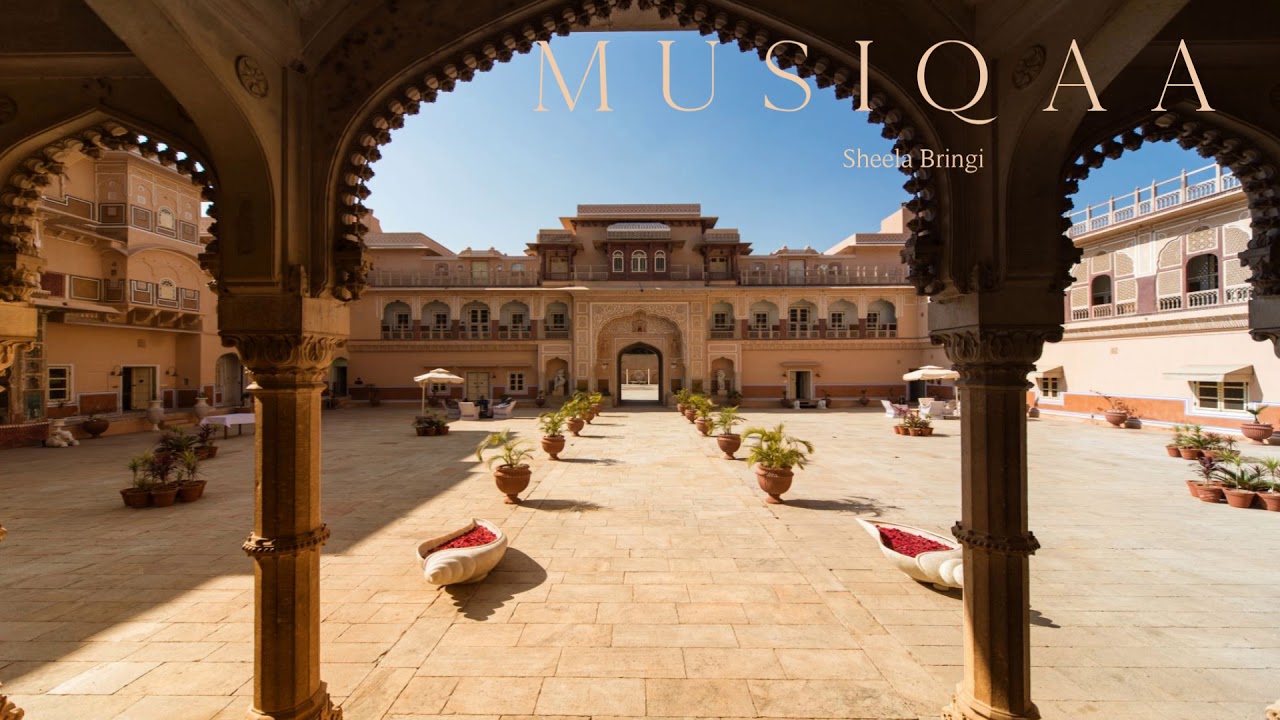
The video opens with the pure, liquid sound of a bamboo flute—the bansuri—entering the sonic space like a prayer taking form. This is "Raja Ram," a 2013 devotional recording featuring Sheela Bringi on bansuri, voice, and harmonium, accompanied by Clinton Patterson on guitar and Javad Butah on tabla. In six minutes, this performance distills something essential about kirtan: the practice of sacred music-making that joins individual voices and instruments in a unified invocation of spiritual truth.
The title alone—Raja Ram—carries centuries of spiritual weight. In Hindu and yogic tradition, "Raja Ram" is a name of the divine, an invocation that calls forward the royal, luminous quality of consciousness itself. "Raja" means king or ruler; "Ram" refers to the avatar of Vishnu, the God of preservation and sustenance. In the Ramayana, one of Hinduism's most revered epics, Rama is the ideal king and hero whose story teaches dharma (right action and righteousness) across generations.
When chanted or sung, the name Raja Ram is understood not as mere sound but as a vehicle for transformation—a gateway through which the practitioner touches something eternal. The repetition of the name in kirtan is not incantation for its own sake; it is a deliberate practice designed to still the mind, align the body with breath, and attune the heart to what yogic philosophy calls atman—the eternal self or soul. Each repetition is an opportunity to return attention from the external world to the inner dimension of being. Over six minutes, as Sheela Bringi and her ensemble continue the invocation, the cumulative effect is meant to create a shift in consciousness: a movement from the fragmentary, anxious mind toward a state of greater wholeness, presence, and peace.
Kirtan, which means "to glorify" or "to sing the praises" in Sanskrit, is an ancient Hindu and Yogic practice of group chanting, typically centered on mantras or the names of the divine. Unlike meditation, which cultivates silence and inward attention, kirtan is music as spiritual practice—the sound itself becomes the method. The practice is rooted in the philosophical understanding that everything, including human consciousness, is ultimately a form of vibration or frequency. By deliberately working with sacred sound—with names and mantras that carry spiritual meaning—the practitioner can attune their own vibration to higher frequencies of consciousness.
A traditional kirtan session typically follows a call-and-response structure: a lead singer or musician offers the mantra, phrase, or prayer, and the group responds, creating waves of harmonic intention. This participatory element is crucial; kirtan is not a performance viewed from a distance but a shared practice. The involvement of multiple voices, all singing the same invocation, creates what practitioners describe as a field effect—a palpable shift in the room's energy as individual hearts and minds align around the same sacred name.
In Sheela Bringi's recording, this structure is distilled into a smaller ensemble, but the intention and function remain the same. Whether in a large group or an intimate recording, the principle is identical: sustained repetition of divine names, supported by breath and music, creates an opportunity for the mind to settle and the heart to open. The bansuri player, the harmonium player, the tabla player, and the singer are not separate performers but collaborators in a single act of spiritual invocation.
The bansuri, the ancient bamboo flute providing the melodic thread in this recording, carries profound spiritual significance in Hindu culture. In Hindu iconography, Krishna is depicted playing the bansuri to charm the gopis (milk maidens) and call the devotees to spiritual awakening. The flute's mournful, longing quality—what some describe as the voice of the soul calling itself home—makes it an ideal instrument for devotional music.
When the bansuri plays "Raja Ram" in Sheela Bringi's recording, it carries this lineage of spiritual yearning and devotion. The instrument's sound is characteristically simple and profound: no electronic processing, no filter—just bamboo, breath, and the subtle movements of the player's fingers creating variations in pitch and tone that carry emotional and spiritual nuance. The bansuri requires extraordinary control and sensitivity from the player; a slight movement of a finger changes the pitch, and the quality of breath directly affects the color and warmth of the sound. This intimacy between player and instrument means that every note is an expression of the musician's inner state and intention.
Alongside the bansuri sits the harmonium, a keyboard instrument introduced to India in the 19th century through colonial contact, but now absolutely integral to kirtan and Indian devotional music. The harmonium provides the harmonic foundation and often carries the drone—a continuous musical undercurrent that anchors the melodic flights of the flute and voice.
In this recording, Sheela Bringi plays the harmonium, adding both rhythmic and harmonic texture to the ensemble. The drone, a fundamental element of Indian classical and devotional music, is philosophically significant: it represents the eternal, unchanging ground of being against which all other sounds—and indeed, all experiences—arise and dissolve. As the bansuri soars and the voice sings, the harmonium's steady drone provides a reminder of the unchanging reality beneath all change. This layering of elements creates a sonic representation of a core yogic teaching: that beneath the ever-changing surface of experience lies an eternal, stable ground of being.
Javad Butah's tabla—the paired hand drums fundamental to North Indian classical music and kirtan—provides the rhythmic heartbeat of the piece. The tabla consists of a smaller, higher-pitched drum (dayan) and a larger, deeper bass drum (bayan). The tabla player in a kirtan context is not merely keeping time; they are creating complex rhythmic patterns called taals that give shape and momentum to the spiritual offering.
In ensemble kirtan, the tabla player is listening intently to the singers and flutist, responding and supporting their rhythmic and emotional flow. The dialogue between tabla and melody is constant and subtle. When Sheela Bringi's voice rises, the tabla might push forward or add flourishes; when the melody settles, the tabla grounds it. This dynamic responsiveness mirrors the philosophy of kirtan itself: individual expression within a larger, harmonious structure; freedom within form.
Clinton Patterson's guitar is the striking outlier in this setup—a Western instrument in a traditionally Indian spiritual context. This choice is not arbitrary; it signals something true about contemporary kirtan and spiritual music: the boundaries between traditions are increasingly permeable, and what matters most is the sincerity and reverence of the offering.
The guitar in "Raja Ram" provides a sustained harmonic bed and rhythmic support that complements the harmonium and tabla. It enriches the harmonic language of the piece while remaining in service of the devotional intention. This kind of cross-cultural collaboration has become increasingly common in recent decades as kirtan artists recognize that devotion itself transcends cultural origin. A guitar played with reverence in service of a sacred name carries the same spiritual potency as a traditionally-made sitar. What matters is not the pedigree of the instrument but the purity of intention of the person playing it.
For anyone new to kirtan, listening to "Raja Ram" offers a natural entry point into a vast and ancient tradition. The practice is remarkably straightforward. The essential instruction is simply to listen—and perhaps, as you become more comfortable, to silently repeat the name along with the recording.
As you listen over the six minutes, notice what unfolds in your body and mind. Some practitioners report feeling an opening in the heart, a sense of expansion or softening. Some find that the usual stream of wandering thoughts gradually settles and becomes quieter. Some experience a sense of connection, belonging, or peace. Others find themselves moved to tears without quite knowing why. The specifics vary from person to person and even from listening to listening, but the consistent testimony across centuries and across thousands of practitioners is that sustained attention to divine names and sacred sound does something real—not through belief alone, but through a kind of sonic medicine that the yogic and Hindu traditions understand as deeply as modern neuroscience is beginning to.
"Raja Ram" is a complete experience in itself—a small gem of a recording that distills centuries of spiritual music-making into six minutes. If this introduction resonates with you, there are several natural next steps. Listen to the recording repeatedly; kirtan deepens through repetition, as the mind becomes more familiar with the melody and melody fades into the background, leaving only the invocation itself.
Explore other kirtan recordings and artists; there are thousands available online, representing diverse lineages, instruments, and styles. Some feature large group settings; others are intimate recordings like this one. The diversity is part of the richness.
If you're drawn deeper, consider finding a live kirtan session in your area. Many yoga studios, meditation centers, and spiritual communities host kirtan gatherings. The group experience—multiple voices singing together, the collective energy of shared intention—carries a power that even excellent recordings cannot fully capture.
Finally, if you're musically inclined, learn simple mantras and chant them yourself. You need no special training or talent. The practice is available to anyone willing to bring attention and sincerity to it. Whether you're playing an instrument as skilled as Sheela Bringi's bansuri or simply singing the name with your own voice, the essential element—the heart's sincere reaching toward the divine—is always available and always counts.