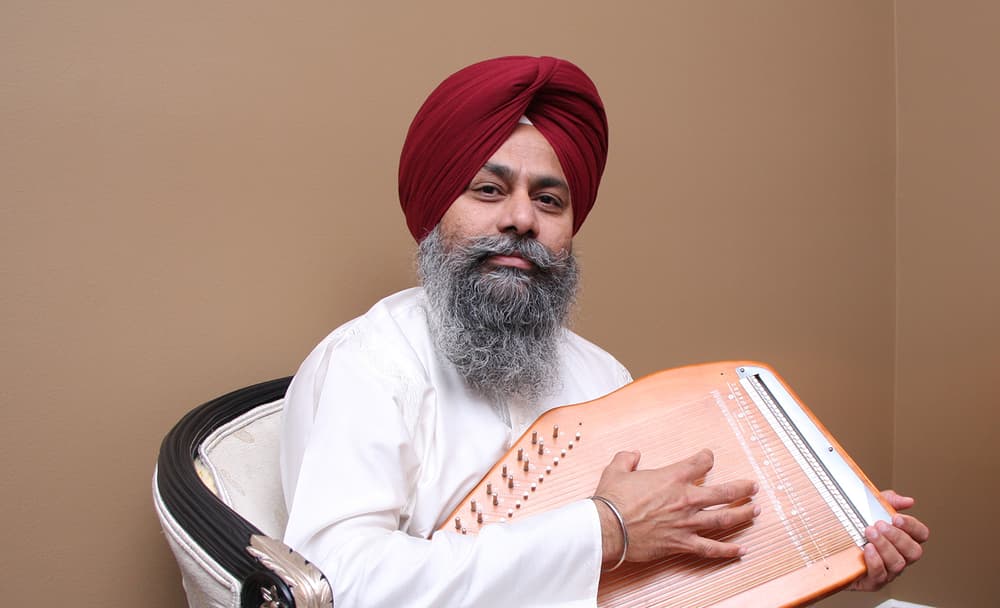
Professor Paramjeet Singh demonstrates Raag Multani Todi, a Hindustani classical raga that combines elements of two distinct melodic frameworks (raags). The performance illustrates the raga's characteristic ascending and descending scale patterns, the use of microtonal slides and bends, and the improvisational exploration central to classical Indian music performance. This video captures a live performance at Jashn-e-Mousiqi in Toronto, showing how a trained vocalist navigates the rules and aesthetic conventions of a specific raga while maintaining expressive freedom.
What is Raag Multani Todi?
Raag Multani Todi exists at an intersection within Hindustani classical music—it is a raga that incorporates elements of two parent raags: Multani and Todi. Each parent raga has its own melodic identity, scale patterns, and emotional character. Raag Todi is known for its melancholic, introspective quality, while Multani carries different intervallic relationships and mood. By combining these frameworks, Multani Todi creates a unique sonic palette that allows for a broader range of melodic exploration than either parent raga alone.
In Hindustani classical tradition, a raga is not simply a scale—it is a complete system governing which notes are used, how they are approached, which intervals are emphasized, and in what order phrases typically unfold. Raag Multani Todi follows these conventions while offering distinctive characteristics that a trained listener can recognize and an informed performer must respect.
How are the scales and melodic patterns structured?
The performance captures the ascending (arooh) and descending (avrooh) patterns that define the raga's melodic shape. Unlike Western scales, which are typically evenly divided, Indian ragas feature unequal intervals called srutis—microtonal gradations that give Indian classical music its characteristic sound. A note in Raag Multani Todi may be approached from below with a slide, bent slightly sharp or flat, or struck directly, depending on the raga's rules and the performer's artistic choice.
Professor Singh's performance demonstrates the phrase-based nature of raga. Rather than simply playing individual notes, classical singers and instrumentalists construct characteristic melodic figures (mukhras) and patterns that recur throughout a performance. These patterns are not rigid; they serve as a vocabulary within which improvisation occurs. The performer generates new variations by altering rhythm, ornamentation, and the length of time spent on particular notes.
What role does improvisation play in the performance?
The core of Hindustani classical music lies in real-time improvisation within a defined framework. A performer begins with a written composition (bandish) but then moves into extended improvisational sections (vilambit and drut khayal) where the melody is elaborated and explored. This is not free-form—every note and slide must belong to the chosen raga. The performer's skill lies in discovering fresh melodic paths while remaining within the raga's aesthetic boundaries.
In Raag Multani Todi, this means that while certain note combinations and ornamentations are preferred or required, the performer still has significant interpretive freedom. Two different singers performing the same raga will sound distinct, each bringing their own phrasing, timing, and emotional emphasis. This balance between structure and spontaneity is central to how Indian classical music is experienced and valued.
How does microtonal inflection enhance expression?
One of the most striking differences between Indian classical music and Western classical tradition is the extensive use of microtones and portamento—continuous pitch slides between notes. A single note in Raag Multani Todi may be sung slightly flat or sharp depending on context. A performer might slide from one note to another rather than jump, creating a seamless, vocal quality even on stringed instruments.
These subtle pitch inflections are not errors or approximations; they are deliberate expressive choices that define the raga's character. Professor Singh's vocal technique in this performance demonstrates how these microtonal shifts convey emotion and establish the raga's particular flavor. The ear attuned to Hindustani classical music perceives these small pitch variations as essential to the music's meaning and beauty.
What is the role of rhythm and time cycles?
While Professor Singh's performance emphasizes melodic exploration, rhythm and time cycles (taals) form the other pillar of Hindustani classical music. A taal is a repeating rhythmic pattern that can last 8, 12, 16, or more beats depending on the taal's type. A performance cycles through this pattern repeatedly, and improvisational phrases are constructed to land on significant beats (sams) within the taal cycle.
This creates a dialogue between the melody and rhythm. The performer must keep track of where they are in the taal cycle even while exploring intricate melodic variations. The listener, familiar with the chosen taal, experiences satisfaction when a phrase resolves on the sam—the first beat of a new cycle—and anticipation during the off-cycle exploration.
How is this raga situated within the broader classical tradition?
Raag Multani Todi represents the depth and specificity of the Hindustani classical repertoire. With hundreds of named raags, each with distinct rules and associations, a classical musician's knowledge is encyclopedic. Training in classical Indian music involves memorizing not only the scales and phrases of many raags but also understanding their emotional character, the time of day or season they are traditionally performed, and their historical lineage.
Professor Singh's performance at Jashn-e-Mousiqi—a major North American festival of Indian music—shows how this living tradition continues to thrive outside the Indian subcontinent. Diaspora communities and international audiences have become important contexts for classical music performance, even as the core principles remain unchanged.
Where to go from here
To deepen your understanding of Raag Multani Todi and Hindustani classical music, explore recordings of the same raga by different masters to hear how individual artists interpret its structure. Listen for the characteristic phrases and the way microtonal ornamentation shapes the melody. If possible, attend a live classical music concert; the immediacy of real-time improvisation is difficult to convey in recorded form. Consider learning about taals and how rhythm cycles interact with melodic improvisation. Finally, seek out documentary or educational resources that explain the historical development of Hindustani classical music and the training systems (gharanas) that preserve and transmit these traditions across generations.