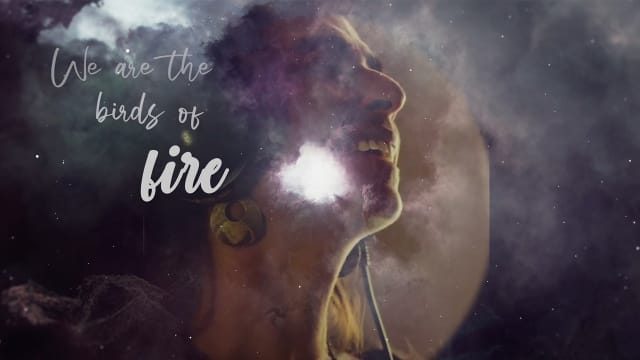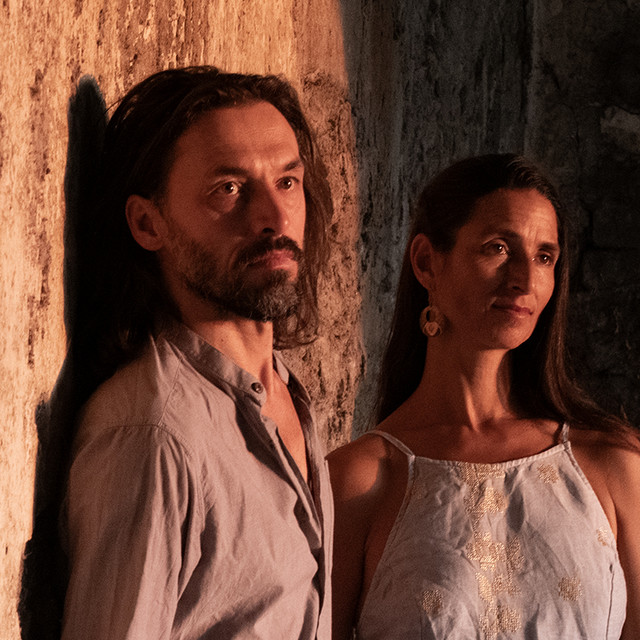
This 2010 Europe tour documentation captures Mirabai Ceiba performing "Prithvi Hai," a mantra from their album A Hundred Blessings that invokes a sacred return to mother earth, father sky, and the river of life itself. The piece explores themes of homecoming, embodied spiritual awakening, and the living presence of natural elements as pathways to soul consciousness. Shot across 20 cities in 11 countries, the performance demonstrates how kirtan—call-and-response devotional singing—creates a field of collective resonance and participatory spiritual practice.
"Prithvi Hai" uses direct, primal language to establish relationship with the fundamental elements of existence. The mantra opens with the declaration "I'm coming home mother earth / I'm coming home father's sky," establishing earth and sky as sacred presences rather than abstract concepts. This structure—addressing earth as mother and sky as father—mirrors ancient Vedic traditions where natural elements are understood as living, conscious principles worthy of reverence and direct address.
The mantra's power lies in its simplicity and its grounding in the body's actual location. Rather than aspirational or metaphorical language, the performer states "the River of Life brings me home," positioning the river—a flowing, continuous presence—as the medium through which homecoming occurs. This is not a journey to elsewhere; it is a recognition that life itself, in its constant motion, already carries the seeker toward home.
The 2010 Europe tour performances of "Prithvi Hai" use traditional kirtan structure: the lead vocalist establishes the mantra, the audience or ensemble joins in call-and-response, and the repetition creates an accumulating sonic and energetic field. The transcript evidence shows moments of sung material interspersed with applause—a sign of active audience participation. The inclusion of applause at intervals (35s, 109s, 126s, 171s, 197s, 211s, 261s) indicates the audience was directly engaged with the performance, not passively receiving it.
Kirtan as a participatory form differs fundamentally from concert performance. When audiences sing the mantra together, they are not processing information; they are generating a collective resonance field. The repetition of "I'm coming home" serves multiple functions: it trains attention to the present moment, it establishes kinship with earth and sky through vocalization, and it allows individual consciousness to align with the group intention. The performance across 20 European cities suggests that this particular mantra was chosen specifically for its universality—its ability to resonate across cultural and linguistic boundaries through elemental imagery.
"Prithvi Hai" appears on Mirabai Ceiba's album A Hundred Blessings, which forms the conceptual and sonic foundation for the 2010 European tour. The title itself—A Hundred Blessings—suggests an abundance approach to spiritual practice: rather than seeking one path or one realization, the album explores multiple doorways, each a blessing in itself. The "Prithvi Hai" mantra fits this framework by offering elemental and relational doorways—earth, sky, river, soul—through which consciousness can awaken.
The choice to tour this material across Europe for two months demonstrates the artistic commitment to sharing these mantras in person, in live gathering spaces. The album serves as both a studio document and a blueprint for live transmission. Kirtan artists understand that the recorded mantra is a pointer; the live experience is where the practice becomes embodied and collective.
The lyric "every moment awakens my soul" positions awakening not as a singular achievement or distant goal, but as an ongoing, moment-by-moment process. This reframes spiritual practice away from accumulation toward recognition: what is already present in each moment is the opportunity for soul consciousness to activate. The mantra suggests that awakening is not contingent on perfect conditions or years of preparation; it is available within the structure of breath, presence, and willingness to recognize where you already stand.
The subsequent lines—"I am coming home mother I'm coming home father's sky I'm the river itself"—track a progression in identification. The speaker begins by seeking to return home to mother earth and father sky, then arrives at the recognition: "I'm the river itself." This is not metaphorical poetry; it reflects the Vedantic understanding that individual consciousness is not separate from the larger flows of existence. To recognize oneself as the river—as the moving, flowing principle of life—is to understand that home was never elsewhere. The river does not journey toward the ocean; the river is already the ocean in motion.
The logistics of the tour—20 cities in 11 countries over two months—indicate significant grassroots interest in kirtan practice across Europe. Each performance created a local gathering around these particular mantras. The documentary structure of the video (described as "a 4 minute short cut" of the full tour) compresses multiple performance moments into a single presentation, giving viewers a sense of the mantra's resonance across different venues and audiences.
The audiences captured in the transcript segments were responsive and engaged—the repeated notation of applause suggests audiences understood themselves as participants in a sacred practice, not consumers of entertainment. This distinction matters: in kirtan, applause often functions as an expression of gratitude and acknowledgment of shared spiritual intention, not merely appreciation for artistic skill.
While the transcript does not explicitly cite sources, the mantra's elemental invocation—earth as mother, sky as father, river as the principle of flow—connects to ancient Vedic traditions where prakriti (nature) and the fundamental elements are understood as divine manifestations. The address to "mother earth" and "father sky" echoes cosmogonic hymns found in the Vedas, where creation is understood through the sacred union of prithvi (earth) and dyaus (sky).
The mantra's emphasis on coming "home" rather than seeking transcendence also reflects non-dualistic philosophy, where the goal is not to escape the world but to recognize its sacred nature and one's inherent belonging within it. This is particularly significant in contemporary kirtan practice, where earth-based spirituality and ecological consciousness have become central concerns.
If "Prithvi Hai" resonates with you, consider exploring other recordings from A Hundred Blessings to understand the full arc of mantras offered on that album. Visit mirabaiceiba.com and spiritvoyage.com for additional resources, recordings, and information about live kirtan gatherings. To deepen your practice with elemental mantras, explore other earth-based invocations in Hindu and Buddhist traditions that similarly use natural forces as entry points to non-dual recognition. If possible, attend a live kirtan gathering in your area; the participatory, call-and-response structure of the practice cannot be fully replicated through listening alone. The mantra works not through intellectual understanding but through vocal resonance, breath coordination with others, and the field of collective intention that gathering creates.