Transcript
[0:01] Good evening, everybody.
[0:04] I want to be sure that um you can hear
[0:07] in the back.
[0:09] Okay, good. Thank you so much.
[0:14] How was last night for you?
[0:16] >> [applause]
[0:27] [laughter]
[0:29] >> I actually had uh
[0:31] decided to do a talk about lineage, but
[0:35] after last night, um I I do want to make
[0:38] a few uh offer a few remarks about um
[0:43] what many of us experienced, actually
[0:45] anybody in this country experienced, but
[0:47] also I've received communications from
[0:51] Brazil, um from uh friends in Serbia,
[0:54] and
[0:55] uh actually people all over the world
[0:57] who are and and Canada,
[1:00] and Japan, and more.
[1:02] We're expressing a lot of respect
[1:06] for um our solidarity,
[1:09] um which is the uh turnout for this uh
[1:14] election.
[1:16] Because many of us, including myself,
[1:19] have felt a profound concern
[1:22] about the uh violence and violation of
[1:25] rights in our country.
[1:27] And no matter on what side of the
[1:29] so-called divide you stand,
[1:31] um any kind of violence and injustice
[1:34] affect you.
[1:36] Because we are one body, no matter uh
[1:39] what our thoughts or ideas uh bring us
[1:42] to.
[1:44] And not only we are one body as a
[1:46] community, um
[1:49] with Independents and Maga and Democrats
[1:52] and Republicans and Conservatives and I
[1:55] don't know.
[1:57] But we're one body with this earth.
[2:02] And actually I this is something that I
[2:04] feel very
[2:06] uh
[2:06] >> [sighs]
[2:07] >> deeply about and that is um the violence
[2:10] that the natural world continues to
[2:12] experience really since the onset of the
[2:15] I agrarian
[2:17] uh era
[2:18] uh
[2:19] many many many years ago but the
[2:22] increasing violence toward our earth and
[2:24] its effects on our lives and the lives
[2:27] of all species.
[2:32] I did experience last night um uh
[2:35] not only uh relief
[2:39] but we know that the uh a reformation uh
[2:43] uh
[2:44] reformations um take a lot of work.
[2:48] And um the relief that um many of us
[2:51] experienced and you know I'm sure that
[2:53] we have people who voted different than
[2:56] I did differently than I did in this
[2:58] room and online and I really respect
[3:02] that you showed up to vote. Um
[3:04] you're you're voting your values.
[3:07] Um but I also uh the feeling that I had
[3:11] was uh not just relief but also the
[3:14] importance of uh commitment to actually
[3:18] engage
[3:19] in shifting um the deeper values in our
[3:22] country.
[3:24] Um values that are built on a capitalism
[3:27] that is fundamentally extractive and
[3:29] that has been uh in operation for a very
[3:32] long time.
[3:34] And also um I recently saw a remarkable
[3:37] film called ghost ghost in the machine.
[3:39] Has anyone seen that film?
[3:42] I I really encourage you to see it
[3:44] because it um
[3:46] uh is a very uh deep analysis of um the
[3:51] roots of artificial intelligence in our
[3:53] country which surprisingly enough come
[3:56] um out of uh the
[3:59] uh
[4:00] uh Nazism out of excuse me of fascism
[4:03] and eugenics.
[4:05] It's really fascinating. Ghosts in the
[4:08] Machine, it's on PBS.
[4:11] Um, and it's clearly accessible.
[4:14] As
[4:15] some of you know, I've been consultant
[4:18] to various Buddhist groups
[4:20] presenting in various who are concerned
[4:23] with uh
[4:24] the effects of artificial intelligence,
[4:28] large language models,
[4:31] ASIs and so on. You know, it's an
[4:33] alphabet.
[4:34] Um
[4:35] very concerned about the effects not
[4:38] only on
[4:39] our human relations and how we actually
[4:43] begin to cultivate the the mind of
[4:46] connection, not disconnection. But also
[4:49] the effects on our environment.
[4:52] And I've been heavily criticized, by the
[4:54] way, for these
[4:57] seemingly more sectarian views.
[5:00] Um, views that are political and have to
[5:03] do with justice and I would say care.
[5:08] And one of the things that I think is
[5:10] very important that we as citizens of
[5:14] this country and of the world
[5:17] um, we have a responsibility to
[5:19] cultivate the quality of mind and also
[5:22] the character
[5:23] that is able to stand in your strength
[5:26] and the strength of
[5:28] what you consider to be an experience as
[5:32] non-violence.
[5:34] Non-violence.
[5:37] Which is a term that covers a tremendous
[5:39] amount of territory.
[5:41] From our own inner violence in terms of
[5:44] our thoughts
[5:45] to the violence that we engage in in how
[5:49] we
[5:50] handle objects
[5:53] to the violence in our economy where
[5:57] 1% is getting even smaller but has
[5:59] bigger bank accounts.
[6:01] And
[6:03] where
[6:04] people who are fleeing from violence in
[6:06] their countries are treated with
[6:11] equal if not greater violence than ours.
[6:15] We have to ask who are we?
[6:18] Really.
[6:19] What is important now?
[6:23] What are we willing to stand for?
[6:28] What are we willing
[6:30] to send our voice into risk our own
[6:33] safety?
[6:35] At a time when we're not just in a small
[6:39] neighborhood
[6:41] on the prairie somewhere.
[6:44] But we are all global citizens and we're
[6:46] all inhabitants on this earth.
[6:50] I feel very strict about this inside of
[6:53] myself.
[6:55] Um because of the sense of uh
[6:58] uh moral dilemmas that I personally
[7:01] experience every day when I turn on the
[7:04] water to brush my teeth and then forget
[7:07] to turn it off as I'm continuing to
[7:09] brush my teeth.
[7:11] Because it's not only in the big acts of
[7:13] our lives
[7:15] of our institutions that we create such
[7:17] as this
[7:18] uh which is a small institution but one
[7:21] that um stands for a set of values
[7:23] related to justice
[7:26] related to compassion, related to
[7:28] respect.
[7:30] But also um the institutions that we
[7:33] engage in as individuals uh and as
[7:37] institutions including our own
[7:40] government where the values um at the
[7:43] onset were clear.
[7:45] And those are reflected in our
[7:46] Constitution.
[7:48] But our Constitution has been um in a
[7:52] certain way uh dis- discarded.
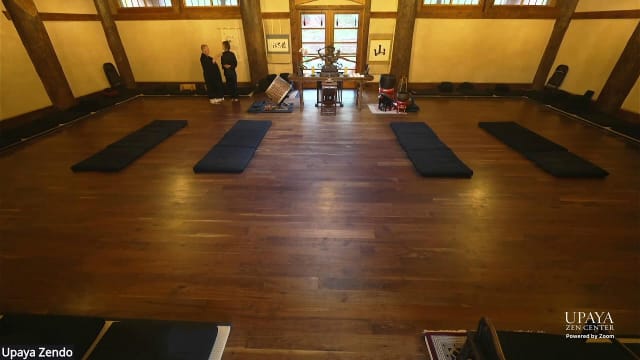
[8:07] So coming here to Upaya, whether you're
[8:09] a resident,
[8:11] a staff member,
[8:13] a visitor,
[8:15] a learner, a practitioner,
[8:18] whatever
[8:19] has brought you to this institution, to
[8:22] this organism,
[8:25] because we're not only an institution,
[8:28] it is essential that you understand
[8:31] what the vision is here
[8:34] and what the mission is here.
[8:36] And that is to create the conditions
[8:38] where you can awaken to the edges that
[8:42] you have not recognized,
[8:44] that you have
[8:46] um
[8:47] been
[8:48] standing on,
[8:50] that you have been falling over,
[8:52] and to actually learn how to be upright,
[8:55] a person of integrity at a time when
[8:58] integrity is compromised in so many
[9:00] quarters.
[9:02] And that you have the strong back
[9:05] of equanimity, which means that you're
[9:07] able to uphold yourself in the midst of
[9:09] any conditions.
[9:12] Where you're not hijacked by your
[9:14] emotions, nor turning away from them,
[9:18] because you have a soft front as well,
[9:20] an open front to the complex realities
[9:23] that are part of your internal
[9:25] experience, your own subjectivity,
[9:29] but also in the intersubjectivity of
[9:31] your lived experience as well.
[9:35] I look at Upaya and maybe it is not that
[9:38] for some, but that would be regrettable
[9:41] for me because Noah indicated this has
[9:44] been tremendous work of 36 years of
[9:48] bringing this institution into being
[9:51] with many people who had faith in this
[9:53] vision of what it is to be an upright
[9:55] person,
[9:57] a true human being, a person of moral
[10:00] and caring character
[10:02] in a complicated world.
[10:06] It's not a place for personal
[10:09] improvement.
[10:12] It's a place to awaken to the sense of
[10:14] responsibility
[10:17] that good human beings have
[10:20] in
[10:20] experiencing, not just seeing,
[10:23] experiencing the suffering
[10:25] in the world
[10:27] whether the suffering is in the
[10:30] trees, the seas, the wildlife,
[10:33] the birds,
[10:35] or that man who outside of your window
[10:39] who made it here from
[10:41] Mexico or El Salvador or Nicaragua
[10:46] who is afraid that he's going to be
[10:47] plucked from this life by ICE.
[10:53] I've said on various occasions that this
[10:56] endo would not be here except for
[10:58] two amazing men
[11:01] from Chihuahua
[11:03] who during the pandemic, which is when
[11:05] we started this project, and thanks Mark
[11:07] and also the contractor,
[11:10] bringing these two men who had not that
[11:12] much experience in building. So, it was
[11:15] a longer project than we had
[11:16] anticipated.
[11:22] But, look at this place.
[11:25] And look at almost every building and
[11:27] every landscape in Santa Fe.
[11:30] Somebody
[11:32] from the south
[11:34] is responsible
[11:36] for that happening.
[11:39] Take this not for granted.
[11:45] And we're turning
[11:46] these people and harming these people
[11:50] and throwing these people into super
[11:51] harm's way.
[11:54] Person after person, child after child.
[11:59] So, every time I walk into this space or
[12:02] into any space at Upaya,
[12:05] somebody from the south
[12:08] >> [clears throat]
[12:09] >> has made that space beautiful.
[12:16] It's to know the roots of things,
[12:17] including lineage.
[12:19] Lineage is important.
[12:25] Now, there is discussion in certain uh
[12:28] Buddhist communities
[12:31] about the inappropriateness for
[12:33] Buddhists to be involved in uh such uh
[12:36] questions.
[12:39] And I would suggest that um that is uh
[12:42] probably not even aligned with the
[12:45] Buddha.
[12:47] What is interesting, if you look at uh
[12:50] what the Buddha studied in terms of
[12:53] uh the governmental structures that uh
[12:56] he established within his own community
[12:59] 2,500 more or less years ago,
[13:03] were learned uh from his uh exploration
[13:06] of the Vajji and Republic.
[13:08] I made a few notes uh about this, and I
[13:10] just want to share some of these
[13:12] thoughts with you. Let me
[13:19] access them.
[13:28] So, some of the things about this Vajji
[13:30] and Republic, and I really encourage you
[13:32] to to study it because many people uh
[13:34] don't uh know
[13:37] that um this is
[13:40] uh in a way the example of an early
[13:43] democracy
[13:45] uh in the uh Indian continent that um
[13:48] became the model for the Sangha
[13:51] that we now practice in today.
[13:58] People in the Vajji and Republic met
[14:00] often, um
[14:02] brought people together frequently.
[14:05] And this goes to this vision, by the
[14:07] way, um of Terry Tempest Williams' book,
[14:10] The Open Space of Democracy.
[14:13] And Monica Rowan's work, who's a lawyer,
[14:15] who looked at what's happened
[14:18] more
[14:19] very often in our own culture with the
[14:22] destruction of the commons,
[14:24] particularly through the
[14:27] world of technology.
[14:29] Uh the parks,
[14:31] the libraries, the movie theaters, and I
[14:34] would say also this is a commons.
[14:37] It just as CVS is also a commons.
[14:41] Uh just as your local restaurant that
[14:42] you don't necessarily order from in
[14:44] order to get your food, but you sit in
[14:47] and kind of feel other people in the
[14:48] space is also a commons.
[14:52] Meeting often in the space with others
[14:54] is really critical.
[14:56] And it is something that we endeavor to
[14:58] practice here in the resident community
[15:00] by virtue of being in a practice space
[15:04] and in a learning space that is and in a
[15:06] living space that is fundamentally
[15:08] communal.
[15:10] An eating space as well.
[15:12] It's more hand to warm hand. It's
[15:15] presence to to presence. And this is
[15:18] really critical because something in our
[15:20] society began to break apart when
[15:22] extended families
[15:24] became an impossibility and the small
[15:27] nuclear family took over and now it's
[15:29] amping up even more through technology
[15:32] and also by people not even coupling.
[15:35] Many people choosing to actually live
[15:37] alone and only having a techno commons
[15:41] to relate to.
[15:44] Commons requires presence.
[15:47] Common requires
[15:49] commons require embodiment.
[15:53] In the Vision Republic, decisions were
[15:56] made not by the Abbot,
[15:59] not by
[16:01] the president. They were made together
[16:04] in a democratic form.
[16:07] And um their traditions um
[16:11] supported that and were deeply
[16:14] respected.
[16:16] There were also important guidelines in
[16:20] the Virgin Republic about protecting the
[16:23] vulnerable,
[16:24] uh the the sick,
[16:27] uh children,
[16:28] uh the elderly, and so forth.
[16:32] I wrote something uh
[16:34] earlier today in um
[16:37] uh
[16:37] reflecting on um this uh
[16:41] remarkable midterm.
[16:52] Really, um I I've been following um
[16:55] politics since I was very, very young.
[16:59] Um I would say about 10 years old. Um I
[17:01] I was quite sick when I was a child.
[17:04] And then I became um subtly politicized.
[17:08] And so at 10 years old, um I
[17:11] uh
[17:12] >> [laughter]
[17:14] >> Breathe. That's a mindfulness bell, but
[17:16] we'd like to have you turn it off.
[17:19] Smile.
[17:23] Thank you.
[17:28] Who's the miscreant?
[17:31] >> [laughter]
[17:32] >> Will you take responsibility? That is
[17:35] part of the practice.
[17:38] To understand that
[17:40] an unsilenced phone affects all of us.
[17:44] Really.
[17:46] An unsilenced or flapping mouth
[17:49] affects all of us, for better or for
[17:51] worse.
[17:56] Okay.
[17:59] >> [clears throat]
[18:01] >> Don't worry. No shaming, but just
[18:03] correction.
[18:07] But it is a beautiful example. Here we
[18:10] are in a commons, and we made a request.
[18:12] And um because we want to create, you
[18:15] know, the
[18:16] the optimal conditions for
[18:18] uh for you. Um and um and then there you
[18:23] are there we are we are this happens all
[18:25] the time and so our lives are filled
[18:28] with moments of going off the rails or
[18:31] maybe not realizing that in fact our
[18:33] phone is not been muted and you go oh
[18:36] dear
[18:37] but it does just a simple thing like
[18:39] that affects the whole space
[18:41] just imagine
[18:44] just imagine
[18:46] with what some of the things that have
[18:48] happened in our country
[18:50] the murder of Renee Good and of Alex
[18:54] Petty
[18:56] this affected all of us
[19:04] all of us
[19:07] things really matter both great and both
[19:10] small
[19:17] so it is one of the reasons why we try
[19:21] and you know I'm going off on a tangent
[19:23] but I'll get back on
[19:25] >> [laughter]
[19:26] >> you know we endeavor at Upaya to um
[19:30] create the conditions
[19:32] where people can understand that the
[19:34] violation of rights of boundaries
[19:39] of vows of agreements
[19:43] affects all of us
[19:46] >> [clears throat]
[19:47] >> and that we have fundamentally
[19:49] collective responsibility to engender
[19:53] safety
[19:55] integrity
[19:57] accountability
[19:58] and harmony
[20:00] in the spaces that we inhabit which are
[20:03] not just human
[20:06] led
[20:07] but also include this room
[20:11] the trees outside and so forth
[20:15] harmony with the world
[20:18] that supports us including
[20:21] the trees the meadows and everything in
[20:24] the natural world.
[20:28] So, I was recently with and will soon be
[20:31] again with um
[20:33] just a
[20:34] wonderful human being. You're wonderful,
[20:36] too.
[20:37] Um she's really wonderful.
[20:40] She is uh the writer Terry Tempest
[20:43] Williams.
[20:44] And I have to tell you she is brilliant
[20:47] but funnier than almost any person I
[20:50] know.
[20:52] I won't repeat um some stories about
[20:55] her, but
[20:56] >> [clears throat]
[20:56] >> I'm glad that we'll be with her. She'll
[20:58] be here
[21:00] uh coming in on the 13th of November and
[21:03] uh
[21:05] She's written a quite a
[21:07] beautiful uh book, a kind of uh
[21:11] uh uh exploration. The book is called
[21:13] The Open Space of Democracy.
[21:17] It's a small book,
[21:20] and she writes uh that um democracy,
[21:23] like wilderness,
[21:25] depends on open space.
[21:30] And again, going back to Mon Ker Row, if
[21:33] any of you have read some of my essays
[21:35] on solidarity,
[21:38] open space
[21:40] we would call also commons.
[21:46] Room for many voices.
[21:51] Room for disagreement.
[21:54] And also for ideas,
[21:58] thoughts, visions,
[22:00] perspectives,
[22:02] room where they can actually circulate
[22:05] freely.
[22:07] And we're going to have someone here
[22:10] uh along with Terry, Molly Crockett, a
[22:13] cognitive scientist
[22:15] from Princeton University um who uh
[22:18] directs the Crockett Lab,
[22:20] who addresses this uh very important
[22:23] point.
[22:26] That in order for communities to be
[22:29] strong,
[22:30] difference and differences need to be
[22:33] present.
[22:35] And we have to build across those
[22:37] differences.
[22:39] And we have to build from difference.
[22:45] Terry goes on to say that it's
[22:47] especially important for us to protect
[22:50] open land.
[22:54] And I want to say something to our
[22:56] credit here at Utopaya.
[22:58] If you look at the face of Sarah Gordo
[23:00] Mountain, over 36 years, small sliver of
[23:04] land after small sliver of land, we have
[23:07] bought the entire face and protected the
[23:09] entire face of Sarah Gordo Mountain.
[23:12] Very few people know that.
[23:15] Why?
[23:17] They wanted us to cut trails through
[23:19] there.
[23:20] I became unpopular in the neighborhood
[23:22] and said, "No."
[23:25] We need open space.
[23:27] In democracy,
[23:29] we need open space and wilderness. We
[23:31] need to understand. We need open space
[23:34] for the wildlife, which now seems to
[23:36] have inhabited Utopaya more thoroughly
[23:39] and decimated our squash uh plant
[23:43] >> [laughter]
[23:43] >> for for harvest, but nonetheless.
[23:48] Open space gives everything space to
[23:52] breathe.
[23:53] Space to be.
[24:00] We've also year over the years protected
[24:03] the Bosque, not just below us, but both
[24:07] to the east and that sorry,
[24:10] to the east and to the the west of us.
[24:13] Areas in the Bosque that could have been
[24:15] developed, built on.
[24:18] And we've concentrated our building on
[24:20] these few flat places that in the early
[24:23] late 19th
[24:25] century and early 20th 20th century were
[24:28] bean fields.
[24:31] So, we built on bean fields here.
[24:34] But, nothing else.
[24:37] Not removing trees,
[24:39] but actually planting. Not only one
[24:41] tree, but now hundreds of trees
[24:44] on the lands that we steward.
[24:51] Terry is saying that the open space of
[24:53] democracy is where people can speak.
[24:57] Where they can experience dissent,
[25:00] difference.
[25:04] And most importantly, where they can
[25:06] really listen
[25:08] to each other.
[25:12] Where they can hear each other.
[25:16] And I feel that is a
[25:19] in a way the the most important element.
[25:22] Developing
[25:24] the capacity to hear deeply.
[25:32] My beloved teacher, Glassman Roshi, that
[25:35] Kodo
[25:36] uh mentioned. I'm so grateful I met
[25:39] Bernie in the '70s
[25:42] and became his formal student in uh the
[25:45] um mid '90s.
[25:47] Um after he and Jishu went to the
[25:49] capital
[25:51] uh DC in January and I think it was '94
[25:55] or something around that.
[25:57] And in the snow, sat a bearing witness
[26:00] retreat with a few close students.
[26:03] Because they realized being um in this
[26:05] wonderful place they had
[26:08] uh just outside of New York City didn't
[26:10] fit with who they were.
[26:12] And they wanted to see in terms of um
[26:15] the road ahead and particularly in light
[26:17] of the Bush administration, what really
[26:20] um
[26:21] what really needed to happen.
[26:24] And they decided to start the Zen Peace
[26:26] Maker Order.
[26:28] And the heart of that order involves
[26:30] three tenants.
[26:32] The tenant of not knowing.
[26:34] That tenant talks about this ability to
[26:37] be radically open.
[26:39] To not be caught in the filtration of
[26:43] your own
[26:44] views,
[26:46] of your knowing, of your education,
[26:50] of your certainty, of your security.
[26:54] But as so many people refer to, to be in
[26:57] this kind of beginner's mind.
[27:00] To be able to listen in such a way that
[27:02] you don't immediately throw out
[27:05] or throw away what another person is
[27:07] saying.
[27:09] And even if what they're saying
[27:13] points toward violence,
[27:17] which was my experience of working in
[27:20] the prison system
[27:21] years ago.
[27:24] Even if what they're saying
[27:26] is pointing toward violence,
[27:29] to hear deeply and to listen
[27:32] deeply, to understand the roots,
[27:37] the lineage that this person came from,
[27:41] of an economically deprived,
[27:44] racially threatened,
[27:47] violent,
[27:49] drug-addicted
[27:51] family and so forth.
[27:56] Not knowing.
[28:00] And the second tenant is bearing
[28:02] witness.
[28:06] By bearing witness, actually,
[28:09] it is this experience of not separating
[28:13] from whatever is being
[28:15] or arising in the moment.
[28:19] It's a kind of expression samadhi,
[28:23] non-separation.
[28:28] Of not pushing away
[28:32] the issue, the person,
[28:35] the violence.
[28:39] There is a line that I often quote from
[28:42] the Denkoroku, Zen Master Keizan's
[28:44] wonderful
[28:46] teachings on these successive
[28:49] awakening of our lineage.
[28:53] The trend in the transmission of light.
[28:56] And it's a line that puzzles some
[28:57] people. And actually I was reviewing
[29:00] Unfinished Vow. I'm
[29:02] I'm scraping through chapters. And I
[29:06] love this line so much because people
[29:08] don't get it at first. And it was really
[29:10] funny. It was three times so far. I'm
[29:13] only into page 60, so it's shown up. I
[29:15] wrote it three times so far in the
[29:17] preceding chapters not realizing it. I'd
[29:19] already said it. But anyway,
[29:22] I'm really fond of this line and I think
[29:24] it's in Francis Cook's translation, by
[29:26] the way.
[29:29] And Keizan, by the way, was came after
[29:32] Eihei Dogen and is kind of known as the
[29:35] mother of the Soto sect.
[29:37] He made Soto practice much more
[29:39] accessible and more related to the
[29:42] indigenous traditions of Japan.
[29:46] And the line is,
[29:49] "Do not find fault
[29:52] with the present."
[29:56] And you're like, "What?
[29:58] What do you think that What do you you
[29:59] know, da da da."
[30:02] "All the stuff that our administration's
[30:03] been doing or my husband or you know,
[30:06] that resident What whatever it is, blah
[30:08] blah blah."
[30:09] But actually what Keizan in that line is
[30:12] suggesting is quite interesting.
[30:16] The present is the present as it is.
[30:20] It is not to say we don't call for
[30:22] accountability.
[30:25] It's not to say that we don't work for
[30:27] justice.
[30:29] But in order to bear witness, you cannot
[30:32] bear witness
[30:34] through the filter of finding fault
[30:36] things
[30:37] that as they are.
[30:40] It's really an interesting
[30:42] poke,
[30:44] if you will.
[30:46] Bearing witness is being absolutely
[30:48] present to the truth of suffering or the
[30:50] truth of joy or of craziness or whatever
[30:53] it is as it is.
[30:58] Without our judgments,
[31:01] our disagreements, our views, our fears
[31:05] filtering.
[31:09] Being fully present,
[31:11] bearing witness.
[31:13] The second tenant.
[31:15] And then Bernie and his wife Tish
[31:19] O'ngyal Holmes had a
[31:20] third second tenant third tenant. And
[31:23] that tenant is compassionate action.
[31:28] Because out of not knowing and bearing
[31:30] witness,
[31:31] compassionate action
[31:33] is possible.
[31:39] Not before.
[31:42] Anything that is viewed through the
[31:45] filter of our
[31:48] desires or fears
[31:56] is
[31:57] prescriptive
[31:59] in terms of the action that we might
[32:00] take.
[32:03] What is it that I've written about this
[32:05] quite a lot. Um if you've read my piece
[32:08] on inactive compassion,
[32:13] forgive me, I'm still jet-lagged, so.
[32:28] What is it to see clearly
[32:31] in an unfiltered way?
[32:35] Without the filters of our fears,
[32:38] without filters confusion
[32:42] without our small hope life
[32:45] not wise hope life
[32:49] without our version mediating
[32:52] but to see things clearly as they are
[32:56] and that is really the point of our
[32:58] practice
[33:00] to familiarize ourselves sufficiently
[33:03] with our subjectivity
[33:05] and the fact is that it's constructed
[33:12] our sense of a separate self is a notion
[33:16] that is constantly
[33:18] preventing us
[33:21] from being truly present
[33:34] going back to Terry's
[33:38] wonderful book of these collected essays
[33:43] you know our constitution
[33:46] puts great emphasis on the value of
[33:49] freedom
[33:52] but also our constitution
[33:55] doesn't begin with I the person
[33:59] it begins with what
[34:03] >> [clears throat and cough]
[34:04] >> they could add a few more phrases like
[34:06] we the people and all sentient beings
[34:10] and non-sentient ones as well
[34:17] freedom is this experience of
[34:20] actualizing
[34:22] our interconnectedness
[34:24] with all beings and things
[34:27] and that at this very moment our lives
[34:30] are often but also not often
[34:34] are also being worked by things that we
[34:37] aren't even immediately in touch with
[34:40] but that are happening simultaneously.
[34:43] Like
[34:44] what's happening to the Rohingya in
[34:46] Myanmar.
[34:49] Or the Palestinians in Gaza.
[34:55] Or what's happening in Ukraine.
[35:00] What's happening to open space all over
[35:03] our country.
[35:07] What's happening in DC right now.
[35:10] I can only imagine.
[35:12] >> [laughter]
[35:14] >> What's happening in Silicon Valley.
[35:18] What's happening in terms of Musk's bank
[35:20] account.
[35:23] And him scratching his head. Money
[35:25] cannot buy
[35:27] the people's voice.
[35:32] Money cannot buy the voice
[35:35] that you carry.
[35:37] They're carried by millions of people in
[35:41] this country.
[35:47] We are at the end. I apologize. I'm
[35:50] admitted over.
[35:51] Perhaps I'll be given another
[35:53] opportunity to
[35:55] give [laughter] this talk on lineage,
[35:58] which is really important.
[36:01] Because the last thing I want to say, we
[36:04] practice within a lineage.
[36:08] And that lineage holds us accountable.
[36:14] We're not making up
[36:16] our
[36:17] enlightenment, our awakening.
[36:25] We're responsible
[36:27] to whatever degree we awaken, how we
[36:30] express that in our relationships and in
[36:33] our lived experience.
[36:37] What it means to live
[36:39] with the attitude of a bodhisattva in a
[36:42] world that is waiting for more of us
[36:46] to show up.
[36:48] Thank you.