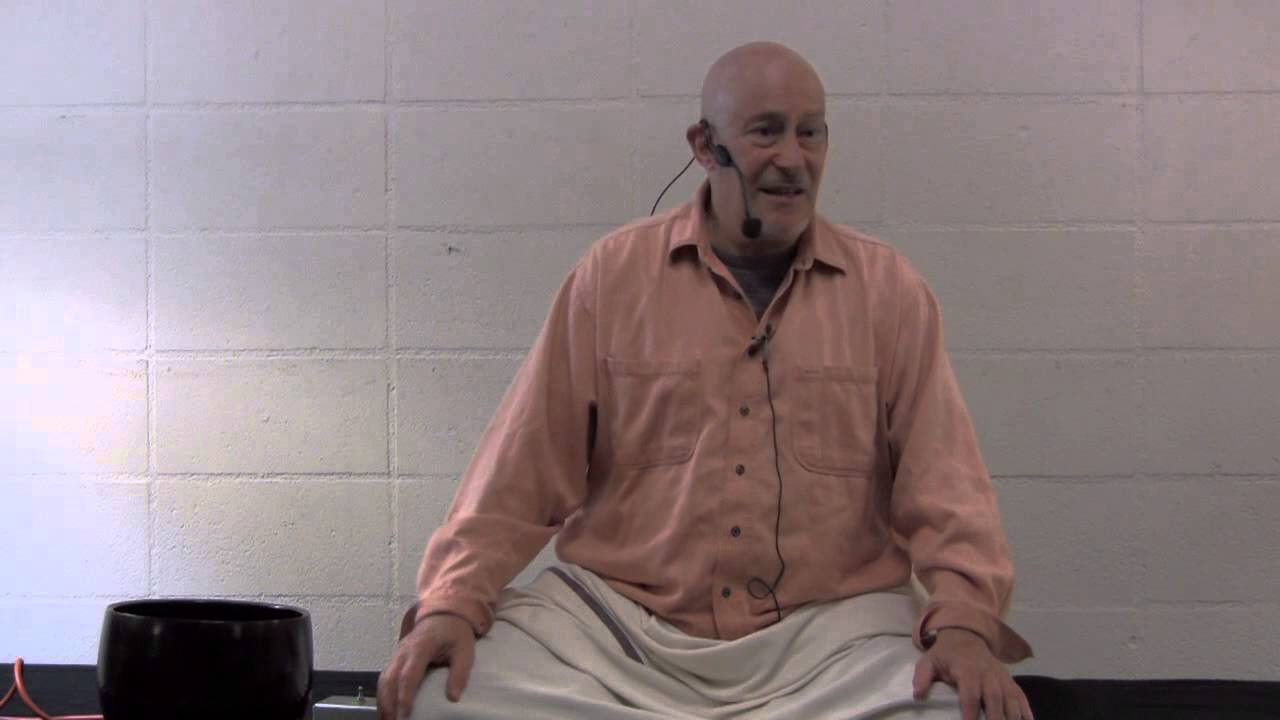
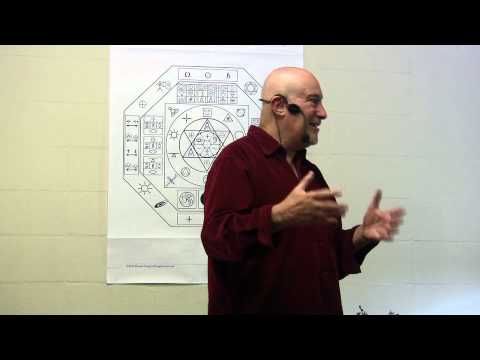
Partway through a short talk filmed at Mt. Carmel Spiritual Centre in Niagara Falls in November 2009, Shinzen Young stops to examine his own vocabulary. The words "witness," "consciousness," and "nondual awareness," he says, are used in different ways by different people, and that gap "can lead to confusion and even unnecessary contention." It is a small admission with large stakes. Meditation teachers have long fought over labels that describe the same ground from different angles. What follows in this roughly nine-minute segment is a careful sorting of the possible meanings of "nondual," a comparison with the Yoga Sutras of Patanjali and a Zen term from Japanese lineages, and then a personal decision. Young argues that the most demanding sense of nondual awareness is not a rare peak state at all. It is a habit: moving over and over between Zero and polarization, the way an ordinary day actually unfolds.
Young opens with a warning: "This is once again possibly an ambiguous phrase." The simplest reading is that nondual awareness is an experience of the oneness of subject and object, the sense that the one who knows and the thing known are not two. Read that way, there are several distinct ways it can occur, and Young treats them as a ladder rather than a single event. Each rung is described in terms of what has stopped happening inside the experiencer. That framing matters for anyone who has tried to judge their own practice against a teacher's words, because the question is rarely "Did I have a mystical moment?" and more often "What exactly fell away?"
"One might say that a nondual awareness is an experience of the oneness of subject and object." (Shinzen Young, talk filmed at Mt. Carmel Spiritual Centre, Niagara Falls, Nov. 2009, 0:41)
The first rung is the most ordinary-sounding and the easiest to miss. A touch, a sight, or a sound arises, and there is no feeling, image, or inner commentary reacting to it. Young is precise about what is absent. There is "no sense of an observer separate from it." What remains is simply the perception itself, and so "there's an experience of being that touch or that sight or that sound."
"There's just that touch or that sight or that sound, without a sense of an observer separate from it." (Shinzen Young, Mt. Carmel Spiritual Centre, Niagara Falls, Nov. 2009, 1:07)
Young connects this stage to what Patanjali calls sabija samadhi. Samadhi here means merging, but Young highlights the word "seed," sabija. The seed is the object that the awareness has merged with. The experience is real and unified, yet it still has a something at its center. That is why he describes this as a meaningful training achievement rather than a final destination. Just hearing or just seeing, he notes, "takes quite a bit of training, typically."
The deeper rung begins when the reaction is gone and the perception still arises, but it never settles. Young's word for this is "unfixated." The touch-sight-sound does not get grabbed, and neither does any feeling or thought that appears afterward. Each becomes a flow. Then the two flows meet, merge into a single wave, and that wave dies down into nothing.
"It just becomes a Flow, and if any feel-image-talk arises, it also is just a Flow, and the two Flows merge and become a single wave, and then that wave dies down into nothing, into Zero." (Shinzen Young, Mt. Carmel Spiritual Centre, Niagara Falls, Nov. 2009, 1:52)
He describes the middle of this process as a pair of forces "in between expansion and contraction," which "vibrate and interpenetrate" before they fall away. When they do, what remains is the oneness of subject and object. Young says that some people would call this nondual awareness, because subject and object have been transcended in an absolute sense.
Patanjali's term for this deeper merging is nirbija samadhi, "merging without an object that is merged with." Young glosses it simply as "a formless merging." The contrast with the seed-bearing state is the whole point. In sabija, there is still a something. In nirbija, the something has dissolved.
He then gives the Zen parallel. In some lineages the state is called ryoumo, with ryou meaning "both" and mo meaning "disappeared." The image is blunt and, in its way, exact: "Both subject and object have disappeared into the one Nothing." For a reader new to these traditions, the useful takeaway is that Patanjali's Sanskrit and the Japanese Zen compound are pointing at the same collapse of the subject-object split, described in two different vocabularies.
This is the hinge of the talk. Having laid out two increasingly rarefied experiences, Young says he personally prefers to use the phrase nondual awareness "to refer to something else, something more ambitious than the things I've just described, which are already very ambitious." The reasoning is practical. Hearing only the sound, or merging with no object, requires a great deal of work. He asks the obvious follow-up: "What's more ambitious than that?"
"What's more ambitious than that, and what I would personally like to use the word 'nondual' awareness for, is the habitual abiding in the cycle of Zero - polarization - Zero - polarization, over and over and over again." (Shinzen Young, Mt. Carmel Spiritual Centre, Niagara Falls, Nov. 2009, 4:36)
The shift is from a state to a pattern. A peak experience is something you have. A habit of abiding is something you live inside. The word "habitual" carries the weight here, and it is worth pausing on. Young is not describing an occasional lift above ordinary life. He is describing a repeated movement that runs underneath it.
Young's description runs as a loop. First, the objective world and the reactive world of thought and feeling both dissolve, becoming waves that merge and flatten into a oneness that is nothing. He puts it directly: "And you are that nothingness. That is the true self, aka the no self." Then the stillness can't hold. "That nothingness is going to break apart and once again polarize, and in the cleft, self and world will regenerate."
The crucial detail is what happens at the moment of regeneration. If you recognize where self and world have just come from, they are not fundamentally separate from Zero. They appear, as he says, "inside Zero," and the return to Zero comes quickly. Then the next arising appears inside Zero, and the return follows again. The cycle is not a sequence of escapes from the world. It is a single world appearing and dissolving within a source that never changes.
For a practitioner, the implication is that the cycle is continuous. It is not reserved for retreat. Young frames it as something that repeats through an entire day, which turns the focus from a single breakthrough to the quality of return.
Young's most vivid passage describes the rhythm of a day. "You go through your day, hundreds and hundreds of times a day, having an experience of touching the timeless, the Zero, and then time being born, but not really." The ordinary self and its world do arrive, and they are real in the ways that matter for living. But the connection to the source is never cut. "The umbilical cord that connects to the Zero is not completely severed."
"You're born but not really born, and your world comes into existence, but not really, because it's still enfolded in the two sides of Zero, and so you come, in the words of the neoplatonist philosophers of Western antiquity, you come from the good, return to the good, without ever really leaving the good, in any fundamental sense." (Shinzen Young, Mt. Carmel Spiritual Centre, Niagara Falls, Nov. 2009, 6:50)
He is explicit that this is what he means by nonduality: "not a separation between Source and the daily life that's born from Source." The practical picture is strikingly modest. You are "just bopping around in the world, doing what anybody does." Nothing dramatic has to happen. The point is that from a practical standpoint there is no fundamental cleft between the transcendent and the ordinary. Young puts the whole idea in a single line: "Creator and creation — that duality has been seen through."
To close the argument, Young turns to the Zen ox-herding pictures, a sequence in which a seeker gradually tames and rides an ox. He describes the person in the final sense as "firmly mounted on the ox," someone who "can never be bucked off the ox, no matter what life throws at them." The ox, in his telling, is "consciousness or emptiness or Source or God or nature." Young's list of names is itself part of the lesson. He is not asking the listener to adopt one theology. He is describing a stability that does not depend on which name you use.
"You can't be bucked off by whatever wells up from the inside or hits you from the outside. You're still never fundamentally separate from Nothing. I would use the term 'nondual awareness' for that." (Shinzen Young, Mt. Carmel Spiritual Centre, Niagara Falls, Nov. 2009, 8:13)
The image also answers a question the earlier rungs left open. If nondual awareness were only a peak, the first hard day would seem to erase it. Young's definition is built differently. The rider is never thrown, because the rider was never separate from the ground in the first place. That is a claim about stability rather than intensity, and it is part of why he thinks the habit deserves the more demanding name.
The talk offers a useful reframing for anyone who has measured practice by rare experiences. Young's own argument moves the goal from an event you attain to a return you keep making. Read that way, the question is less "Did I touch Nothing?" and more "How often do I come back to Zero when the self and world reappear?" The talk does not supply a method for this, and Young does not claim one here. What it provides is a map that makes the return visible.
It is also worth remembering how openly Young frames his own terminology. He begins by saying the words are used differently by different people, and he ends by saying which meaning he prefers. That candor is the best guide to reading the talk. He is not announcing the one correct definition of nondual awareness. He is proposing a usage, explaining why, and inviting the listener to notice whether the description matches their own experience of an ordinary day.
Start with the video itself, which is short and rewards a second listen, especially the passage on the cycle of Zero and polarization. Then pair it with the original Patanjali passages on samadhi, so you can see for yourself how sabija and nirbija are defined in the source text rather than only as Young glosses them. Finally, try the practical question Young's framing invites: during an ordinary stretch of the day, notice when a sound, a sensation, or a thought arises and whether it settles into a reaction or dissolves back into quiet. You do not need a special state to notice the return. Young's point is that the return happens already, hundreds of times a day, and the habit is learning to see it.