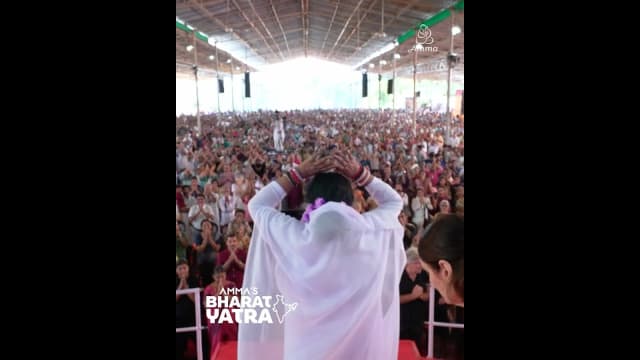
Some of the most affecting moments in devotional life are the ones with almost no words in them. A two-minute clip from Mysuru, posted under the title "Amma Arrives in Mysuru | Bharata Yatra 2026," is one of those. Its audio is mostly music, its transcript is nearly empty, and the whole thing runs less than two minutes. Yet it carries a full sequence of traditional Indian welcome and devotional rites: a gathering at the gates, a full-vessel greeting, circling lamps, meditation and bhajans at the darshan venue, and a closing distribution of mahaprasad. For readers who weren't there, the ritual vocabulary is the key to understanding what the footage shows.
The channel's description says Amma's children gathered at the gates with poornakumbham and arati. A poornakumbham is a vessel filled to the brim, usually a pot of water topped with mango leaves and a coconut, and carried or offered to an honored guest as a sign of abundance and auspiciousness. The word combines purna, "full," and kumbha, "pot." In South Indian temple and household practice it is one of the classic ways to greet a respected visitor at a threshold, before they step inside.
The description is the only source for this detail. The clip itself does not show the vessel clearly, so what the reader can say with confidence is that the welcome was described as a poornakumbham greeting, and that the practice itself is long established in the region.
Arati is the other half of the greeting. The description says the sacred lamps circled before Amma, and that the joy of her arrival "shone on every face." Arati is a clockwise waving of lit lamps, often with camphor, in front of a deity or a revered person. Devotees offer it as a way of honoring the presence rather than only greeting the body. The gesture is repeated at the close of many puja ceremonies, which is why it appears at both ends of a visit: the welcome and the farewell.
Darshan means "sight" or "seeing," and in practice it refers to being in the presence of a saint or holy figure, often in a formal gathering. According to the description, Amma led her children in meditation and bhajans at the darshan venue. Bhajans are devotional songs, typically sung in a call-and-response style with a steady rhythm. The short clip gives us only a fragment of this: a long stretch of music and a few sung or spoken lines.
One line in the auto-generated transcript reads, "All I need is right here on my heart." The transcript does not say whether this was sung or spoken, and it does not attribute it to a particular song or talk. It should be read as a line that appears in the video's audio, not as a confirmed quotation. The same transcript includes a passage that appears to say "And you're drawing the triangle," which may refer to a sacred diagram or a gesture, but the footage doesn't make that clear. Treat both as unverified.
The description ends where many such gatherings end: with Amma distributing mahaprasad to all her children. Prasad is food or flowers that have been offered to a deity or guru and then returned to devotees as a blessing. Mahaprasad, the "great prasad," is usually a more substantial offering, often a meal. Its place at the end of a program reflects the idea that devotion should be shared outward, from the teacher to the community, and that the blessing is physical as well as spiritual.
Less than the title suggests, and that is worth saying plainly. The clip doesn't show the full arrival, the speeches, the audience, or any teaching. It doesn't establish the schedule of the wider Bharata Yatra tour beyond the fact that this is a stop in Mysuru, described as "a new land." What it does show is a consistent ritual pattern: a welcome that honors the guest, lamps that honor the presence, music that opens the heart, and food that closes the circle.
For a reader who has not watched it, the most useful takeaway is the structure. Indian devotional gatherings of this kind are built in a deliberate order, and each element has a meaning that is older than any single event. Watching the clip with that order in mind makes its sparse footage far more legible.
- Watch the original video on the Amma channel and listen for the call-and-response structure of the bhajans.
- Look up the traditional meaning of poornakumbham and arati in a standard reference on South Indian ritual practice, rather than relying on a short clip to explain them.
- If you are interested in the wider tour, check the channel's other Bharata Yatra 2026 uploads, since this clip only covers the Mysuru arrival.