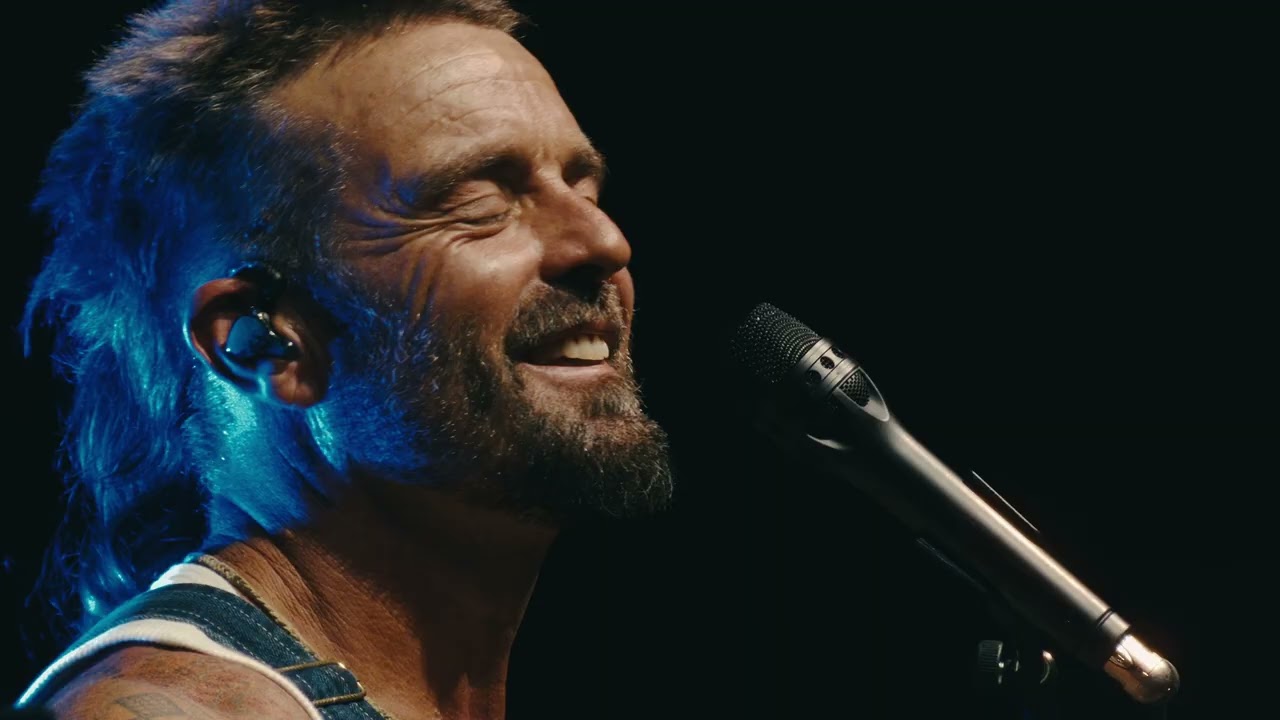
Xavier Rudd's "Moments" is a two-minute acoustic ballad about the texture of human connection—apology, memory, grief, and the simple act of holding someone's hand through life's turns. Filmed in Vancouver in May 2024, the song moves from regret and anxiety through scenes of joy (surfing, ocean time, travels to Sri Lanka) to the bedrock truth that growth happens not alone, but alongside someone willing to witness and share your loss. The refrain—"And we need, oh we need / Someone to share our grief"—is the song's ethical center: grief is not meant to be borne in isolation.
Rudd opens the song with a moment of vulnerability: "Sorry for those moments that I let you down / All swept up and anxious and I'm spinning out." This is not the theatrical guilt of a ballad protagonist. It is the specific admission of someone caught in their own nervous system, swept up in anxiety, unable to be present. The apology is honest because it names the condition—spinning, unsettled—that prevented him from showing up. And then, immediately, he holds up the witness to that failure: "It's you inside that window that shines so bright / Now I'm so very blessed to have you in my life." The person who saw him spin was also the one whose presence made sense of the mess. Blessing is not something abstract here; it is relational. It is the other person's capacity to remain visible and bright even when he was absent.
The middle verses build a philosophy of refuge. "Excavating cavities with confidence / Wrapped up in this love will be our best defense" suggests that intimacy is not escape—it is excavation, a digging down into the difficult places—but that this work, done together, becomes a shelter. Love is not denial of pain; it is a shared container for it. He then offers another image: "Swimming from the body to escape the noise / Looking for that lifeboat that we once deployed." There is a dissociative impulse here—the urge to flee one's own flesh to escape the ambient static of the world. But the corrective is not to force grounding; it is to find the lifeboat, the rescue, the other person who has already been stationed there as a resource.
The song's narrative arc moves through a catalog of shared moments: running to the ocean, salt water stinging eyes, surfing until sunset, the sound of Muslim prayer rising through a town, Sri Lankan mountains in blazing sun. These are not generic memories; they are specific, sensory, geographically rooted. Rudd is doing what memory does best—not preserving a moment unchanged, but letting it brighten and season the present. "Memories of Sri Lanka in the blazing sun / Sense of new beginnings mountains overcome" is not nostalgia for a better time; it is evidence that the couple has already moved together through difficulty, already overcome. Memory becomes proof of resilience. It is a living archive that says, "We have done this before. We can do it again."
The refrain appears twice, with a subtle but important shift. First: "And we grow, oh we grow / Sometimes we can't move on / And we need, all we need / Someone to share our grief." The inability to move on is not a failure; it is part of growth. Grief is not a stage to pass through; it is a permanent feature of a conscious life. And the need is explicit and non-negotiable: we need someone. Not to fix it, not to explain it, but to witness it. The second iteration carries the same logic: "And we grow, oh we grow / Sometimes we will move on / And we need, all we need / Someone to share our grief." The shift from "can't" to "will" is not optimism exactly; it is acknowledgment that movement happens, but only because grief itself is shared. Solitude amplifies sorrow. Witness transforms it.
The song closes not with grand gesture but with radical simplicity: "And I / Will hold your hand / And I / Will hold your hand." The repetition strips away all commentary. Hand-holding is the most basic form of human reassurance—not words, not explanation, not rescue. It is presence. It is a current of warmth passing between two nervous systems. In a song about memory and loss and growth, about swimming away from the body and excavating cavities, the final promise is the smallest one: I will be here. I will hold your hand. This is enough. This is everything.
Listen to "Moments" in full on Xavier Rudd's EP Freedom Sessions and consider what memories live in your own body—not as nostalgia, but as proof that you have survived before and can survive again. Reflect on the people in your life who have been willing to witness your grief rather than fix it, and whether you have returned that witness. Notice the next time you are anxious or spinning, and instead of forcing yourself to feel better, ask: who can I tell? Who will hold my hand through this?