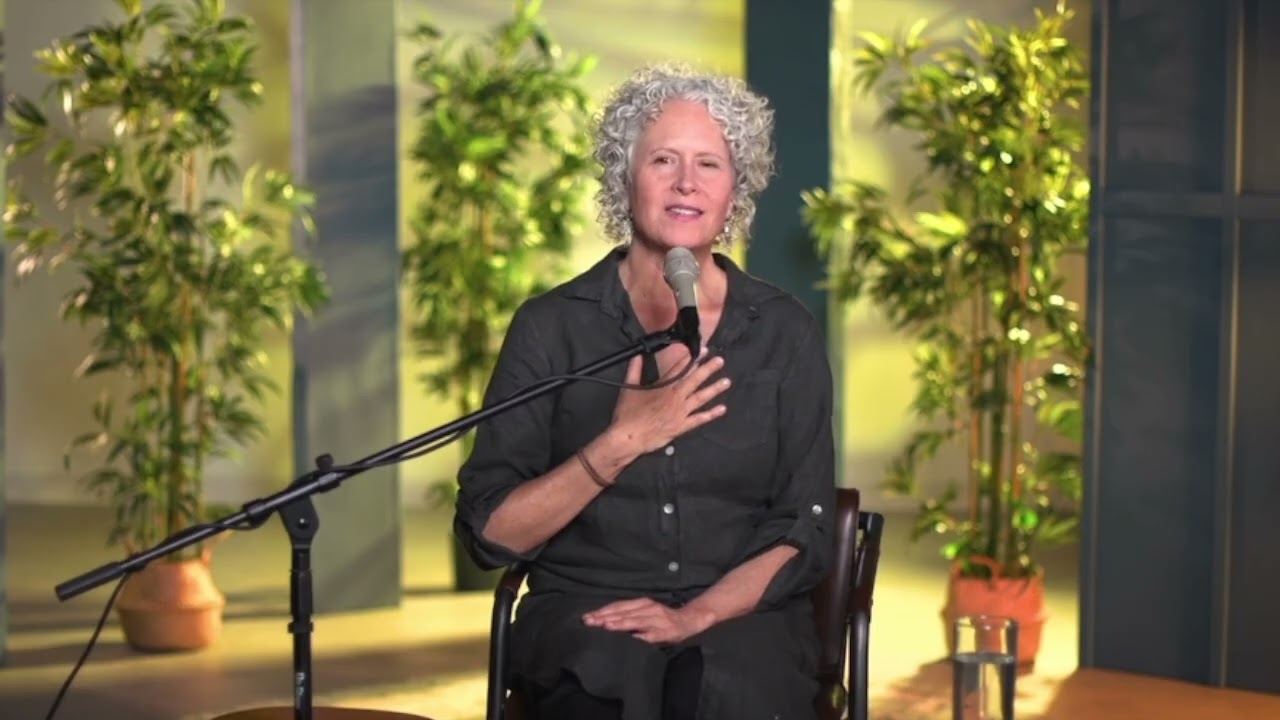
A room goes quiet in the middle of a manifestation workshop. Someone has just said a sentence that changes the air. In a May 2026 video, the contemplative teacher Cathy Baumann describes that moment: "Our jaws all dropped," she recalls, and the words were, in essence, "Enjoyment is my abundance." From that single line, she builds an argument that the usual goals of manifestation, the house, the partner, the job, are really stand-ins for one thing, the enjoyment of being alive. Her claim is that the mind is the wrong instrument for reaching it. Visualization, mental pictures, and the lists we write for the universe keep the ego busy, and the ego, she says, is always looking sideways at what everyone else has. The alternative she offers is less a technique than a posture: breathe, rest in your essence, and let life show you what would bring more joy. It sounds simple. The video makes the case that it is harder, and more interesting, than it looks.
Baumann's opening move is a question she wants viewers to sit with: "What if the measure of all abundance is simply your level of enjoyment in life?" She asks why anyone seeks money, a relationship, or a new home, and answers her own question: "Is it not ultimately for enjoyment?" It is a reframing rather than a rejection. Abundance, on this reading, is not a pile of things but a felt condition, the sense that life is good to live.
The argument works because it moves the target. A house is a specific object with a specific price. Enjoyment is what the house was supposed to deliver in the first place. When you aim at the enjoyment directly, she suggests, you stop being disappointed by the gap between the picture in your head and the life you actually have. Her video makes the point that the first form of abundance is the one you are already experiencing when you are at ease in your body.
"What if the measure of all abundance is simply your level of enjoyment in life?"
— Cathy Baumann, May 2026 video (0:00)
Baumann is careful not to dismiss the tradition she is questioning. She names The Secret, Neville Goddard, and the book The Secret Is Feeling, which she says she listened to and enjoyed. She also recalls a training from roughly 25 years ago, brought into the company where she worked, called Lou Tice Training, built around visualizing and "feeling the end, looking at your whole life." She calls this lineage "top-notch" and "groundbreaking," and she means it.
Her objection is specific. These methods, she argues, "get very mental," and that mental focus gives the ego a handle to grab. Once the ego is involved, it begins "seeking contentment from gaining things externally" all over again. Visualization can be a good pathway to explore and play with, she says, but eventually a practitioner realizes that true fulfillment lives somewhere else: "in your heart, in your embodiment, in presence."
"The only thing is, it gets very mental and there's a tendency for the ego to latch on and once again, start seeking contentment from gaining things externally."
— Cathy Baumann, May 2026 video (1:58)
This is the central distinction of the talk. The problem is not that you desire things. The problem is where the desiring comes from. A picture built in the mind draws on what the mind has already encountered, which is the same ground the ego walks on. Baumann's remedy is to move the source of the wish from the head toward the body and the heart.
The video's description, which Baumann's channel published alongside it, puts the core idea in a single pair of sentences: "The mind only knows everything it has seen. Your true essence knows what you would love more than anything you've ever seen or experienced." That is the logic underneath the whole talk. If the mind can only imagine from its catalogue of past experience, then it will always produce a version of the familiar. Essence, by contrast, is presented as a source of knowing that can point toward something unseen.
In the video, Baumann widens the frame to the universe. She asks listeners to consider that "God, the whole universe, creator, call it your higher self" are, as she puts it, "all one in the same," and that the individual is "a microcosm of the macrocosm." Her question is provocative: "What if God knows me better than I know myself?" She does not ask viewers to accept a theology, only to entertain a possibility that changes how wishing feels. If the universe already knows what is in your heart, then the wish does not have to be engineered. It can be offered.
She also names the trap of comparison. Her image is the neighborhood: "Look what the Joneses are doing next door. They got a big house." At that point, she says, the mind is "sitting over here without the big house." She calls this "mental, low-level, unconscious, old energy, separation, comparison games," and links it to the broader human pattern of "battling and fighting and greed and power." It is a bold connection, and she offers it as her view rather than as a settled argument.
One of the most useful instructions in the video concerns how to handle the ego. Baumann does not ask her audience to destroy it. She describes the ego and what she calls the "problem solver" or "survival aspect" as dedicated protectors. "It's not a bad thing," she says. "It's very, very dedicated to keeping you safe, to keeping your life on track." Her method is to dissolve the ego through presence and awareness, not confrontation.
"The more you dissolve the ego, not fighting it, not battling it, not demonizing it, the more you're simply aware of it in a state of non-judgment."
— Cathy Baumann, May 2026 video (2:37)
The working tool she returns to is breath, paired with a short self-address. She guides viewers to "take a breath and remember, I am that I am. I am creator. I am source." She pauses between lines, inviting the listener to feel the words rather than process them. Her ritual is simple enough to do in the middle of a day: breathe, name the presence, let the body settle. Whether the words land for a given person depends on that person, but the structure matters: the breath comes first, the story second.
The most theatrical moment in the talk is a ritual. Baumann asks viewers to "take all the stuff we've asked for, throw it into the fire pit," and then to speak a release: "I welcome the most enjoyable life possible. I welcome more and more enjoyment. And so it is." She closes with "be done with it." It is a gesture that asks for letting go, not as resignation but as a clearing.
Then comes the question she considers essential: what does the ego do next? Her answer is candid. "It's going to feel like it's lost a job," she says. The problem solver, the critical thinker, will come back looking for work. Her strategy is to give it a job that does not sabotage the process. Rather than let the ego scramble to make things happen, she suggests a counter-phrase.
"It's going to feel like it's lost a job... this problem solver in our brain, this critical thinker, this survival guy... it's going to come back and want a job to do. So, let's at least give it a job."
— Cathy Baumann, May 2026 video (6:25)
The job is a small sentence: "Hmm, life has my back." When the urge to fix things arises, the listener is to breathe and repeat it. Baumann says the old thoughts will keep arriving, the "yeah, but" thoughts about a newer car, the bank balance, whether friends really like you. The point is not to suppress them but to answer them with a different frame.
The phrase Baumann returns to most often is "Everything is perfect. Thank you." She describes having been "playing with that one a lot," and she invites listeners to notice what happens in the body when they say it. "Feel how your body relaxes when we choose those words," she says, "not the thoughts of victimhood or disempowerment." Her claim is experiential. She is not offering a clinical result, but an invitation to test whether the body responds.
"Everything is perfect. Thank you. The whole universe, every particle of creation is conspiring for my enjoyment. Thank you."
— Cathy Baumann, May 2026 video (8:39)
She also speaks personally about the provision she has experienced: "I've never gone um without. So, life always has my back." Her reference point is "50 years," which she offers as a lived example rather than a rule for anyone else. The provocative question she leaves listeners with is her own: "How many years has life actually taken care of you?"
Language, for Baumann, is not neutral. She makes an observation about words that carry different charges for different people. She once described herself as "very stubborn," and she came to love that trait, because it meant "nobody's going to make me do something I don't want to do." Her reframing of the same quality into mastery is the real lesson: "Mastery of your mind and emotions is the greatest gift instead of being a victim. You become a master simply because you choose it. Nobody can knight you into masterdom." The shift is from a self-description that limits to one that empowers.
The practical thread running through the video is what Baumann calls "turning the dial" toward what feels good. Her instruction is to keep adjusting, paying attention to what the body and heart register, rather than checking a result. Several practices follow naturally from the talk.
- When a wish arises, notice whether it is coming from the mind's catalogue of what others have, or from a felt sense of enjoyment.
- Take a breath before acting on the urge. Say, in your own words, something like "life has my back."
- Replace the disempowering thought with a phrase that calms the body, such as "Everything is perfect. Thank you."
- Reexamine self-descriptions. A trait you label negatively may be a strength you can master.
- Choose words that feel good to you personally, since the same word can lift one person and drain another.
- Let the ego keep its job, but give it a gentler one than managing your outcomes.
None of this requires abandoning the older manifestation books. Baumann's position is that visualization is a legitimate stage that, at some point, reveals its limit. The shift she describes is from the mind as director to the mind as observer, and from the outcome as the goal to enjoyment as the living of it.
The best way to test Baumann's ideas is to watch the full video, which runs about fourteen minutes, and to pay attention to the pauses where she asks you to breathe. Her channel also lists free classes, a blog, and group events in its description, and her book recommendations, including The Secret Is Feeling, are a natural next read for anyone interested in the feeling-based side of manifestation. If you try the practices, keep the experiment honest: notice what changes in your body, not only what changes in your circumstances. Abundance, in her framing, begins with the enjoyment you can feel right now.