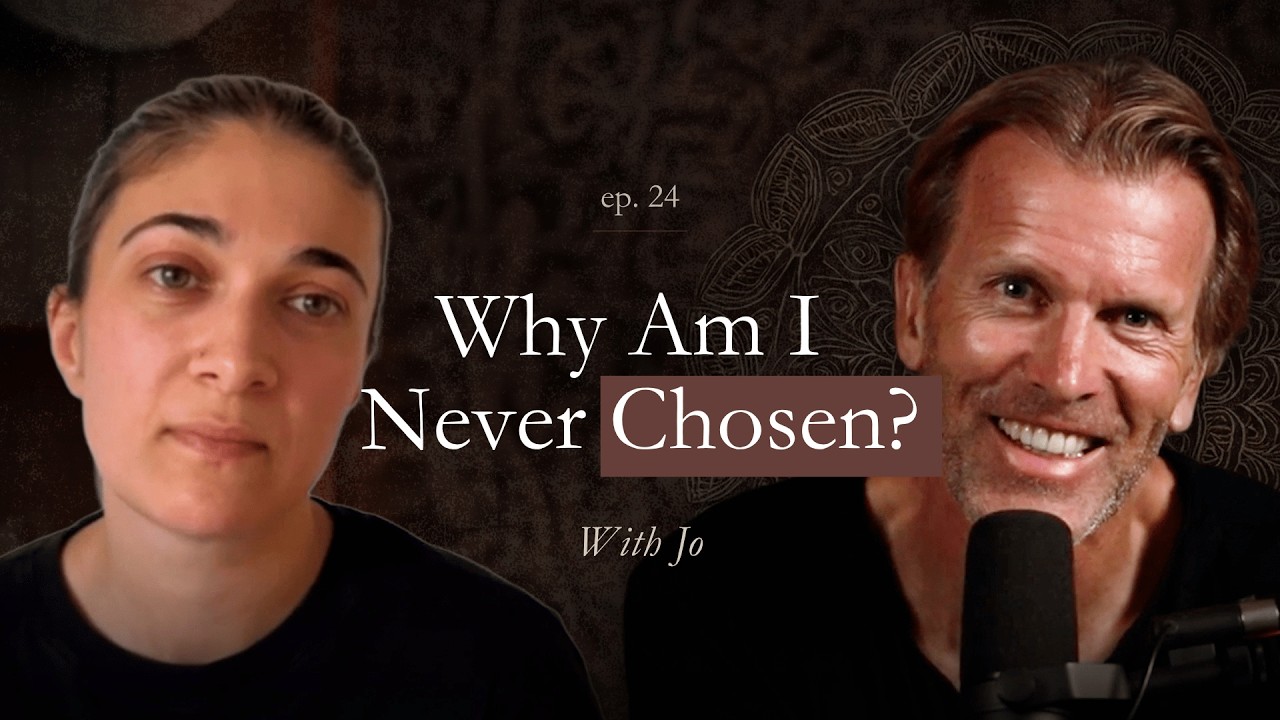
In this session, Peter Crone works with a woman in her late 30s who wants to recreate an intense love she experienced at age 20—a marriage that ended when her husband led a double life and tragedy followed. Crone identifies the core blind spot: she is energetically driving her car by looking in the rearview mirror, trying to fulfill on something impossible, which keeps her stuck. He reframes the real obstacle as a lack of presence and a misbelief that love exists outside herself. By examining how she manufactures the feeling of love around a fantasy figure from the past, she discovers her own authorship over her experience—and that the path forward is to become present now, not to wait for an excuse to live.
What Does It Mean to Be Looking in the Rearview Mirror?
Crone uses a vivid driving metaphor to describe the woman's dilemma (around 2:30 in the talk). She wants to go back to the intensity of love she felt at 20, after meeting a man she "worshiped the ground he walked on." They married, but he was living a double life. Two weeks later, her brother was murdered—a compounding trauma that devastated her for over a decade. Now, at 39, she wants to recreate that relationship, driven by biological urgency and family legacy (her parents were divorced).
The problem, Crone explains, is that she is trying to fulfill on something literally impossible. "You can't go back to what you had," he says. The energy behind the desire—trying to satisfy an impossible condition—creates a paradox: by perpetually reaching for what cannot be achieved, she sustains the very resistance that keeps her from having a relationship now. "You keep sustaining, which is the part you get to be right about not having a relationship," he points out (around 1:00).
When you drive forward but look backward, you crash. Metaphorically, that is what she is doing: all her intention, desire, and mental energy are fastened to a fantasy of the past, while her body and future are supposed to move ahead. The split creates a subtle but powerful resistance. She is not actually present to the possibility of genuine love now because she is psychologically in 1999, married to an idealized version of a man who wasn't even that good to her in the first place.
How Does the Mind Manufacture Love Around a Fantasy?
One of Crone's key insights is that the woman is not actually missing the man from 20 years ago—she is manufacturing a feeling and attributing it to him. "Your thoughts are confirming the illusion of what you think he represents," he says (around 6:30). She still thinks about him, and those thoughts loop a narrative: I was in love. It was pure. I was alive. I will never feel that way again.
In reality, Crone suggests, she was 20 years old, not particularly wise, and infatuated with a man who turned out to be deceptive. Yet she has spent eleven years building a mythology around that experience. She tells herself she is waiting for love to return because love is something that happens to her—something external, located out there in the universe, embodied in a particular man.
Here is where Crone makes a crucial flip: if love were truly out there, she would be waiting for it, chasing it, or manufacturing it in memory. But if she is the one generating the feeling—if she is the author—then she has far more power than she thought. "You are manufacturing the experience," he says. "You're using him as the excuse." This is liberation, not blame. Once she understands that she is creating the sensation, the longing, the sense of what love was, she can ask: What am I actually creating? And can I choose differently?
The good news, he tells her, is that if you are doing it—if you are manufacturing the experience—then you can own it. As long as you think the feeling is caused by someone else, someone not even in your life, you remain a victim of circumstance. But the moment you see that you are the author, you reclaim your power to shape your experience.
Why Does Urgency Destroy Presence?
The woman mentions her age: "I'm going to be 39 and I'm like okay, I want it all back—I want to meet someone and build a life." Biological clock, cultural pressure, family narrative (divorced parents), and trauma (her brother's murder) all converge to create urgency. This urgency is relentless and, from her perspective, justified.
Crone asks a simple question: "When you're urgent, are you more present or less present?" (around 4:00). The answer is obvious: less. Urgency contracts you. It narrows your field. It makes you grasp, hunt, and pursue. It triggers survival mode. And when you are in survival mode, you are not relaxed, open, or magnetic. You are tense. You are broadcasting scarcity. You are acting as though the right person is rare and time is running out—which is exactly the signal that repels genuine connection.
Most people, Crone observes, are "literally wired just to make it, just to try and survive." The pain of not having love, the fear of aging without a family, the fear of dying alone—these are "hefty things for a woman particularly," he says, acknowledging the weight of cultural expectation. But he also points out the trap: "Why would you be relaxed and present? Your mind is so preoccupied with the hurt from history that you haven't yet accepted and the fear for a future that you anticipate is going to happen, which is all completely made up" (around 3:20).
The future she fears—ending up alone, childless, a statistic of divorce—is purely imaginal. It is not happening now. Yet she is energizing it now, making decisions now as if it is already true. This is how urgency ensures the very outcome she fears: by not being present, she cannot attract or build genuine intimacy.
What Is the Relationship Between Self-Worth and Love?
Crone asks the woman to imagine a man who is in every way superior to her memory of the man from 20 years ago—authentic, safe, reverent toward the feminine, committed to being a father, respectful, adoring, inspiring. And he says this man is heading toward her, in her future, arriving in two months. How does she feel?
Her response: "Awe, maybe. It's kind of unbelievable. And almost... like I don't quite deserve it." She laughs nervously. And Crone seizes on this. "Who me? Are you still talking to me?" he reflects back to her. "That tells us a lot about the way you view yourself, doesn't it?" (around 5:00).
The insight is profound. She is not primarily blocked by the absence of a good man or the ticking of a biological clock. She is blocked by a core disbelief in her own worthiness. Deep down, she does not actually believe she deserves a man who is safe, committed, adoring, and inspiring. So even when she imagines such a man appearing, her first reflex is: That can't be for me.
Crone does not soften this. "The way that Juliana views herself, I'm going to assert, isn't that great. Welcome to humanity," he says (around 5:45). Everyone has a shitty view of themselves in some way. But the work is to see how this particular view—unworthiness—is in the way. She is chasing love as a way to prove herself lovable, to get validation, to finally feel like she deserves to exist. But that is not what genuine love is about. Genuine love does not care about your resume or your timeline. It cares about your presence, your authenticity, and your willingness to receive.
How Does Waiting for Love Create the Wrong Frequency?
Crone points out a subtle but crucial trap: "Because love is something that you wait for, why would you do [anything about your life] now?" (around 10:00). In other words, as long as love is a future event—as long as it is something that will happen when the right person arrives—then the present moment is just a holding pattern. You are waiting for an excuse to live.
He asks: "Do you see we're all waiting for an excuse to get on with our life instead of getting on with our life and allowing life to present what is appropriate for the new frequency that we embody by virtue of being responsible and authors over the life?" (around 10:15).
This is radical. It suggests that the way to attract a genuine partner is not to position yourself as someone waiting, hoping, or desperate for love to arrive. It is to become someone who is already living fully, taking care of herself, cleaning her garage, tidying up her life, and embodying a frequency of self-respect and aliveness. When you do that—when you stop waiting and start authoring—you become attractive not because you are "trying," but because you are actually present and alive.
The woman realizes there are things in her life that need attention. "I might have some stuff in my life that I'd want to tidy up," she says. Maybe her closet, maybe her garage, maybe her old wounds. But as long as she is waiting for love to happen, she has no motivation to do that work. Waiting is comfortable. It asks nothing of you. It keeps you innocent. But it also keeps you stuck, because the universe does not reward those who wait—it responds to those who act, who take responsibility, who embody the life they want to live.
What Is the Lie at the Core of This Block?
Crone asks directly: "What's the lie about the love you're looking for? Where is love for you?" (around 6:30). The woman responds: "It seemed to be outside of me." And Crone affirms this is the core belief: most people think love is outside them. "If love is outside of you, what do you do?" he asks. "You wait for it. You chase it. You hunt it. You do all of these things, but it all occurs that you're looking for something outside of you."
The lie is: Love is outside me. Love is a property of another person. I feel love because of what someone else does or is. The truth, implied throughout this dialogue, is the inverse: Love is what I am. Love is the ground of being when I am present. I create my experience of love by the quality of my presence and the beliefs I hold.
This is why being tied to the man from the past is so insidious. She is still trying to extract love from him—from the fantasy of him, from the idea of him, from the memory of the feelings he triggered in her. She is trying to get something from outside herself, from someone who isn't even there. As long as she does this, she will never find love, because she will never look where it actually is: inside, in her own capacity to be present, to receive, to embody, and to radiate.
Where to Go From Here
The path forward has several components. First, stop trying to go back. The past is not a destination. Accepting this is grief work, but it is essential. Second, examine the belief that love is outside you. When you catch yourself waiting, chasing, or manufacturing feeling around a fantasy, pause and ask: Who am I in this moment? What frequency am I broadcasting? Am I present or am I in the past?
Third, address the core belief that you are not worthy of the love you desire. This is not done by positive affirmations or willpower. It is done by taking real responsibility for your life—cleaning your house, healing your wounds, tending to what matters, and becoming someone you respect. As you do this work, your frequency shifts. You stop broadcasting scarcity and desperation. You start broadcasting wholeness and authenticity. And that is what attracts genuine partnership.
Finally, understand that the only place you have power is where you are. Not in the past. Not in an imagined future. Now. When you are fully present—to your breath, to your body, to the person in front of you, to your own worthiness—you become magnetic. Not in a manipulative way, but in the way a flame is magnetic to a moth. Life organizes around presence. Authentic connection organizes around presence. Your future partner will be drawn to the presence you embody, not to the desperation you feel about finding them.