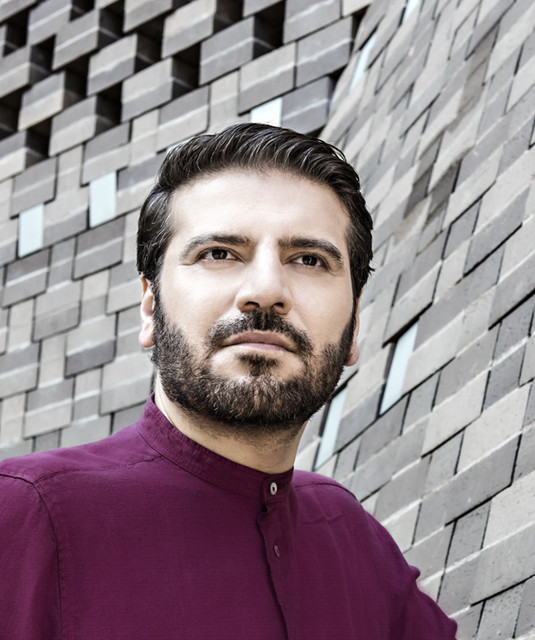
"Lifting the Veil" is a live devotional piece recorded on 6 June 2026 at the 29th Fes Festival of World Sacred Music, where it opened Sami Yusuf's concert inside the ancient walls of Bab Makina in Fez, Morocco. It is drawn from his studio album Ecstasy, and this performance is the first live release of the track. Built on a balaban introduction, a sung refrain that circles back on itself, and a supporting ensemble that includes the erhu, the piece is a study in how a sacred text can be carried by very different instruments without losing its center. What follows is a reading of the performance itself: the sound, the words, and the reasons a concert in Morocco's spiritual capital would begin with a single image of lifted veils.
The piece does not begin with the voice. According to the video's description, it opens with a haunting balaban introduction played by Magsad Azizov. The balaban is a double-reed wind instrument associated with Azerbaijani music, and its reedy, breath-driven tone has a quality that sits closer to a human voice than a string does. Starting with it sets the room before a single word is sung. The listener is drawn into a space that feels older than the song, and the introduction works as a threshold, which fits the title: a veil is something you pass through before you see anything.
For a performance staged in a historic gateway, that choice carries weight. The introduction gives the ensemble time to settle, and it tells the audience that this is not a pop show with a spiritual flavor. The sound is the first argument the piece makes.
The vocal line opens with a couplet that anchors the whole performance: "The veils have been lifted from the full moons of perfection / Welcome, welcome to the people of beauty." It appears at about 1:00 in the video and returns again around 1:27, so the listener hears it twice before the first big structural turn. The repetition is deliberate. In devotional singing, repeating a line is less about emphasis than about letting the words sink below the level of ordinary attention.
The credits name the words as the work of 'Abd al-Qādir al-Jīlānī and Sidi 'Ali Al Wafā, and the lyrics read as the language of Sufi-style devotion: a lover addressing the masters, asking to be heard, and describing a state of being that the world is not able to share. The most striking phrase is one that inverts the usual relation between self and other. At about 5:25 the singer offers: "I am poor toward you, and rich through you / After you, I have no desire for anyone else." Poverty and wealth are paired, and the wealth comes from the beloved rather than from the self. That is the logic of the whole song. The self is emptied so that something else can fill it.
"I am poor toward you, and rich through you / After you, I have no desire for anyone else."
— sung text in the recorded performance, "Lifting the Veil," Fes Festival of World Sacred Music, 6 June 2026
The most rhythmically insistent section arrives at about 3:18, when the singer begins a short couplet: "Pass the cups among the companions / For all of creation is intoxicated by my state." In the transcript this couplet repeats seven times in a row, each pass nearly identical. Wine imagery is one of the oldest and most contested vocabularies in the mystical poetry of the Islamic world. Within that tradition it is usually read as a metaphor for spiritual rapture rather than literal drink, and the song's own phrasing points that way: the "cups" are passed among companions, and the intoxication belongs to all of creation rather than to a party of revelers.
Listeners who know the tradition will hear that reading immediately. Listeners who do not can still feel what the repetition does. Seven passes of the same line build a kind of hypnotic momentum, and that momentum is the mechanism of the piece. Repetition is how a devotional recitation moves a room from attention to absorption.
The structure also explains the title. A veil, in this vocabulary, is the thin layer between ordinary perception and the thing perceived. The first couplet says the veil has already been lifted. The cup couplet is what that looks like from inside: a state intense enough to spread outward, to "intoxicate" everything. The song is not asking the listener to imagine the lifting. It is performing it, and inviting the audience to be carried along.
The description names erhu master Guo Gan as the performer who brings the erhu into the piece. The erhu is a two-stringed bowed instrument from Chinese music, and its voice is famously close to the human singing voice: it slides between pitches, bends notes, and can hold a long, sorrowful line. In a performance that already holds a balaban at its opening and a sung vocal at its center, the erhu does not compete with the voice. It answers it, extending the singer's phrases into a second register.
That is the most interesting craft decision in the piece. Three instruments and a voice from distinct traditions (Azerbaijani reed, Chinese bowed string, and a vocal line rooted in devotional poetry) are arranged so that none of them dominates. The result is less a fusion than a conversation among traditions that each have their own relationship to the sung word. The video's description frames the effect this way: the piece "creates a sacred space where the boundaries of time, culture and self dissolve." That is a claim about intention, and the performance is the evidence for it.
The credits, as published with the video, list Sami Yusuf as composer and musical director. Mixing and mastering are by Arash Pakzad, and video editing is by Omar Al Balushi. The performance was recorded live on 6 June 2026 at the Fes Festival of World Sacred Music. The Fons Sophiae Collective supports Sami Yusuf's vocals and instrumentation, a line-up that the description identifies as the working ensemble behind the piece.
Recording live matters here. A live capture leaves in the breath, the small timing variations between players, and the acoustic response of a historic space. When a piece is built on repetition and slow accumulation, those imperfections are part of what keeps it alive. A studio take would sound tighter. It would not sound like a room that has been entered.
"Lifting the Veil" arrives as the opening track of a new album and as the first live release from that record, which places it at a useful intersection: a studio work finding its body in front of an audience. The Fes Festival itself is a long-running gathering devoted to sacred music from many traditions, and an opening piece built on a balaban, a sung Sufi-style text, and an erhu is a fitting statement for that context. The performance does not explain itself. It trusts the listener to hear the veil, the cup, and the companions, and to feel what the repetition does over several minutes.
For a reader who has not watched the video, the central point is simple. A sacred text does not need a single tradition to be heard. The same couplet can be sung over a reed introduction and answered by a bowed string, and still say what it says: that the self is poor without the beloved, and that the veil is already lifted for anyone willing to pass through the threshold.
If the performance has pulled you in, the next steps are straightforward. Listen to the studio version on Ecstasy, the album from which the piece is taken, and compare the studio arrangement with the live take recorded at Fes. Watch the artist's official playlist, which the description links to, for other recordings from the same period. Then read the two couplets that anchor the song, the veil and the cup, slowly and aloud. The words were written to be sung many times, and the repetition in the video is the clearest guide to how they were meant to land.


