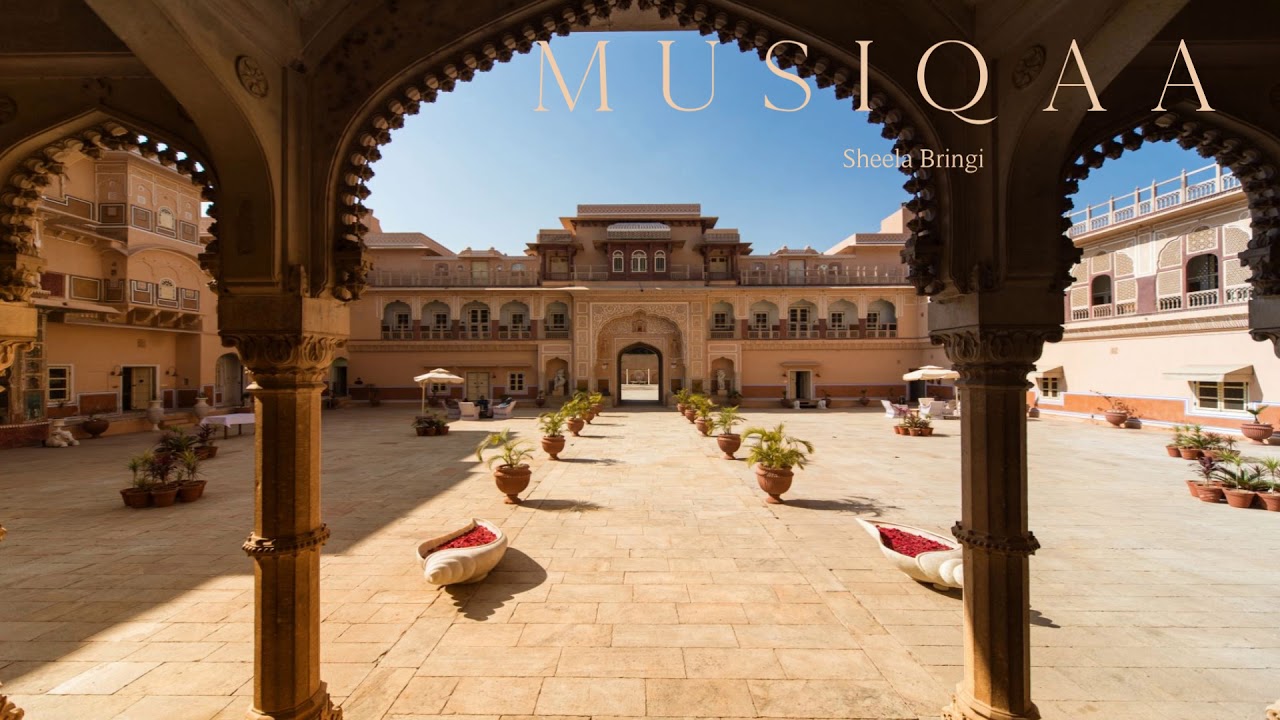
Four players stand close together on a small stage, and the first thing you notice is how little space there is between the sounds. A harmonium holds a single pitch low in the room like a floor laid down before anyone walks on it. A tabla keeps time with the fingers rather than the wrists. A violin hovers above them, and a harp, played by the singer herself, answers the voice in the gaps. That is the setting of 'Ghungata,' a live performance by Sheela Bringi, recorded at Corazon Performing Arts in Topanga, California, and posted to her YouTube channel on May 5, 2018. The song is a bhajan, a devotional song, by Kabir, the 15th-century poet-saint whose verses have traveled for six centuries through oral transmission and sung performance. Bringi sings it with Shiva Ramamurthi on violin, Miles Shrewsbery on tabla, and Brent Kuecker on harmonium. The result runs under nine minutes and asks a listener to hear a very old text through a very particular modern ensemble.
This article is built from the video's title, its description and its credits, not from a transcript, because none was available. That matters. The description names the song, the poet and the players, but it does not include the lyrics or a translation, so this piece will not pretend to paraphrase individual lines. What it can do is explain the forms, the instruments and the image in the title, so that the performance makes more sense to someone who has not heard it before.
A bhajan is a devotional song, sung in a community or alone, usually in praise of the divine or in the voice of a devotee longing for it. The form is less a fixed composition than a living repertoire. Songs pass from singer to singer, get adapted to new settings and new instruments, and survive because people keep choosing to sing them. Kabir's poetry is one of the great examples of this. He is described here as a 15th-century poet-saint, and his verses have remained in circulation long enough that a performer today can take one up and make it sound newly alive without needing permission from a publisher or a printed score.
That is part of why a piece like this is worth attention. The bhajan carries the weight of centuries, but it has no single authorized version. Every performance is an interpretation, and the choices a singer and her players make about tempo, texture and who plays what are the interpretation. In this video, those choices are the whole story. The text is old and fixed in its broad outline; the sound is what the four musicians build around it on this night.
The credits list Bringi on "voice, harp," which tells us she is both the lead vocalist and the instrumentalist who accompanies herself. That double role changes the physics of the performance. When a singer is also the person plucking the strings, the harp is not backing her up from behind; it is part of the phrase. The harp's notes decay as they are struck, so each plucked line leaves a shimmer behind it, and the voice has to decide whether to ride that shimmer or cut through it.
The harp is also an unusual choice in a bhajan setting, where the ear is often trained on harmonium, tabla, and small hand percussion. A harp brings a Western-style clarity to the attack and a wide, bright resonance to the sustain. In the context of a Kabir text, that combination asks the listener to hold two traditions at once without forcing either into the other's shape. Nothing in the material says why Bringi chose the harp for this song, and it would be a mistake to invent a reason. What the instrumentation shows, plainly, is that the arrangement is open to the idea that a devotional song can travel into new sound.
Each of the three remaining players has a distinct job, and the best way to listen is to follow one at a time.
The harmonium, played by Brent Kuecker, is the drone. In devotional singing across South Asia, the harmonium has long been the instrument that holds a sustained pitch while the voice moves above it. A drone does something subtle: it gives the ear a fixed point, so that the melody's changes feel like movement rather than drift. When a harmonium is doing its job well, you hardly notice it. You notice its absence when the room suddenly feels unanchored. It deserves the same reverence a guitarist gives a great amplifier or a horn player gives a well-made reed, because its steadiness is what lets everything else take risks.
The tabla, played by Miles Shrewsbery, is the pulse. Tabla is a pair of drums, and its craft lives in the fingers and the palms more than in any stick or mallet. The players who do it well can make a single phrase sound like breathing, pushing forward and pulling back inside the rhythm without ever losing the cycle. In a bhajan, the tabla is what turns a sung poem into something you can move with. It sets the expectation the voice and violin then bend against.
The violin, played by Shiva Ramamurthi, is the line that flows between voice and harp. A violin can slide between pitches in a way a fixed-tuned instrument cannot, and that gliding quality suits devotional melody, where the emotional color often lives in the bend of a note rather than in the note itself. In a small group like this one, the violin tends to take the role of a second voice, answering the singer, doubling a phrase, or stepping forward when the text opens a space for it.
Together, the four parts form a kind of layered conversation: a drone at the bottom, a steady pulse just above it, a bright harp that doubles as a second melodic voice, and a violin that can speak in the language of the singer. Whether that conversation is in any sense "traditional" depends on how you define tradition, and the video does not settle that question. It simply demonstrates that a bhajan can hold this many voices without losing its center.
The word in the title is usually understood as referring to a veil, the head covering used in parts of South Asia that a woman draws across her face. Devotional poetry has long borrowed this image. A veil can suggest modesty, but it can also suggest distance: something hides the beloved, and the longing of the singer is partly a longing to see past the cloth. In much devotional writing, that figure becomes a way of describing the gap between the individual and the divine, the sense of being close to something and still not quite able to see it.
This reading is an interpretation rather than a fact drawn from the video. The description does not explain the song's meaning, and the performance does not come with a program note. But the title's central image is the reason the piece is worth hearing with attention to the words that the video does not print. A listener who knows that the veil is a figure of separation will hear the music's repeated gestures, the pulls and releases, the way a phrase seems to reach and then withdraw, as a kind of enacted longing. That is one productive way into this song, though not the only one.
The clearest facts come from the credits. The performance was shot by Tom Bartolac and Marie Bartolac of Angel Video Productions, with Marie Bartolac also handling the edit. It was filmed live, not in a studio, which gives the recording the room sound and the audible give-and-take of a real stage. Published on May 5, 2018, it carried 5,826 views at the time the source metadata was captured, a modest audience for a piece that rewards close listening.
What the video leaves out is also instructive. There is no transcript, no lyrics on screen as far as the description indicates, no translation, and no spoken introduction recorded in the metadata. That means a first-time viewer has to bring some of the context themselves. The most useful thing to bring is a willingness to listen to structure rather than to chase words: notice when the harmonium holds, when the tabla lifts, when the violin and voice trade places, and when the harp fills the space a line leaves open.
For a song nearly nine minutes long, that kind of attention repays itself. The arrangement is spare enough to hear each instrument clearly, and dense enough that the parts reward being followed one at a time before being heard together.
If this performance has pulled you in, the most rewarding next step is to listen to it twice. On the first pass, let the whole sound wash over you and pay attention to the overall feel. On the second, pick one instrument and follow it from start to finish: the harmonium's drone, the tabla's cycle, the violin's glides, or the harp's shimmer alongside Bringi's voice. You will hear the song differently once you have heard how each part holds its place.
From there, a curious listener can seek out the wider repertoire of Kabir's verses in translation and in other musical settings, comparing how different singers handle the same texts. Doing so turns a single live recording into an entry point into a much larger tradition, one that has kept its poet's voice alive through song for centuries.