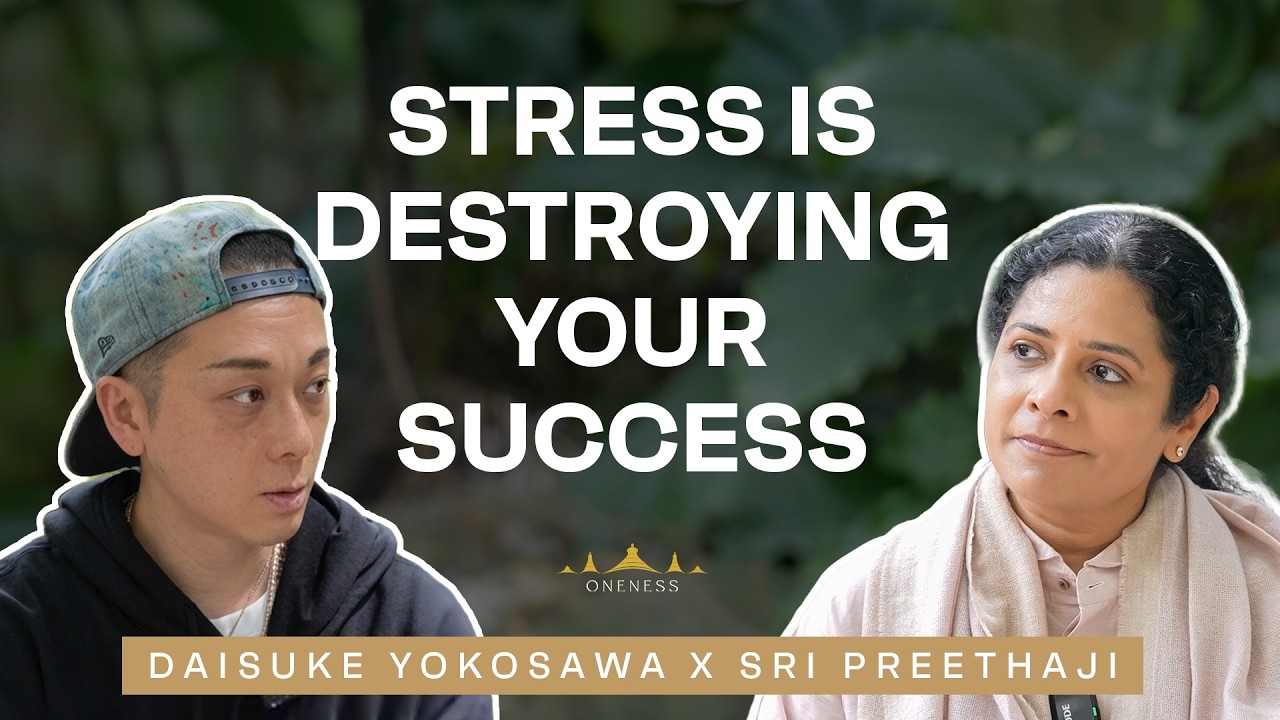
Sri Krishnaji addresses a historic moment where automation and AI are fundamentally redefining human work and purpose. Rather than solve the identity crisis through wealth, power, or policy, he proposes that the answer lies in cultivating a powerful, beautiful inner state. He teaches that human beings operate in only two fundamental states: a stressful, suffering state and a non-suffering state. Mastering the shift between these inner states—not external success—becomes the real foundation of abundance in wealth, joy, love, and peace.
Why the Future Crisis Demands a New Answer
Sri Krishnaji begins by naming a coming inflection point in human civilization. Within the next few years, humanoids and AI systems will walk alongside humans in daily life, and "most of our day-to-day routine jobs, everything is going to be taken over." This isn't a distant threat—it's immediate.
The professions we've long relied on as markers of success and identity—spiritual work, transformational coaching, medicine, law, engineering, coding—will "rapidly change." For the first time in modern history, entire categories of work won't disappear gradually; they'll transform in years, not decades.
This creates an existential question that no government policy, salary increase, or career pivot can avoid: What is the purpose of my life? Am I becoming too insignificant? What am I going to do in this entire scenario of change? For many, the ground beneath their identity and sense of value shifts.
Will Money, Power, and Position Solve the Meaning Crisis?
The instinctive response is to lean on what has worked before: accumulate more money, gain more power, climb higher in position, or wait for new government policies to create new safety nets. These are external solutions to what is fundamentally an inner problem.
Sri Krishnaji's answer is direct: no. The question isn't whether you can earn more or negotiate better terms with systems that are themselves being automated. The real question is whether you can find meaning, purpose, and stability in something that doesn't depend on your job title, your paycheck, or your status. "We need something more," he says, "and that something more is within you."
This isn't spiritual bypassing of economic reality. Rather, it's recognizing that if your sense of abundance—of having "enough"—is entirely tethered to external position, then any disruption to that position destabilizes your entire sense of self. That vulnerability is the real risk.
The Two States: Suffering vs. Non-Suffering
Sri Krishnaji distills human consciousness into a fundamental teaching: human beings live in only two states. Either you are in a stressful state (a suffering state), or you are in a non-suffering state.
This isn't a continuum or spectrum with infinite nuance. It's binary in its clarity. At any moment, your nervous system, your emotional tone, your quality of attention, and your capacity to respond to life are shaped by which of these two states you're in.
In the stressful state, the body is in sympathetic activation. Cortisol and adrenaline are elevated. Your perceptions narrow. You react rather than respond. Your immune system is suppressed. You age faster. You make poorer decisions. Your relationships suffer because you can't truly listen or attune to others; you're in survival mode.
In the non-suffering state, the parasympathetic nervous system is active. Your mind is calm and clear. You have access to intuition and wisdom. Your decisions come from intelligence, not fear. Your immune system is robust. You age more slowly. You can be present with others. You are creative, generous, and resilient.
The teaching here is radical: if your state changes, everything changes. Not because the external circumstances have shifted, but because your inner capacity to relate to those circumstances has transformed.
How Inner State Governs Wealth and Opportunity
One of the most practical applications of this teaching is its direct impact on what we call "abundance." The question isn't rhetorical: how much money, love, health, and peace can flow into a life that is chronically stressed?
When you're in a suffering state, you're literally unable to perceive opportunities that are in front of you. Your brain's threat-detection system is so active that subtle signals—a conversation, a synchronicity, an intuitive hit—pass right by. You miss the job that would have been perfect. You overlook the person who could have been a collaborator. You don't recognize the resources available to you because you're too busy protecting yourself.
Conversely, when you're in a non-suffering state, your nervous system is in a state of openness and receptivity. You notice more. You connect with others more easily. You're more likely to say yes to invitations. People want to work with you because you're not radiating stress. Opportunities seem to find you—not because you've suddenly become luckier, but because your state allows you to perceive and attract what was always there.
This is the "inner science of prosperity" that Sri Krishnaji references. Prosperity isn't merely a function of effort, strategy, or timing. It's a function of state. And state is something you can learn to shift.
The Discipline of Shifting States
The teaching implies a crucial skill: the ability to recognize which state you're in, and the capacity to move from a stressful state into a non-suffering state. This isn't positive thinking or spiritual bypassing. This is nervous system literacy and regulation.
In the context of massive change—the arrival of AI, the dissolution of job certainty, the questioning of identity—learning to shift states becomes a survival skill and a spiritual practice simultaneously. If you can move from stress to calm, from reactivity to responsiveness, then the external circumstances lose their power to destabilize you.
This ability is trainable. It's not genetic. It's not something only "spiritual" people have. But it does require practice, attention, and often guidance from someone who understands the architecture of human consciousness deeply.
Where to Go From Here
Sri Krishnaji's teaching suggests several practical directions for anyone touched by this message:
First, audit your state. Throughout your day, pause and notice: Am I in a stressful, suffering state right now, or a non-suffering state? Don't judge. Simply notice. This awareness alone begins to create choice.
Second, stop outsourcing your sense of abundance to external circumstances. Your job, your salary, your title, your partner's opinion—these are not the sources of your stability. They're conduits. The source is your capacity to be in a beautiful inner state, regardless of what's happening around you.
Third, invest in learning this skill from someone who has mastered it. Sri Krishnaji and Sri Preethaji offer immersions, teachings, and guidance specifically designed to teach human beings how to live in non-suffering states. This isn't self-help; it's consciousness work.
As AI reshapes the world, the question "What makes me valuable?" won't be answered by your resume. It will be answered by the quality of your inner state, your capacity to be present, and your ability to bring consciousness and care into whatever you do. That's the abundance that lasts.