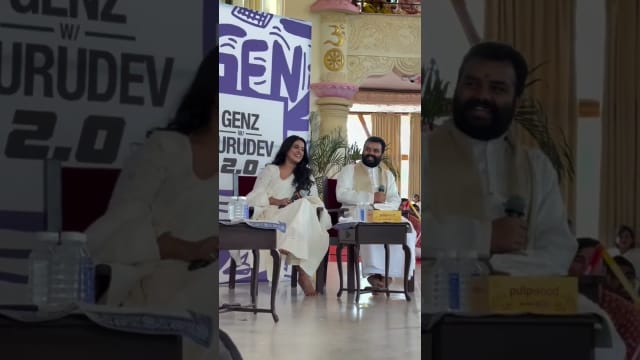
In a gathering published by The Art of Living in late October 2026, Gurudev Sri Sri Ravi Shankar sat with elders of the Whadjuk Noongar Nation and Indigenous representatives in Western Australia to talk about what two very old cultures might offer each other. The meeting was framed as a step toward a Memorandum of Understanding between the Art of Living and Dandjoo Koorliny, a commitment to social upliftment and community wellbeing. The conversation moved from the preservation of Indigenous languages and traditions to river systems, regenerative agriculture, youth depression and the incarceration of children, and then to the breathing practices and meditation Gurudev proposed as one answer. What holds the video together is a simple claim, repeated by several speakers: this is meant to be a bridge that runs in both directions, not a one-way gift.
Early in the video, one of the Indigenous speakers describes the meeting as a two-way bridge. Both lands, the speaker says, are very old, very powerful and very spiritual, and the exchange is meant to move in both directions: the Indigenous hosts share what their knowledge holds, and they also take in what Gurudev's group brings (video, 3:27). That framing matters because it resists a familiar pattern in cross-cultural encounters, where one tradition arrives as the teacher and the other as the student.
The speaker also suggests that the meeting is a beginning rather than an event. The elders meet in the room, the speaker says, but the connection is expected to carry on far longer than the day itself (video, 3:13). Read alongside the MoU described in the video's description, that reads less like a photo opportunity and more like a plan: a handshake followed by a relationship with obligations on both sides.
The most striking idea in the first few minutes is a refusal to rank knowledge by who owns it. The speaker says plainly that collectively, not one person is a knowledge holder, and not one society, but all of them together are (video, 2:41 to 6:11). Knowledge, in this telling, is a system that is shared and travels, not a possession kept in one place.
The same speaker places spiritual knowing alongside, and at times ahead of, modern science. Science, the speaker suggests, takes many generations to catch up with what the spiritual world already holds (video, 4:54). This is a bold claim and the video offers it without evidence, so it is best read as a statement of how the speakers see their own traditions rather than a verified comparison. What is clear is the intent: the value of ancient knowledge is presented as applicable now, not merely preserved as history. A later speaker says that this knowledge is missing in today's society, and names a particular quality of it: a stillness and quietness, and an understanding of the connection between people, place, plant and animal (video, 9:07).
Gurudev's own remarks echo the collective framing. The video describes him highlighting the universal relevance of ancient wisdom and the power of breathing practices, meditation, service and collective action to build a happier, more peaceful world. The shared vocabulary is a deliberate choice: "collective consciousness" and "likemindedness" recur throughout the opening, presenting the gathering as people who already know that together they can make a difference.
The environmental section is where the conversation gets most concrete. One speaker, a former ranger who says he worked in the role for 30 years, sets out the stakes in plain language: "Working with the environment is the future for us as Aboriginal people," and that is the work now, for the rangers (video, 9:26). He describes a way of seeing the land in three colours: brown for the planet, green for the environment, and blue for water, which he calls the single most important resource there is (video, 9:46).
Water is the center of his argument. The speaker places the southwest region of Western Australia within one of the highest biodiversity hotspots in the world, and warns that once much of that diversity is lost it cannot be replaced (video, 9:58). He then turns to a point that many agricultural conversations skip. People talk about regenerative farming and regenerative agriculture, he says, but rarely about how to care for the river system and the tributaries that keep the whole landscape alive (video, 10:03). In that reframing, soil health is not separate from waterways; the health of one depends on the other.
This is the kind of insight worth carrying out of the video. Regenerative practice is often described in terms of yield or carbon. The speakers here describe it in terms of a watershed, and the people who have spent decades as rangers reading that watershed. Their knowledge is operational, not abstract, and it is precisely the knowledge that a shared agenda on environmental conservation would need.
The video's most sobering passage concerns the young. A speaker says depression has become a very big issue among Indigenous people in the region, and that it must be addressed immediately (video, 10:38). Another places the problem within a wider frame: social justice, health and housing, and incarceration rates. The speaker describes children being jailed at ten years of age, a detail the video gives without further breakdown, and notes that when health declines and children are taken into the justice system, families are disturbed as well (video, 11:11).
These remarks shift the conversation from cultural preservation to survival. They also explain why wellbeing and mental health appear in the MoU's framing alongside language and land. For many communities, the loss of language and connection to country is not a separate problem from depression and incarceration; it is part of the same chain. The video does not spell out the causal argument in detail, but the juxtaposition is deliberate.
Gurudev's response is practical and direct. He suggests that people take up breathing exercises and meditation, and he describes a kind of intoxication with love and wisdom that does not leave a person once it arrives (video, 11:31). He then makes a specific request: that teachers and volunteers attend to the youth of the community. The idea is not a generic wellness programme but a relationship, delivered by people who will show up and stay.
The second half of his response is about identity. Young people, he says, need more self-confidence and should not be apologetic about who they are. They should feel proud of their roots, their culture, their customs and traditions (video, 12:05). That emphasis reframes the tension the video keeps circling: how to strengthen cultural roots while embracing modern progress. The answer on offer is not to choose one over the other but to stand securely in the first in order to meet the second.
A speaker close to the end adds a point about method that is easy to miss. The speaker says that the cultures of these communities teach people how to think: to take different ways of doing things, to look at all the perspectives, and then to arrive at what one believes is the right way (video, 13:11). That is a philosophy of discernment rather than doctrine, and it sits comfortably beside the meditation and breathwork Gurudev recommends. Both invite a person to look inward and reason outward.
The video shows the signing moment, and a speaker asks the parties to sign the agreement and become part of the world peace that everyone strives for (video, 12:53). The description characterizes the MoU as an expression of shared commitment to social upliftment and community wellbeing. The video itself does not list specific terms, funding, timelines or deliverables, so readers should look to the parties' own announcements for those details. What the video does establish is the spirit of the agreement: language, land, youth and mental health are the stated priorities.
The video also includes a reference to the Art of Living's engagement with an international body through Geneva, which a speaker presents as a way of contributing at the highest level possible (video, 7:08). The same speaker argues that people in a position like theirs, in a culture described as the longest continuous unbroken culture on the planet, need to be at the table. That is a claim the speaker makes about their own heritage, and it is offered as the speaker's view rather than an independently verified fact.
The Art of Living, according to its channel description, was founded in 1981 by Gurudev Sri Sri Ravi Shankar, operates in 180 countries and says it has touched the lives of more than 500 million people. The video ties that reach to its World Culture Festival, which a speaker mentions as an example of sharing something beautiful with everyone.
If you want to go deeper, watch the video with the transcript in view. Its captions are rough in places, so several passages above are paraphrased where the wording was unclear. Pay attention to how often the speakers return to the idea of exchange in both directions, and to how the environmental, youth and identity sections are linked rather than treated separately. For readers interested in regenerative agriculture, the ranger's remarks on watersheds are the most usable part. For readers working with young people, the request that teachers and volunteers show up consistently is the detail to hold onto. And for anyone curious about the MoU itself, the next step is the parties' own published statements, since the video gives the spirit of the agreement but not its fine print.