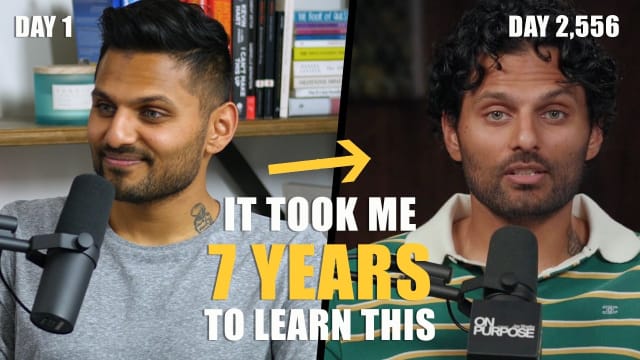
A boy falls off his bike, or gets teased on the playground, or loses the game he trained all season for. Before the feeling has a chance to arrive, someone says some version of the same thing: man up, walk it off, don't be so soft. In his video "How We Taught Generations of Men to Hide Their Feelings," Jay Shetty argues that this moment is not a timeless fact of human nature but the end point of a long, deliberate process. His case runs from Homer's Iliad, where the greatest warriors wept in the open, through medieval Christianity and nineteenth-century British boarding schools, to a modern world where a man who cries in a performance review can pay for it professionally. Along the way he connects that history to a documented gap in how men can recognize and name their own emotions, and to the places young men now go looking for permission to feel. The argument is less a call to become someone new than a case that suppression was taught, and can be unlearned.
Shetty starts with the most celebrated warrior in Western literature. Achilles, the hero of Homer's Iliad, "cries repeatedly, openly, without apology," and Shetty stresses that the poem never treats this as a flaw for Achilles to overcome. "His tears aren't despite his greatness," he says. "They are evidence of it. The grief and the valor come from the same place." The Iliad goes further. In book 16, Zeus, king of the gods, weeps.
The gift of tears had a later life too. Shetty notes that medieval Christianity treated crying as a sign of holiness: the ability to weep during prayer was understood as a sign that God was present in a person. Across these periods, tears were not the opposite of masculine status. They were part of how status was recognized.
So the question Shetty actually asks is not whether men cried in the past, but how the standard changed. For him, the answer begins with war and empire.
Shetty points to Napoleon, who in the late eighteenth century built what was then the largest army the world had seen. To turn ordinary men into soldiers who could endure conditions that would break most people, the army needed men who could stay functional under strain. Emotional control became a working requirement, not a personal virtue.
The template then moved into schooling. By the nineteenth century, Britain was the most powerful empire in the world and needed men to run it. Shetty describes elite public schools such as Eton, Harrow and Radley taking the model of the successful soldier and building a curriculum around it. Boys as young as eight were sent away from their families to institutions that relied on corporal punishment, cold showers and intensive sport. The stated aim, in his telling, was to produce men who could be sent anywhere and not flinch, or at least not show what they felt.
His summary is blunt: the gods wept, Achilles wept, and then a new standard was built, one that asked men to be something "even Zeus himself never managed to be." He frames it as a shift from a culture that treated grief as part of greatness to one that treated grief as proof of failure. In the video he delivers the line that anchors the whole talk:
"This is what men are. This is what men do. Men don't cry." (Jay Shetty, video, 4:10)
To make the cost concrete, Shetty introduces a composite figure he says is not a real person but one his audience will recognize. He calls him Lenny. Lenny hasn't cried since he was nine. At work, his project is criticized in a meeting, not cruelly but publicly. He feels something, maybe embarrassment or hurt, and notices a rise of anger. He nods, says he'll look at the feedback, and moves on. That evening his daughter scrapes her knee and cries, and he comforts her easily. Afterward he sits in front of the television without really watching it. When his partner asks whether he's okay, he says he's just tired.
Shetty's point is that Lenny isn't lying. He genuinely doesn't know what is wrong, because he never learned how to find it. The clinical word for this is alexithymia, and Shetty explains it plainly: "It literally means without words for emotions." (Jay Shetty, video, 6:18)
He cites a rough prevalence figure of about 10 percent of the general population with clinically significant levels, with men at nearly double the rate of women, 13 percent compared with 7 percent. His interpretation is the core of the argument. The boys who were always told to stop crying, he says, do not become tougher adults. They become adults who cannot identify their own emotional needs. Suppression, in this account, doesn't remove a feeling. It removes the vocabulary for it.
Shetty's most useful observation is about conditions. Sport, he notes, is one of the few places in modern life where a man crying in public is not just tolerated but celebrated. Roger Federer is his central example: he has cried at the Australian Open, at Wimbledon, at the French Open, at trophy ceremonies and during speeches, and in Shetty's telling it enhanced his status rather than costing him any.
But the permission depends on context. "High stakes, public competition, the battle has to come first," Shetty says. "The tears are only acceptable because everyone in the room just watched him earn them." (Jay Shetty, video, 7:30)
He cites several studies to show how narrow that permission is. As he describes one, crying male firefighters were rated as more emotionally appropriate and higher in workplace status than crying male nurses. Men reported being more likely to cry after losing a weightlifting competition than after losing a figure skating competition. The pattern holds that a man's tears are read through the lens of whether his masculinity has already been established by the setting.
Then he moves from the stadium to the office. He cites a study published in the Journal of Applied Psychology that found men who cried during a performance review received lower evaluations, decreased assessments of their leadership ability, and more negative written recommendations. The lesson a young man absorbs from that is not that crying is wrong in every case, but that it is risky in the places where his career is decided.
If the permission to feel only arrives after the battle is won, Shetty argues, many men eventually stop looking for it from the people around them and start looking elsewhere. He points to the manosphere: a loose network of online communities, mostly on social media and podcasts, that speak directly to young men about what it means to be a man.
He is careful not to dismiss the whole category. Some of it, he acknowledges, is genuinely useful, including fitness advice, financial guidance, and men talking to other men about purpose and discipline. The problem is a recurring instruction running through much of it, the same one the video opened with: emotional expression is weakness, and vulnerability is something to be overcome.
Shetty's counterpoint is a distinction that runs through the whole talk. "Self-regulation is real," he says, "but there's a difference between regulating your emotions and exiling them." (Jay Shetty, video, 8:24) Regulation means feeling something and choosing how to respond. Exile means the feeling is sent somewhere it cannot be seen, including by the person having it.
Shetty then turns to the physiology, and he is clear about the conditions. According to the research he describes, a good cry under the right conditions reduces cortisol, the stress hormone, and activates the body's calming response. The benefit depends on setting. Crying alone, in shame, with nowhere for the feeling to go, does not produce the same result.
That qualification is what makes the history matter. A culture that teaches men to cry only in private, or only after winning, or never, is not just asking them to look a certain way. It is removing a release mechanism from the people who most often have been told they can't use it. Shetty's argument is that the cost lands on the body, on relationships, and eventually on the men themselves. In the later part of the talk he describes that cost in more detail, calling the numbers devastating and tracing how many men learned early that their feelings had no legitimate place.
The useful takeaway from this video is not a verdict on masculinity. It is a reframing. The Iliad, the medieval gift of tears, and the boarding-school curriculum show that the rules about male emotion were built at specific moments for specific purposes, which means they can be examined and revised. Shetty's distinction between regulating and exiling gives a practical test: when a feeling arrives, can you name it?
If this history is new to you, the most direct next step is to watch the full talk, where Shetty works through the consequences and the path out. Pay attention to the sections on Lenny and on the performance review study, since those are the moments where the abstract history becomes a daily experience. The question he leaves with the viewer is simple and hard: what would it take for the next boy who falls to be told that he is allowed to feel it?