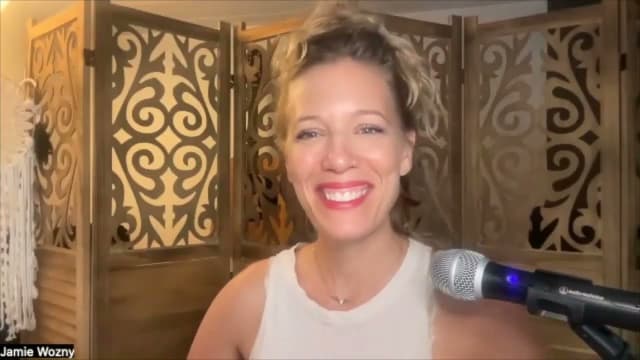
Jamie Wozny's eleven-minute guided session, "Higher Self Devotion Activation," opens with a confession: she is about to use words, but what she feels "so deeply in my bones" is already in the room. The transmission, she says, is here, and the listener should simply drink it in. What follows is less a lecture than a practice in three movements: grounding the body into the earth, naming the self as a particular expression of the divine, and then asking that self to release old fears and call its power home. Its central image is a playful one that becomes, by the end, a serious proposition. Each of us, Wozny suggests, is a specific "flavor" of God, the way salt and pepper are two different seasonings of the same meal. Read closely, the session is a working method for what she calls the integration point between human and divine, and it closes with a homework assignment: notice that self in ordinary life.
The session is built for a seated listener. Before any invocation, Wozny asks you to "gently notice the connection between yourself and the chair under you." That small instruction is the grammar of the whole piece: begin with the body, the chair, the floor, and only then reach upward. The breath is the metronome. "Breathing in, breathing out, softening the body" recurs like a refrain, and each return drops the listener a little further into the present before the next layer of language is added.
Notice, too, how the grounding is framed. She is "grounding your body into the earth through intention, using the words that resonate with you," and she admits she is "doing my best to find the ones that work for the group." That remark tells you this reads as a group session, not a recording engineered for one listener. The language is shaped in real time for the people present, which gives it the loose, responsive quality of a live room rather than a script.
Then comes the anchoring, a deliberate ladder of nouns. The group chooses "to anchor into our sense of self, into our soul, into our divinity, into the integration point of our humanity and divinity, into our truth, into our authentic self encoded within it, our me-ness." Each phrase narrows toward the particular. The session moves from the general sacred to the specific person sitting in the chair, and that movement is what the rest of the piece depends on.
This is the idea that gives the session its spine, and Wozny introduces it with a joke. Recalling that Michael Neill used to call the soul "God," she repeats the word until it loosens: "God. God. God. Jamie-flavored God. Like, there's salt, there's pepper, there's God-od." The laughter in the room is part of the teaching. It makes a serious claim easy to hold.
The claim is that individuality is not a diluted copy of the sacred. In her words, "you are a specific flavor of the divine, an individuation of the divine through the body." Then she resolves the apparent paradox: "Yes, whole and one and transcendent and you." She follows it with a question she asks the listener to sit with: "Could I open to the possibility I can be both?"
For a practitioner, this matters because it changes what spiritual growth looks like. If the divine is only out there, the task is to escape the particular self and merge upward. If the divine particularizes through a body, the task is to become more fully the person who is already sacred. The session chooses the second path. The goal is not to stop being Jamie, or you, but to be the specific flavor you are without apology.
Wozny's approach to fear is notably gentle. Rather than attacking the fear, she offers it attention. "I offer compassion and love to the part of my experience that contains the fear," she says, and then adds a striking image: from the frequency of one's own truth, the fears "don't even exist. And if they do, they fly by like a little cloud bird in the sky."
The release itself is a litany addressed to what she calls Source. Listeners are asked to say, in effect: clear and transmute "any reasons I am afraid to trust divine me," and do it "gently and easily, no side effects." The request reaches back for origins: "Take me back to before I was programmed that any parts of me were weird, wrong, different, not okay. Download the original blueprint of the truth of who I am." Here the vocabulary of programming frames fear as a learned overlay, something picked up rather than something essential. Whether or not a listener shares that metaphysics, the structure is clear: the self is not being fixed, it is being returned to a version it already was.
She also makes a candid admission that deserves more attention than the session gives it. Describing her own healing work years ago, she realized "I was afraid to heal cuz why might be bored? I love this healing stuff. What happens next?" It is a funny, human confession, and it names something many seekers recognize: a quiet dread that wholeness might leave nothing to do. Her answer is that there are "infinite levels of consciousness," and that joy, learning, and growth continue after the knot is loosened. The release, in other words, is not an ending. It is a door.
The middle of the session turns to relationship, specifically the pull of other people's approval. Wozny offers a set of "May I" statements that work as permissions rather than commands: "May I know that I care so much more about you than others' opinions. May I know that I can be human and make thousand mistakes as I remember your name." The grammar matters. "May I" invites rather than demands, which fits a practice about trust. Trusting yourself does not mean being flawless; it means being willing to be imperfect while staying in relationship with yourself.
She also addresses the fear of not knowing how to do this at all. "I don't need to know how, but my willingness will call forth the help, the support, the educators that remind me." And she pairs it with the phrase "May I go small and slow," which may be the most practical line in the session. It is a reminder that embodiment happens at the pace of a body.
The session then calls the self by name, in the most intimate register: "Hey soul. Hey me. Hey self. Hey fill in your name flavored God. I choose you." It is a small act of recognition that turns the abstract idea of flavor into a direct address.
Wozny ties the inner work to an everyday reference point. She recalls a moment before the pandemic when she went to see Oprah speak and wrote a note card with a line she kept: "I am the most important person in the room." She turns that line into a gift to the listener: "may you be the most important person in the room to you." The sentence is not self-absorption. It is an order of operations. "From that place you can still consider and connect with other," she says. You cannot offer real care to others from a place of self-erasure.
The session then assigns the week's practice. Wozny refers to a chapter called "the sacred part of you" in her book, Sacred Fire Your Longing Heart, which she says she channeled. Her description is vivid and easy to try. You "just see them from across the room and you kind of wink cuz you recognize each other." That part may arrive as sadness, as joy, or as a clear instruction about "your business or the next leg of your life." The gesture is simple: "Oh, you. Hey. Wink from across the room at the party."
There is craft in this assignment. It turns a metaphysical claim into a perceptual one. The sacred part is not a state you must achieve; it is something you notice, the way you notice a friend across a crowded room. It also lowers the stakes. You do not have to understand the sacred part to acknowledge it. Acknowledgment, she suggests, is enough to let it "open and blossom."
The session ends by reframing protection altogether. "You really are the medicine," Wozny says. "Your bio fuel is the impact of you and others just by being yourself. That is your protection." She is careful to distinguish this from defensiveness: "Protection not from a hardened closed place, protection from I am in such an embodiment of love no matter my imperfections, no matter what it looks like that that stuff can't even come into my field." She notes that the phrase is the name of her course, which is a reminder that these ideas are part of an ongoing body of teaching she has built.
Taken together, the arc is coherent. Ground the body. Name the self as a specific flavor of the divine. Acknowledge fear with compassion and let it pass. Trust your own knowing above the noise of opinion. Notice the sacred part across the room. Protection, in the end, is not a wall but a field of love that you carry with you.
If the session has stirred something, the most useful next step is the homework itself. This week, pick a few moments to notice the part of you that feels sacred: a flash of sadness, a spark of joy, an instruction about the next chapter of your life. Acknowledge it quietly, the way Wozny suggests, with a nod across the room. You do not need a dramatic experience to begin.
For deeper reading, Wozny points listeners to her book, Sacred Fire Your Longing Heart, and especially to the chapter on the sacred part of you. She also cites several teachers across the session. She attributes the line "I'll know what I need to know when I need to know it" to Michael Neill, and says she believes "the challenge contains the solution" is from Wayne Dyer, though she hedges on that attribution. Tracing those sources is a good way to see how the session's ideas sit within a wider lineage of self-inquiry. Finally, return to the session itself. It is short enough to repeat, and its refrains, the breath, the "May I," the wink across the room, get more familiar with each sitting.