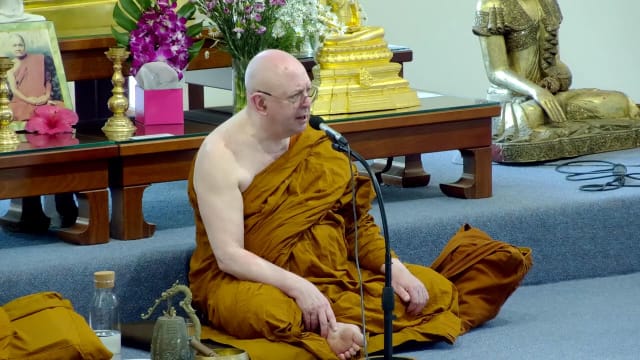
There's a radical moment early in any meditation practice when the teacher says something that flips the usual approach on its head. This video captures one: instead of fighting your mind, instead of chasing some distant state of calm, what if you started by noticing what your body already finds delightful?
The guided meditation opens with an unusual instruction. The teacher asks not "what hurts?" or "what's distracting?" but rather "What part of your body is the most delightful? What feels good?" It's a simple reorientation, but it moves the entire practice away from problem-solving and toward discovery.
Most people, the teacher observes, have been trained to focus on discomfort. There's a knee that aches. A shoulder that's tight. An itch. The mind naturally gravitates toward friction. In meditation practice as in life, we hunt the problem. But this approach asks you to flip the sequence: find what already feels good, celebrate it, and use that as your anchor into peace.
The teacher's own example is deliberately ordinary—the belly, warm and comfortable, even without having eaten since morning. The point isn't the specific location; it's the permission to start with joy instead of resistance.
A core teaching emerges as the meditation deepens: "I'd never do anything in meditation. I just let go and enjoy what's happening." This isn't passivity masquerading as wisdom. It's a specific skill—the art of not interfering with peace once you've found it.
The practice invites you to notice silence not as the absence of noise, but as a texture you can enjoy. Yes, there's the sound of the air conditioning. But that's only a small noise, the teacher notes. Mostly, everything is silent. The instruction is to receive that silence without commentary, without trying to improve it or deepen it artificially. Just enjoy peace.
This points to something essential in contemplative practice: the difference between reaching for a state and allowing one to settle. Striving creates tension. Enjoyment creates openness. When you start by celebrating what's already pleasant in your body and your environment, the mind naturally relaxes into receptivity.
Toward the end of the guided portion, the teacher offers a compass for anyone uncertain whether they're "doing it right." The essence of meditation, he says, is peace and freedom and the joy which that gives you. Not a particular posture. Not a specific breathing pattern. Not even a particular technique—especially because, the teacher notes with warmth, he never teaches the same technique in meditation twice.
What matters is results: whether you're calming down, whether you're learning to be peaceful and kind, whether beautiful happiness arrives as a by-product. For someone just beginning, that calm might feel incomplete. But the practice itself works. You're building the capacity to shift your baseline from reactivity to receptivity, from hunting problems to celebrating resources that are already yours.
The repeated instruction to celebrate delightful sensations isn't sentimentality. In Buddhist meditation, particularly in the cultivation of states like the jhanas (profound concentrative absorptions), the quality of joy or contentment is not incidental—it's the fuel. When you learn to genuinely enjoy your breath, the silence, the warmth in your belly, the peace of the present moment, you're training your nervous system to recognize safety and rest as real options.
This has a cascading effect. The more you practice celebrating what's already good, the more you retrain your attention away from the threat-detection mode most of us live in. You begin to see that peace isn't something you have to earn or achieve or force into being. It's already here, underneath the noise. Your job is to notice it and let it be.
One of the more poetic moments in the guided session is the teacher's explicit instruction not to add anything to silence. You don't improve peace by analyzing it or chasing it deeper. You just notice it. You inhabit it. This is different from the idea that meditation requires effort or progress. Sometimes the most profound work is the work of letting go of work.
The sound of air conditioning becomes, in this context, not an obstacle but simply part of the whole. The body's sensations—the delightful ones—become anchors. The silence becomes a presence you can rest in. And the teacher's own gradually decreasing speech creates space for the meditator to move from instruction into direct experience.
If you're new to meditation, this session offers a practical entry point: sit comfortably, close your eyes, and genuinely ask yourself what part of your body feels good right now. Not what you think should feel good, but what actually does. Start there. Celebrate it. Let that celebration be your gateway into the larger peace that's available in silence and stillness.
If you've been practicing for a while, the session invites you to check whether you've slipped into effort. Are you trying to meditate? Are you reaching for a state? The teaching asks you to reset: let go. Enjoy. Trust that peace and freedom are not destinations you have to earn, but capacities you can activate by paying attention to what already feels delightful.