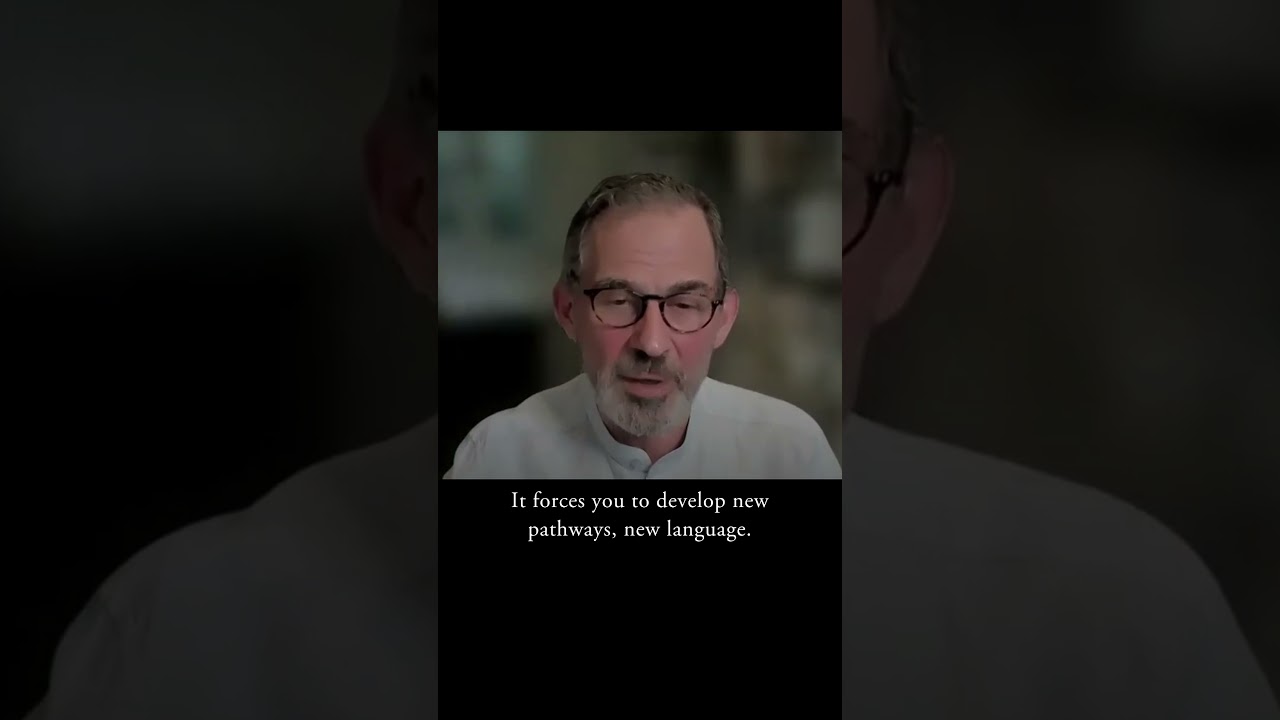
At San Damiano, a retreat center in Italy where seekers gather in March, someone asks the question that stops most spiritual teachers cold: What if there's no time? What if your life is a doctor's schedule, or a parent's avalanche, or both? This teaching from Rupert Spira addresses that exact dilemma, revealing that self-realization doesn't require withdrawing from life—it requires finding the gaps already present within your busiest days. Through micro-pauses between thoughts, emails, and conversations, your true nature becomes not a destination you visit but the home you live from, even while fully engaged with work, family, and responsibility.
Can you recognize your true nature in just a few minutes?
A seeker stands to ask about practice in a busy life. Rupert doesn't sidestep the obstacle. He invites them to close their eyes. "Tell us about yourself," he says simply. "Not your thoughts, feelings, history, or relationships. Tell us about yourself."
In this instruction lives the entire method. Not effort toward self-realization. Recognition of what's already here.
The seeker closes their eyes. "It's quiet," they say finally.
"Good. What else?"
"It is aware."
"Yes. Don't add anything to it."
They try to say more, to qualify, but Rupert corrects gently: "You're not observing it from a distance. It's you. I'm asking about yourself, not another yourself. I am quiet. I am aware."
And then the landing: "I am. I am. I am."
"That's it," Rupert says. "Don't add anything. You've recognized your true nature."
What is the "I am" that Rupert is pointing to?
What's being pointed to here is as old as Advaita Vedanta and as direct as a mirror. Your true nature is not some exotic state you have to build toward. It's the awareness in which all your experiences occur—prior to thoughts, prior to emotion, prior to identity. When you strip away everything you can observe or describe about yourself, what's left is the simple fact of being: I am. Not "I am a doctor" or "I am anxious" or "I am advanced in my practice." Just: I am.
In non-dual philosophy, a crucial distinction is made between your essential nature—awareness itself, the sense of "I am"—and all the qualities, experiences, and identities that appear within that awareness. You are not your thoughts, emotions, body, mind, or life story. These are all objects within the field of consciousness. What you are is the aware presence in which all of this appears. Most people locate themselves in the content: when you ask "Who am I?", the mind automatically responds with attributes. But if you inquire deeper—What's aware of these things?—you find yourself back at the source: simple awareness, before qualification.
This recognition, Rupert explains, is not rare or exotic. Every human being touches it. You experience it in the gap between sleep and waking, in the space between thoughts, in moments of complete absorption. The question is: can you consciously, deliberately access it? And once accessed, can you keep going back?
What is the gap between visiting and living your true nature?
The seeker names the immediate problem: "But I don't stay there."
Rupert's answer contains the entire methodology. You've now traveled a three-minute pathway back to yourself. You have the map. Use it. Again and again. Each time you return to your true nature, the content of your experience—the thoughts, emotions, and circumstances that usually pull you away—loses a bit of its power. It's like a habit that weakens from disuse.
Each time you go back to yourself, you weaken the power that the content of your experience has to take you away from yourself. And you begin to feel that you don't just visit yourself from time to time, you live there. It becomes your home. You still go out into the world, you still act and relate. But you stay home. You work from home. You don't go to the office.
The image is precise. Home is not a vacation you plan for. It's where you are. It's the baseline. You can leave to work, run errands, tend to relationships—but you're working from home, relating from home. Your foundation is the recognition that you are awareness itself, not the temporary resident of a busy life.
How can you practice when you have no time?
For the doctor in the room, another question surfaces, and it's practical: I have no time. Patients all day. Minutes between appointments. What use is a three-minute journey back to myself when I can't find three minutes?
Rupert doesn't argue for time management or a stricter schedule. He reveals what's already present.
There's a micro pause between every thought. Between every email. Between every phone call. Between every conversation. There are all these micro pauses. You need five seconds. Pause. You go back to your being and then you attend to your next patient.
The doctor pushes back. The schedule is relentless. There's no break.
"But there's always a second," Rupert says. "Even if there's only a second, there's always a gap."
This teaching, while deceptively simple, pivots the entire approach. Traditional practice separates spiritual life from ordinary life: meditation happens at dawn, in a quiet room, separate from work and responsibility. The direct path, as Rupert teaches it, is available in the fabric of life itself. In the one-second gap between one thought and the next. In the breath between patients. In the pause in a conversation when someone takes a breath.
Don't think "Oh, I don't have 50 minutes. I can't practice." Just find numerous 10-second gaps. 50, 60, 70 times a day. Just for 5 or 10 seconds at a time.
Each micro-pause is a return home. Each return weakens the hypnotic pull of email, conversation, worry. Over time—days, weeks, months—these returns compound. You're no longer constantly knocked off-center. The recognition of your true nature shifts from being somewhere you have to go to being where you live.
What is Rupert's own story with this teaching?
How does Rupert know this works? Because he did it. His own professional life, he explains, was "extremely extremely busy." But there were always micro-pauses. He found them. He used them. He kept returning to himself in five-second gaps.
In his early years, Rupert spent his free time "fanatically reading Ramana Maharshi"—the 20th-century Tamil sage who taught self-inquiry as the path to liberation. Ramana's teaching was powerful but, for Rupert, arrived wrapped in centuries of classical Advaita philosophy. Sanskrit terms, metaphysical frameworks, interpretive layers that required struggle to decipher.
"When I first came across it, I had to decipher it and struggle with it," Rupert explains. "I loved and had great respect for the classical Advaita tradition, but it wasn't so clear to me. It took me a long time to understand."
How has the direct path evolved over time?
What's remarkable is what Rupert observes next: The teaching itself has evolved. The same truth that required years of fanatical reading is now available in a much simpler, clearer, more direct form.
Fifty years ago, the understanding wasn't available in the way it's available now. It wasn't so clear. It wasn't so direct. It wasn't so simple.
This happened through the work of several great Indian teachers of the last century—Atmananda Krishnamenon, Nisargadatta Maharaj, H.W.L. Poonja—who brought the direct path "out of its obscurity in the spiritual Vedantic tradition." They taught it person to person. Directly. Stripped of ornament. The point made crystal clear.
What this means is that the barriers to realization have lowered. The teaching hasn't changed—awareness is still what you are—but the packaging has. Where once it required initiation into Sanskrit philosophy and meditation on abstract concepts, now a person can recognize their true nature in minutes, using nothing but the direct question and their own honest introspection.
The integration that emerges from this teaching is neither transcendence nor denial of life. You don't leave your responsibilities. You don't withdraw from your relationships. Instead, you return to yourself repeatedly in the micro-pauses already present, and over time, the center of gravity shifts. What was somewhere you visited becomes your home.
You stop thinking, feeling, acting, and relating on behalf of the old separate self that you once believed yourself to be. You now lead your life in service of love and understanding.
For a doctor, this means attending to patients from presence rather than urgency. For a parent, it means tending to your children from your true nature rather than from a wounded self. For anyone, it means the ancient rift between spiritual life and ordinary life closes. Not by transcending the world, but by repeatedly remembering where you truly stand.
Where to go from here
If this teaching resonates, the direct path is surprisingly actionable. You don't need to reorganize your life or find a monastery. Start where Rupert points: Notice the gaps. They're already there. Between one thought and the next—a micro-pause. Before you check your email again—five seconds to close your eyes. Between conversations. Between tasks. These are your practice ground.
Each time you return to yourself in these gaps, ask: Who am I? Not your name, not your role. What is aware of all of this? I am. That's it. Don't decorate it. Don't make it mystical. It's simple and obvious: I am quiet. I am aware. I am.
Do this 50 times a day for 10 seconds. A hundred times if you can find them. Over weeks and months, something shifts. The pull of distraction loses its power. What was somewhere you visited—your true nature—begins to feel like home. And from home, you can tend to everything: work, relationships, the full kaleidoscope of a lived life. But you're no longer lost in it. You're working from yourself, not trying to find yourself in your work.