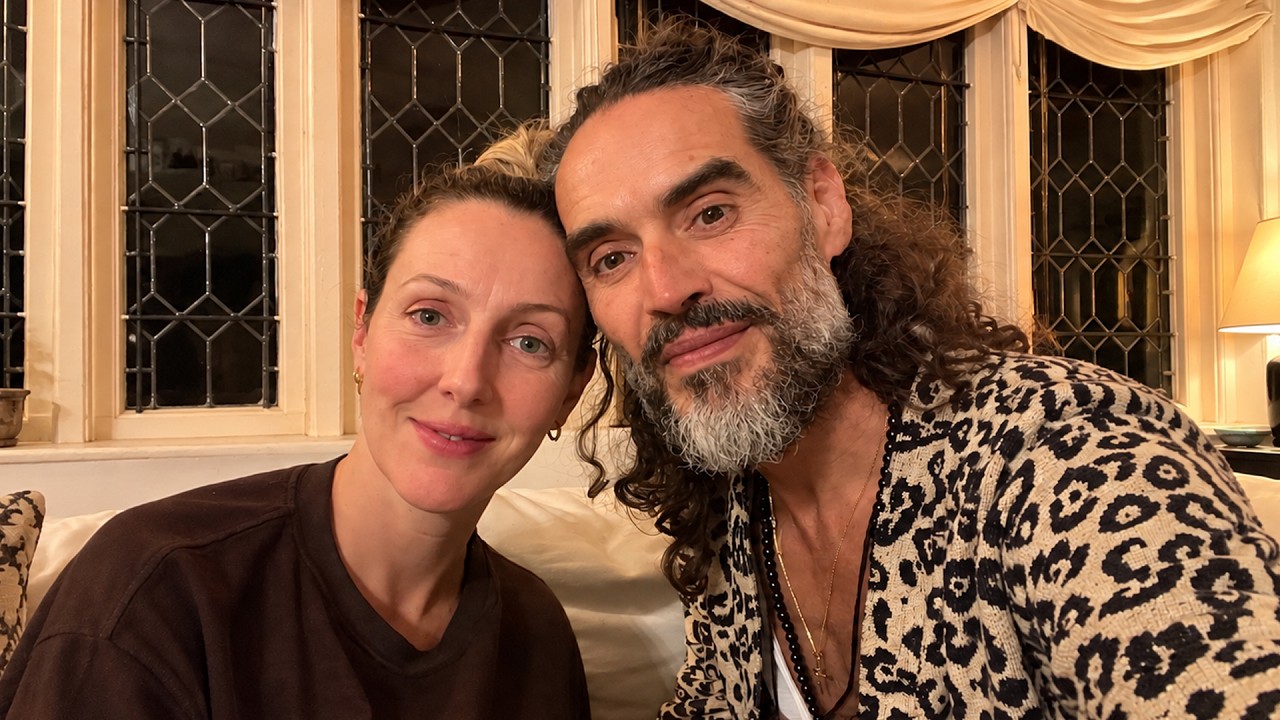
The clip opens mid-sentence, with a man admitting he got nervous before going to court. It is four and a half minutes long, recorded as part of a Sunday Service conversation between Russell Brand and his wife Laura, and posted to YouTube in October 2026. Nothing dramatic happens on screen. What it contains is a short, unusually candid account of what it feels like to walk out of a car into a crowd of cameras that does not shout, and of why that silence unsettled them. Brand and Laura use the scene to talk about media narrative, fear, and the experience of feeling God close during the hardest weeks of a life. The piece is worth reading because it treats an ordinary, frightening moment with real attention, and because the image at its center, the silent eye of a storm, holds up under scrutiny.
Brand's nerves, as he describes them, were not about the courtroom itself. They were about the threshold. He was not used to the moment of stepping out of a vehicle while press, photographers and passersby turned toward him. He was careful to say the people were not necessarily aggressive. The discomfort was in the sense of being swept into what he called a moment, a point where a private person becomes a public image before he has taken a single step.
Laura picked up the thread with a comparison that gives the scene its shape. She had been talking to Russell about her fascination with storms, and about the satellite view of a hurricane that week, when the image of the system drawing everything inward became a way to describe the courthouse steps. On a storm map, she said, the arrows point in toward the center, from every direction. Then the eye arrives, and it is absolutely silent.
"Well, guess what? When we stood outside with the paparazzi the other day, it was silent." (Laura Brand, in the Sunday Service conversation published on YouTube, October 2026)
That reversal is the core of the talk. The expected sound of the scene, the shouting and the flashes, is what would have felt normal. Its absence felt like the lull at the centre of a system, a place where something large is going on but nothing is audibly happening. Laura describes the quiet as eerie, a sense that everyone is aware of something and nobody says it aloud.
Brand reaches the same point from another angle. He notes he has been in paparazzi situations before and has never liked it when it gets shouty. Calm, he suggests, can be jarring in its own right. But he also insists that stillness can mean what it is supposed to mean. "The calmness can feel exactly what it is meant to feel which is calm and still and sort of holy," he says in the clip. The same silence can register as threat or as peace, depending on what a person brings to it.
The second half of the clip turns from the feeling of the scene to the story being told about it. Brand suggests the photographers are not neutral observers but part of a larger machinery of media. "That is because they have acclimatized to the idea that by their own position as primarily operatives within the machinery of media," he says in the exchange, arguing that without mainstream media behind them, there would be no paparazzi as the public knows them. He says he believes the media's position on his trial is clear, and that in his view they believe he is guilty. He is careful to flag that he may be overstating it, but he is firm on one point: that anyone who claims to be a victim of crime deserves to be taken seriously and treated with respect.
He then names a specific instance of the framing he objects to. People told the couple that a headline had described him as "spotted" entering court, "supported by mystery woman." The phrasing, Brand says, is a small thing that reveals a larger one. Laura is his wife, and the sentence turns a marriage into an intrigue. For Brand, this is where you can see what he calls narrativization happening: the facts are not so much reported as arranged in advance to fit a conclusion. "There's a predetermination to present information in a certain way," he says.
The argument is not a legal one, and the clip does not try to settle any question about the allegations or the proceedings. What it offers is a description of a particular experience of being covered by the press, one in which the gap between what happened and how it is framed becomes impossible to ignore. Brand's objection is to the framing, and his point about respect for victims is offered as a principle he holds even while disputing how he is being portrayed.
The emotional center of the conversation comes when the talk turns to faith. Brand connects the strangeness of the courthouse scene to a broader feeling, the sense that life sometimes stops feeling real. "Things don't feel real," he says, "and ultimately that does bring us back to the point about God." He describes walking out of court and, for a moment, finding the silence itself unnerving, a discomfort that made him feel nervous precisely because it was not loud.
He then asks Laura about the first time she walked into court, and whether she took it slowly, and whether she felt God with her in every step. Her answer is the most direct statement of faith in the clip:
"By God's grace, something never more than in the concentrated times of these challenges and trials have I more felt the presence of God. In the intensive care unit by our son, in midst of allegations, walking in the court, I felt so close to God. So close." (Laura Brand, in the same Sunday Service conversation, October 2026)
Notice what she links together. The intensive care unit where their son was, the allegations, and the walk into court are placed side by side as moments of the same kind. None of them is presented as a good experience. Each is presented as a place where the sense of God's presence became more concentrated, not less. That reframing is the most important idea in the talk: hardship is not described as a gap where faith disappears, but as the place where it is most felt.
This is also what gives the storm image its meaning. In a hurricane, the eye is calm not because the storm has stopped but because it is at the centre of something turning. The people in the clip treat the silence outside the court the same way: as a stillness in the middle of a larger, noisy process, a stillness that can be frightening and can also be a kind of holiness, depending on where you are standing.
Three ideas carry the clip. The first is that a physical experience, such as being photographed, can be a lens onto a larger story about who is controlling the frame. The second is that calm and noise are not reliable signs of what is happening. A quiet crowd can be as disorienting as a loud one, and it is the meaning brought to the silence that decides whether it feels like threat or grace. The third is that faith, as Laura describes it, is not an answer to the fear but a presence that grows strongest where fear is greatest.
Brand closes the clip with a practical note. He has a new book, How to Become Christian in 7 Days