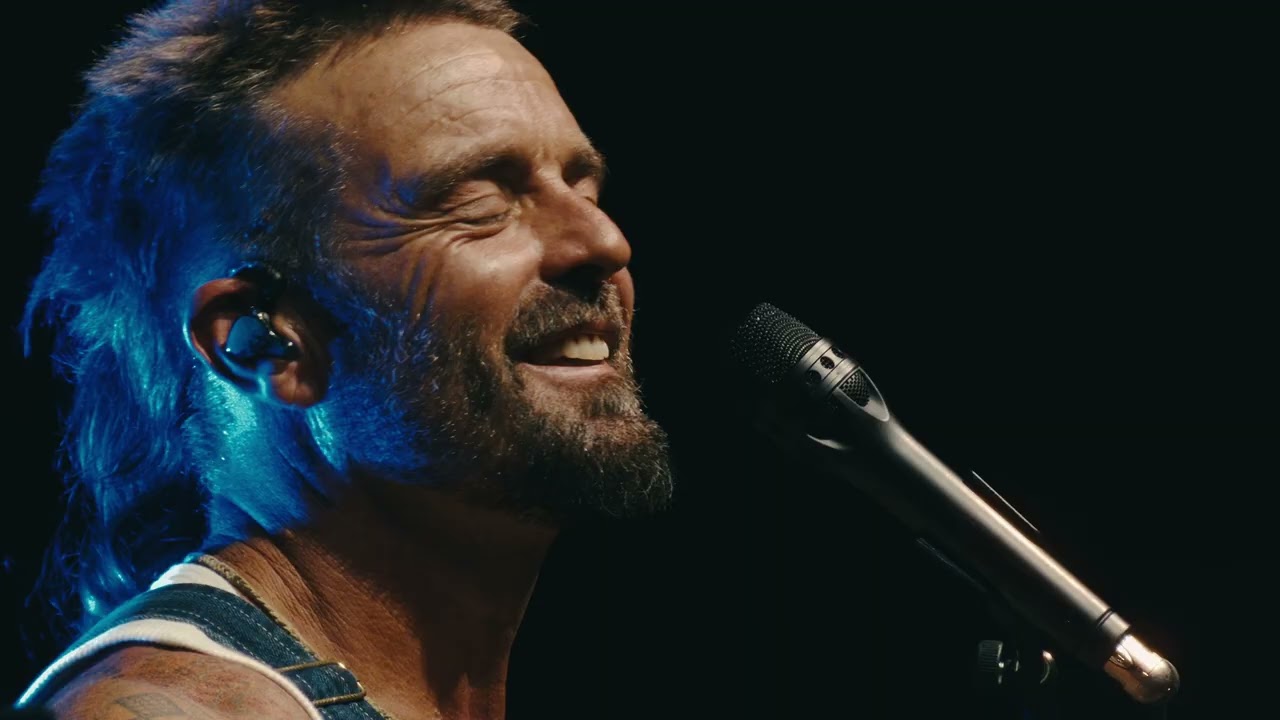
Xavier Rudd's "Energy Song" is a lyrical meditation on spiritual connection and earthly presence. Written during a solitary evening at Bells Beach in Victoria, the song explores the sensation of being fully alive through communion with nature—particularly through surfing—and the speaker's intimate relationship with earth, trees, and the cosmos. Performed live at Ancienne Belgique in Brussels during Rudd's Jan Juc Moon tour (January 2022), the piece emerges from a transitional moment in the world, as communities were gathering again after COVID isolation and Rudd was returning to solo performance after years of collaborative work.
What Is the Core Story Behind "Energy Song"?
Rudd anchors "Energy Song" in a specific memory of creative emergence. As he describes in the video introduction, he wrote the song "sitting in the water one magical evening at Bells Beach." That moment of solitude in the ocean crystallized the song's central metaphor: surfing as a spiritual practice that aligns the body and consciousness with natural forces. The image of "surfing between" the sun and moon—waiting for "the sun [to say] it's done"—captures a state of complete temporal and sensory presence. The surfer becomes a medium through which celestial and terrestrial energies interact.
This is not abstract spirituality. Rudd grounds the experience in the physical body and specific geography. The water, the weather, the season—these are not decorative details but the actual substrate of the experience he is describing. When he sings "I feel so connected and I feel so alive," he is not referring to an escape from the body but rather a heightened inhabitation of it, one that occurs when the boundaries between self and environment dissolve.
How Does the Song Map the Landscape of Isolation and Return?
The opening verse establishes a stark emotional terrain: "all alone in the snow, nowhere seems to be close. The cold moves now to my bones. It's beauty is long long gone." This is not romantic solitude but genuine separation—isolation that has etched itself into the physical body. The cold has penetrated to the bones, suggesting that the isolation is not merely psychological but somatic, embodied. Beauty has withdrawn; the world feels drained of aliveness.
But the verse does not remain in this state. Recognition arrives: "I know now this is wrong and I should move on. Time to ref[ugee], time to be with my home." The repetition of "time to" signals urgency and shift—a turning point. The word "refuge" (partially sung as "ref") suggests that home is not a location to return to but a state of being to re-enter. The song moves the listener from disconnection toward reconnection, from isolation to the possibility of homecoming.
This arc mirrors the larger context Rudd provides. The performance was recorded in January 2022, a moment when the world was "coming out of COVID and coming together again to remember the importance of our basic freedoms and the power of community coming together as one." The song's emotional journey—from cold isolation to warmth and connection—resonates with that collective passage. Yet Rudd is clear that this was also a personal moment of artistic recalibration: "I was returning to performing solo again after many years playing with others and was locked into an intimate space with myself and my perception of the world at the time."
What Role Do Trees and Earth Spirits Play in the Song?
The middle section of "Energy Song" shifts the focus from the self in isolation to the self in relationship with the living world. "These trees I've known now for years and years. How contain my fears. Spirit up from this big old Earth that I have felt since my birth." Here, Rudd positions the trees and the earth as both witnesses and healers. He has known these trees for years; there is a covenant of familiarity and trust. The trees "contain" his fears—they hold space for them, they don't erase them but provide a container.
The phrase "Spirit up from this big old Earth that I have felt since my birth" is crucial. Spirit is not something that descends from above or exists only in the mind. It rises from the earth itself, emerges through the ground. Moreover, Rudd positions this earth-spirit as something he has "felt since my birth"—not as a new discovery but as a fundamental frequency he has been attuned to since his first moment of consciousness. This suggests that the spiritual connection to earth is not aspirational but primordial, woven into the body's earliest neural pathways.
The song then articulates the consequence: "I know now this is right here. I've spend so much time in this connection, this space at the end of the [month]." The recognition "this is right here" echoes the earlier "I know now this is wrong"—the song has moved from misalignment to alignment. The time spent "in this connection, this space" becomes the actual substance of life. Presence in connection is not a detour from living; it is the living itself.
How Does the Sun-Moon Metaphor Function Spiritually?
The central refrain introduces a cosmological dimension: "I feel so connected and I feel so alive when the stars [sun] at the Sun [stare at the sun]. On the days I am surfing between them until the sun says it's done." (The lyrics shift slightly between "stars at the Sun" and "when the moon stares at the sun," both versions appearing in the performance.) This image invokes a liminal space—the threshold between night and day, between the reign of the moon and the reign of the sun.
In many spiritual traditions, the threshold—the in-between time of dawn or dusk—is considered a window of heightened permeability. The boundary between opposing forces (light and dark, masculine and feminine, active and receptive) becomes thin. When Rudd sings of "surfing between them," he positions the body as a vehicle that can navigate these cosmic forces. The surfer is not separate from nature's rhythms; he is a conduit through which they move.
The phrase "until the sun says it's done" introduces a surrender motif. The aliveness and connection Rudd describes are not under the surfer's control. They depend on the sun's willingness to set, on the natural cycles completing their arc. This is a theology of participation rather than mastery—the human subject aligns with forces larger than the self and allows those forces to determine when the moment is complete.
What Does "Germination Inside Her" Mean?
A later verse introduces a feminine principle: "I lay down before us this place, this choice of our freedom. The germination inside her begins again now." The shift to "her" and "inside her" suggests that the earth itself is gendered as feminine. Germination—the biological process of seed activation, of potential becoming actual—occurs inside her. This is not metaphorical germination but rooted in the actual reproductive capacity of the earth. When the surfer lies down "before" this place, when he surrenders to this space, something generative awakens.
The phrase "this choice of our freedom" is ambiguous in a generative way. Does "our" refer to humanity and earth together? Does the freedom belong to the human, or to the earth itself, or to both in relationship? The performance does not resolve this ambiguity. Instead, it holds it—the indeterminacy mirrors the liminal space of surfing between sun and moon, of being alive at the threshold where boundaries blur.
How Does the Live Performance at Ancienne Belgique Amplify the Message?
Rudd performs "Energy Song" in an intimate venue in Brussels, a space far from the ocean where he first wrote the song. Yet the performance itself becomes a kind of surfing—a navigation between solitude and community, between Rudd's inner world and the responsive energy of the Belgian audience. Near the end, he sings "that beautiful Belgium energy"—acknowledging that the specific geographical and communal context of this performance is not separate from the song's power but intrinsic to it.
This is significant. Rudd could have recorded the song in isolation, a pure artist-to-listener transmission. Instead, he chose to release it as a live capture, acknowledging that the energy of gathering—of people coming together in a room after isolation—is woven into what "Energy Song" means. The performance is not a delivery of a finished product but an enactment of the song's core theme: the aliveness that emerges when connection is present.
The introduction to the video also provides context: this performance was captured during the Jan Juc Moon tour, named after the beach near Bells Beach where the song was written. The tour itself was a homecoming—Rudd returning to solo performance and to the geographic and spiritual landscape that birthed the song. The performance at Ancienne Belgique thus exists at a productive intersection: a song about deep communion with Australian coastal geography being performed in a Brussels venue, extending its reach while remaining rooted in its origins.
Where to go from here
To deepen engagement with "Energy Song," consider exploring Rudd's broader discography, particularly works that engage with place-based spirituality and ecological awareness. The song exists as part of a larger artistic practice committed to honoring the earth and the body's attunement to natural forces. For those drawn to surfing as a spiritual practice, the work of philosophers and athletes like Alain de Botton (on the contemplative dimensions of sport) or the growing genre of "ocean literature" can extend the conversation. For those interested in the threshold spirituality invoked by the sun-moon imagery, studies of liminality in anthropology and religious practice—particularly the work of Victor Turner—offer theoretical grounding. Finally, consider the geographic and sensory specificity of Rudd's practice: how does your own local landscape (ocean, mountain, forest, urban space) function as a teacher or spiritual anchor? "Energy Song" suggests that such attunement is not available only to those with poetic or musical training—it is the birthright of any body willing to listen.