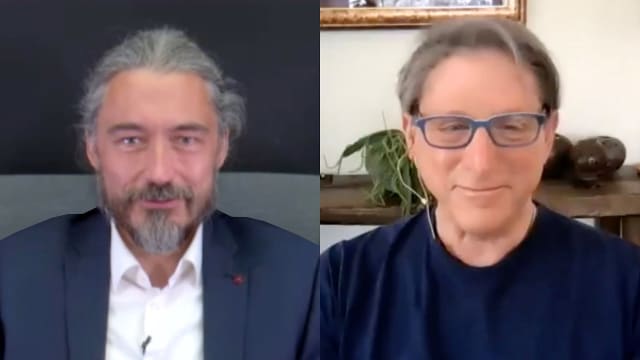
Transcript
[0:01] So, yeah, welcome again. We've heard
[0:04] from many healing practitioners seeking
[0:06] to refine their attunement to clients
[0:08] and more deeply understand the
[0:11] individual, ancestral, and collective
[0:13] dimensions of trauma healing as we
[0:15] navigate these increasingly complex
[0:17] times alongside our clients.
[0:20] That's why we're really excited to
[0:21] announce at Thomas Hübl's new 5-month
[0:23] live online intensive, The Inner Science
[0:26] of Healing.
[0:27] So, we'll share more about this new
[0:29] practitioner training at the end of this
[0:31] event, but enrollment is now open. The
[0:34] course begins November 15th. If you're
[0:37] ready to learn more, you can click your
[0:38] e- check your email uh now for details
[0:41] or visit the link in the chat.
[0:43] And for any of you who are new to Thomas
[0:46] and his work, he is a renowned teacher,
[0:49] author, and international facilitator
[0:52] who has been leading large-scale events
[0:54] and courses for over 20 years on the
[0:56] healing of collective trauma.
[0:58] Thomas works within the complexity of
[1:01] systems and cultural change, integrating
[1:04] the core insights of the great wisdom
[1:05] traditions and mysticism with the
[1:07] discoveries of science.
[1:10] Welcome, Thomas.
[1:14] >> Thank you, Anna. Happy to be here with
[1:16] you.
[1:16] >> Yeah.
[1:17] >> With everybody.
[1:18] >> Yeah.
[1:20] Okay, so we're going to be getting to as
[1:21] many of your questions, everybody, as we
[1:23] can. And I'd love to start by asking
[1:26] you, Thomas, to share what it means to
[1:29] work with the energetic and spiritual
[1:31] principles of trauma healing and how
[1:33] this complements more traditional
[1:35] therapeutic models. And how can healing
[1:37] practitioners integrate these elements
[1:40] into their work with clients? Also, why
[1:42] is this so important right now as we are
[1:44] facing the challenges today?
[1:47] >> Basically, all of it at once.
[1:48] >> Yeah, [laughter]
[1:50] perfect.
[1:53] >> Um so, yes. So, let's start. Um
[1:57] first of all, I think that um
[2:00] you know, there are thousands of years
[2:02] of wisdom traditions or healing
[2:05] traditions that precede our time and
[2:09] that that are living within us. And of
[2:11] course, we find a specific expression, a
[2:14] scientific expression. But many of the
[2:17] things that we are thinking, somebody
[2:19] thought already about. Uh, and so we are
[2:23] like on the
[2:25] sitting on the shoulders of the giant.
[2:27] And that's always like a lovely humility
[2:30] to bring. And that a lot of a lot of
[2:33] people around the world that felt like a
[2:36] similar calling
[2:38] as we do.
[2:40] Everybody who feels drawn to healing,
[2:43] feels drawn to therapy and coaching and
[2:46] facilitation and conflict resolution
[2:49] like feels something. We do this because
[2:51] we are passionate about it, not because
[2:53] we have to.
[2:54] We do it because we we feel Yeah,
[2:58] healing healing is deeply
[3:01] infused
[3:03] into like into our soul.
[3:06] And that calling, I think is so
[3:08] beautiful. There's some something very
[3:11] elegant. Every time I talk about this,
[3:13] like I feel so passionate about the
[3:15] what deeply calls us into into this kind
[3:19] of
[3:20] work, what however we framed it.
[3:24] And and that
[3:26] that calling, I think gives us on the
[3:29] one hand the possibility to develop
[3:31] skills and you know, learn, study, have
[3:35] knowledge and develop skills, how to
[3:38] apply those in different techniques and
[3:40] methods and therapy methods.
[3:43] But it also calls us to live it.
[3:46] It's not enough just to to have the
[3:49] skills because what we're looking at is
[3:52] how we become the wholeness
[3:56] how we become whole
[3:58] to host fragmentation.
[4:02] And that that capacity to become more
[4:05] whole
[4:06] is that our own healing and our own
[4:08] calling
[4:11] constantly asks us to develop.
[4:14] And that development is trustworthy.
[4:17] And we see that development in our own
[4:19] personal lives, obviously, but it's
[4:22] being accelerated by the professional
[4:25] life that we all live. And all the
[4:27] issues that show up, all the challenges,
[4:29] all the difficulties we experience, if
[4:31] we see those as teachers, so we more and
[4:34] more develop wholeness that gives more
[4:37] and more people the chance to
[4:40] be hosted in their fragmentation.
[4:44] And that's that principle of
[4:45] interdependence, I think, is so
[4:47] important in any kind of healing work.
[4:51] And that's what I'm very interested in.
[4:54] So, it's the calling, it's the training
[4:56] and integration work because we need
[4:58] training, refine our skills, and we need
[5:01] to integrate our energy because that's
[5:03] where we hit difficulties in ourselves,
[5:05] our own trauma history, our own
[5:07] ancestral trauma history, the cultural
[5:11] conditioning [snorts] that we are part
[5:12] of. All of that shows up sometimes as
[5:15] limitations.
[5:17] And when we take that seriously and we
[5:20] work it, so we continuously expand and
[5:23] refine our energy.
[5:25] And that is, I think, the beauty of
[5:28] learning a method
[5:30] crystallizing it
[5:32] becoming like a mentor and eventually
[5:36] becoming an elder
[5:38] in society, like a wisdom keeper.
[5:41] And that that journey, I think, is is
[5:44] within the the calling, the archetypal
[5:47] path of a of a healer. And I think
[5:50] that's that's very very powerful. And
[5:52] this And the second thing is that
[5:55] I think we see more and more how
[5:58] refining our own
[6:01] inner experience and our own awareness
[6:04] is the way how we meet our client more
[6:07] and more specifically or more and more
[6:10] attuned.
[6:12] And with the higher fluidity in our own
[6:16] relational capacity. And that is true
[6:18] for the individual development of our
[6:20] clients, but it's also true in the
[6:22] ancestral develop intergenerational
[6:25] development of our clients, so where our
[6:27] clients come from. The systemic
[6:30] dimension and of course the collective.
[6:33] So what we also do is like how how we
[6:35] open the map
[6:37] that nested
[6:39] systems like an individual
[6:42] in an ancestral
[6:44] system in a collective system.
[6:46] And that that I find that in in our
[6:48] trainings and deeper training programs
[6:50] deeply healing when we can open up that
[6:53] map and and have more
[6:56] more information available for any level
[7:00] here that we address.
[7:03] So yeah, so that's maybe we zoom in more
[7:05] specifically, but for the beginning
[7:10] maybe we we zoom in
[7:13] with different questions into some of
[7:15] these aspects.
[7:22] >> Great. Thank you, Thomas.
[7:25] Um
[7:26] So yeah, we can start with some
[7:29] questions and maybe
[7:31] even if you can speak a little bit more
[7:33] to this eco-systemic
[7:36] um aspect of healing
[7:38] and what what you mean by that and how
[7:42] we start to work with that and attune
[7:44] with that.
[7:45] >> Mhm.
[7:47] So,
[7:48] let's say
[7:50] like
[7:51] individual development looks like, okay,
[7:54] this is the person that shows up in our
[7:56] group, so it shows up in the office of
[7:58] the therapist,
[7:59] and and all the internal unintegrated
[8:02] processes seem like in the person. But,
[8:05] in a way, those unintegrated aspects is
[8:08] like in a jigsaw puzzle. If you take
[8:10] take it from the original jigsaw puzzle,
[8:13] the big puzzle, you take one puzzle
[8:15] piece, in the puzzle it makes complete
[8:17] sense. It fits
[8:20] completely. That's why we call it any
[8:22] defense mechanism is a
[8:25] is an ecosystemic necessity
[8:29] in the system of origin, the family of
[8:31] origin, for example.
[8:33] But, if you take that jigsaw puzzle and
[8:35] you put it into complete in a different
[8:38] puzzle, which is our life today or us as
[8:41] a
[8:43] in our business or in our family, so
[8:46] then it certain things look strange
[8:48] because they don't fit.
[8:50] And so,
[8:51] our attunement
[8:53] as professionals, how to hold our
[8:57] clients not only as a person, but be
[9:00] ecosystemically attuned, which is
[9:02] different from understanding the
[9:04] ecosystem intellectually.
[9:06] So, there's an intellectual attunement,
[9:09] but then there's an emotional, the
[9:10] physical, the systemic attunement to the
[9:13] ecosystem.
[9:15] I have seen as very, very powerful in
[9:18] unlocking
[9:20] certain stagnations or what's perceived
[9:23] as stagnations or blocks,
[9:26] and it helps us to beautifully reframe
[9:31] instead of pathologizing those
[9:33] mechanisms to reframe those as
[9:36] ecosystemic intelligence where we come
[9:38] from cuz in that system that defense was
[9:41] absolutely necessary.
[9:44] Or the highest possibility we could
[9:46] could implement.
[9:48] But of course when we go into our life
[9:50] today as grown-ups it's it creates all
[9:52] kinds of symptoms.
[9:54] And so that that we that the tune and
[9:57] this to our clients and to developmental
[10:00] processes in our clients.
[10:03] And it's and that's more than
[10:05] coregulation.
[10:07] Cuz some people understand attunement as
[10:10] coregulation. So when somebody is
[10:11] stressed and expresses
[10:15] fight, flight, freeze symptoms that
[10:17] attunement helps us to down regulate
[10:20] that stress. So that is attunement, but
[10:23] we are also speaking about developmental
[10:25] attunement. So like different age levels
[10:29] and how our nervous system is like an
[10:31] instrument and can ping different levels
[10:34] of development of our clients. So I I
[10:37] I relate to the person
[10:40] and to the specificity of their process
[10:42] that creates the symptoms.
[10:44] And on the other hand of course when we
[10:46] begin to hold energetically the family
[10:50] system or whatever was the
[10:53] the system of origin where those
[10:55] mechanisms arose or the ancestral system
[10:59] then it's much easier to work with those
[11:01] mechanisms in the person today. They get
[11:04] much more or much easier unlocked.
[11:08] And and that I think is a very powerful
[11:11] display
[11:13] where we transcend the trauma symptoms
[11:15] of sep- separation
[11:19] like that an individual is not separate,
[11:21] but an individual is always
[11:23] interdependent with within its
[11:25] ecosystem.
[11:27] And I think that it allows us much more
[11:30] space, much more data that's included in
[11:33] the process work. It but it's something
[11:35] we need to train because it doesn't just
[11:39] or not always come easy.
[11:42] Uh so it we need to train it so that our
[11:45] nervous system is also trained and
[11:48] integrated enough to be precisely
[11:51] attuned because otherwise we imagine
[11:54] things, we project things, we like we So
[11:57] we need to
[11:58] uh practice that but I think that goes a
[12:01] long way. And the same is for a tune
[12:03] when we facilitate groups for everybody
[12:05] who works with groups or teams or
[12:08] even conflict resolution, how
[12:11] much space we can provide and how
[12:13] attuned we are to what's in the room
[12:16] helps to create a bigger space.
[12:19] And we all know that
[12:22] real witnessing, energetic witnessing,
[12:24] not disconnected intellectual listening,
[12:28] but real attuned witnessing is the most
[12:32] subtle form of intervention.
[12:35] And I believe that witnessing goes
[12:37] through space and time.
[12:40] So it transcends like our current notion
[12:43] of space-time
[12:44] and hence it it helps us to integrate
[12:49] what we call the past
[12:51] uh
[12:52] in a much stronger way.
[12:55] So yeah, so that is all exciting.
[12:57] And that is I think a confluence of
[13:01] what science comes up with more and more
[13:03] through neuroscience and trauma science
[13:06] and quantum mechanics and how how the
[13:09] wisdom traditions approach this.
[13:12] There's an ancient language for these
[13:13] things and there's a modern language and
[13:16] then there is a negotiation between
[13:18] those.
[13:20] Yeah, so that's what's what we mean with
[13:23] ecosystemic attunement.
[13:25] And of course our spiritual practice as
[13:28] practitioners, I think is also very
[13:30] important because if spirituality is not
[13:32] used as a bypass,
[13:35] then
[13:36] mindfulness practices, embodiment
[13:38] practices, deeper deeper alignment
[13:41] practices in the practitioner
[13:44] are very powerful resources that we can
[13:47] provide to our clients. And
[13:50] we are also more attuned to these
[13:53] aspects in our clients.
[13:55] And uh so the spiritual practice holds a
[13:58] lot of resourcing
[14:01] and also clarity and capabilities to
[14:05] clarify our own process and also to
[14:09] contemplate our clients or groups in a
[14:12] different way. So it creates more
[14:14] clarity.
[14:15] When something is unclear, there are
[14:17] many tools how to clarify that
[14:20] unclearity
[14:21] in ourselves, with others, with peers,
[14:23] with supervisors, of course.
[14:25] And our spiritual practice, I think is a
[14:27] powerful is a powerful um
[14:31] resource to because we want to do this
[14:35] work
[14:37] as long as we feel passionate about it.
[14:39] And if that's for decades, we want to
[14:41] feel refreshed.
[14:43] We want to feel that um
[14:46] we grow constantly through our client
[14:50] work. We become wiser. Hence, it's
[14:53] actually more and more easy
[14:55] even though
[14:57] the times seem to be more and more
[14:59] complex.
[15:01] So it's it's less of a
[15:04] a drain or an effort and it's becomes
[15:07] easier and easier. It flows more through
[15:09] us.
[15:10] And I think that also increases our
[15:12] impact on
[15:14] clients or groups or systems.
[15:20] >> Yeah, this is great, Thomas. I I kind of
[15:23] want to highlight some of what you're
[15:25] saying again and um that like through
[15:28] our through our spiritual practice,
[15:30] through our integration work, when we
[15:32] have more space inside, when we sit with
[15:34] somebody,
[15:35] and then we learn through training it to
[15:38] really sense what's the intelligence in
[15:40] what they're doing. We start to see,
[15:42] "Ah, this is intelligent in some
[15:44] ecosystem." And we start to actually not
[15:46] think about, but really feel the
[15:48] environment around them or
[15:51] many layers of that. You might just
[15:52] notice, "Oh, like my client doesn't
[15:55] really share emotional information
[15:57] much." And then you start to sense, "Oh,
[15:59] there wasn't that exchange in their
[16:01] family."
[16:02] Or it was a cold you feel I was a kind
[16:04] of cold environment and they're alone,
[16:06] right? And then you become
[16:08] a bit of the ecosystemic remedy today
[16:11] for that part. And that deep attunement,
[16:13] I love what you say that we can witness
[16:15] across space and time.
[16:17] And that through really practicing this,
[16:19] we can really support the client. Also
[16:21] not to go into their head and like, "Oh,
[16:23] I know you're here with me." Yes, but
[16:25] they can't feel it at that part. And so
[16:27] this this real deep practice of bringing
[16:30] awareness and a warm environment, for
[16:32] example, where there never was one. And
[16:34] that then their system
[16:36] can start to take another step cuz it
[16:38] starts to recognize, "Ah, somebody is
[16:40] finally here in this young part." And so
[16:42] I just wanted to highlight the beauty of
[16:44] also this ecosystemic sensing, which I
[16:46] think does take training. And that we
[16:49] can get more deeply into this in the
[16:51] course as well. It's a it's like a
[16:52] different way of attuning and sensing
[16:54] the environment and and the relief of I
[16:57] I don't need to get my client anywhere.
[16:59] We're not going somewhere. I'm with the
[17:01] intelligence in their system, which will
[17:03] continue to operate. And it will operate
[17:06] in this moment when the system senses
[17:08] something new is happening. So I just
[17:10] want to add
[17:11] >> That's beautiful. Yeah, and what you
[17:12] just said is not us us having the
[17:16] like where we
[17:18] the end point in mind, but really being
[17:21] able to listen to the unfolding
[17:25] of the original intelligence. And that
[17:27] is a skill, like to really be dialed
[17:30] into like our clients' intelligence and
[17:33] see how
[17:35] by bringing more attention to the
[17:37] inhibitions of the development, like how
[17:40] the
[17:41] the the intelligence is unfolding by
[17:43] itself.
[17:45] And
[17:46] I think
[17:48] many people know this phenomenon that
[17:52] um
[17:54] that sometimes we spontaneously say
[17:57] something, or suddenly we have an
[17:59] insight and we say it, and then we see,
[18:01] well, that really touches the point. And
[18:04] it was not just a premeditated
[18:06] or knowing, I read this in a book and
[18:09] now I'm bringing it into the session.
[18:11] It's like suddenly you know something,
[18:15] and when you say it, it's it kind of
[18:18] meets exactly what's happening right
[18:20] now. And that openness is is a spiritual
[18:24] function.
[18:26] So, that's part of of our own inner
[18:28] alignment, and we can train that to
[18:31] happen more and more often because we
[18:34] allow, we open ourselves up to this
[18:38] inner stream of knowing.
[18:40] And that's that's different to
[18:42] what I imagine, like there's imagination
[18:45] and there's alignment.
[18:47] Imagination is what I might project
[18:49] outwards, but
[18:51] um this alignment is connected to the
[18:54] current flow of the process.
[18:57] And I think that's also So, there's the
[18:59] space, there's the presencing, there is
[19:02] this like a much deeper regulation of
[19:04] our own nervous system as facilitators
[19:07] that invites our clients into a deeper
[19:11] regulation capacity, but then there is
[19:14] um
[19:15] this kind of
[19:16] deeper attuned knowing
[19:19] and sensing and seeing that then becomes
[19:22] like um
[19:23] a more and more available function. From
[19:26] it happening from time to time, it
[19:28] actually becomes like a stream.
[19:31] And that like a stream of consciousness.
[19:33] And I think that's a very powerful
[19:35] function that the wisdom traditions talk
[19:37] a lot about.
[19:38] >> Mhm.
[19:40] There's actually Thomas a question that
[19:42] came in that's very related to this from
[19:44] the um
[19:46] Someone asked when we when we sense
[19:47] something in a client before they can
[19:49] name it, before they are aware and can
[19:52] name it, how do we discern whether that
[19:54] knowing comes from this attunement to
[19:56] their individual ancestral or collective
[19:58] experience or from our own spiritual
[20:01] attunement as you're saying our channel
[20:03] or it's inherited memory or projection
[20:05] in us. And how can we offer what we
[20:07] sense without making our spiritual
[20:09] knowing more authoritative than the
[20:11] client's own truth?
[20:13] >> Yeah, that's
[20:15] I think that's a fine point because
[20:18] first of all
[20:19] for many of us it also it it is like a
[20:22] training and it also needs even if we
[20:25] work professionally already for some
[20:27] years, like it's good to have this for
[20:29] this kind of attunement work practice
[20:32] circles with like-minded people where we
[20:35] can train this
[20:37] and and experiment with it and get
[20:40] reflections
[20:41] so that we can learn that. So on the one
[20:44] hand because we need to develop a sense
[20:47] there is a sense when we feel it comes
[20:50] from from this core and there's a
[20:52] different sense when we start to
[20:55] interpret,
[20:57] to imagine and also get get triggered in
[21:01] subtle ways so that we begin to project
[21:03] our own information onto our clients.
[21:07] And so there there inner states when we
[21:09] know oh when I am in this inner state
[21:12] the likelihood that it's it's my own
[21:14] projection is very low.
[21:17] And that I notice when I get triggered I
[21:19] realize this and and I take this in
[21:22] account responsibly in in my client
[21:25] interactions.
[21:26] Or as a group facilitator. And if
[21:29] but there are there is a sense when when
[21:33] we feel there is this kind of inner
[21:35] freedom and this inner spaciousness or
[21:37] presence where information is is just
[21:41] arising and it doesn't have a pressure
[21:43] it doesn't have a it doesn't have
[21:45] certain qualities that show us
[21:48] So that's the on the one hand.
[21:49] Even though we
[21:52] know certain things doesn't mean we
[21:55] always
[21:56] have to say it.
[21:58] You know it's like it's like I can know
[22:00] things or I can see things and then
[22:03] through articulate or skillful questions
[22:06] like see if if that knowing arises by
[22:09] itself.
[22:11] But sometimes it's also important to
[22:13] bring that information in and that is
[22:15] that is determined by the relationship.
[22:18] That isn't there's not a rule here you
[22:20] do it like this and here you do it like
[22:22] that there is like um
[22:24] the relationship determines what's
[22:26] actually needed.
[22:28] And and the the state of the process
[22:30] determines that.
[22:32] And so I think
[22:34] uh
[22:35] that is a very complex question but it's
[22:37] a very interesting question and I and I
[22:40] think we're all here to refine this more
[22:42] and more and more and to be able to
[22:44] notice
[22:46] when we hit something in ourselves that
[22:49] then becomes like is a filter between us
[22:52] and our clients or the groups or when
[22:54] there is this
[22:56] attunement. And the second part is that
[22:59] often like what we observe very often is
[23:01] that there is a certain level of
[23:04] achievement. They often say it's like
[23:05] you take your USB plug and you put it
[23:08] into the USB port of your client. Then
[23:10] you perceive information, but then you
[23:13] unplug it, you take it back into your
[23:15] own hard disk, and then you interpret it
[23:18] somehow.
[23:19] But that's different from streaming.
[23:22] And
[23:23] real relational connection is like a
[23:26] streaming.
[23:30] And whenever trauma comes into play, we
[23:32] see how the relational space becomes
[23:35] fragmented or limited.
[23:38] And so, even if that happens from a
[23:41] client, if if the streaming ability is
[23:44] there is open to host this,
[23:46] then
[23:47] it's it's wonderful. But if we get
[23:49] subtly triggered
[23:51] by by that, then we need to look at
[23:53] ourselves. And that's also because there
[23:55] are other questions that came in is
[23:58] about this
[23:59] notion of taking on
[24:02] other people's energy.
[24:04] And I think this is really something to
[24:07] look at because
[24:09] I don't think we are taking on other
[24:11] people's energy.
[24:13] I think like often
[24:15] other people's process
[24:18] has a resonance in our own process. And
[24:22] when we walk away
[24:24] from that session or group session, then
[24:27] we feel like a residue
[24:29] in in in us.
[24:32] But it's not that we took on the energy
[24:34] of another person. That's That we we are
[24:37] not fully aware of how that resonance
[24:39] also lives in us.
[24:41] And I think this is difficult because
[24:43] sometimes people try to constantly clean
[24:45] themselves from the energy of the
[24:46] client, but that stays like a perpetual
[24:49] process.
[24:50] Instead of integrating,
[24:52] looking what do I need, sitting with
[24:54] myself, clarifying this, journaling,
[24:57] having peer-to-peer conversations,
[25:00] having a supervision, what helps me to
[25:03] integrate that part of myself so that my
[25:06] energy continuously grows and those
[25:09] phenomenas
[25:11] subside at least on that level.
[25:16] Because then it might be that on a
[25:17] larger level like in ancestral systems
[25:20] or in the collective systems if you work
[25:23] with collective I don't know, the
[25:25] colonial wounds, racism, gender
[25:28] violence. Like they're big big
[25:30] collective
[25:32] uh wounds around the world that that
[25:36] many of us share. So, our own
[25:39] clearing process in our own
[25:42] uh life information of course will bring
[25:46] up different levels of it. But if I have
[25:48] a practice how to look at this
[25:51] differently, then it's not like how do I
[25:54] protect myself from my client's energy?
[25:56] How do I integrate my own energy so that
[25:59] I can be more and more related without
[26:01] feeling any side effects
[26:05] in in the process. And I think that
[26:07] that's an important reframing
[26:09] because otherwise we stay often in this
[26:13] what I think not very helpful
[26:16] framing of taking on energy and that I
[26:21] need to protect myself against something
[26:22] that comes from the outside.
[26:25] So, I think that's a that's a very
[26:27] important question, too.
[26:30] And and it's beautiful because like this
[26:32] we just grow and then these things have
[26:33] less and less impact. It's it we feel
[26:36] more and more free and we don't take
[26:39] uh
[26:40] stuff with us.
[26:42] Yeah.
[26:45] >> Yeah, this is a really important topic
[26:47] as well. And just on that, maybe you
[26:49] could speak a little bit. We have many
[26:50] other questions, but this with our
[26:53] energy being more and more free, I how
[26:55] our energy becomes in a way bigger or to
[26:59] how we bring wholeness to fragmentation.
[27:02] You mentioned that in your beginning
[27:04] talk, but what is this process of
[27:06] becoming bigger and bringing wholeness
[27:09] to the fragmented parts? You're
[27:10] beginning to mention a way in which that
[27:12] can happen that we become the ecosystem
[27:15] that can hold the fragmentation. But can
[27:17] you say a bit more about that?
[27:19] >> Yeah, on the one hand like
[27:21] if and like if you take this title of
[27:24] healer, that speaks for many
[27:26] professions. They're like when when we
[27:28] interact with client or patients or
[27:30] groups or systems like in the healing
[27:33] because we actually the beauty I think
[27:36] the beauty is
[27:38] that this calling
[27:40] is also
[27:43] us being part of the self-healing
[27:46] mechanism
[27:48] of life.
[27:49] Everybody who feels a calling to
[27:53] to healing
[27:56] is part of the self-healing mechanism of
[27:58] life
[27:59] or the divine principle of grace.
[28:03] It's grace.
[28:04] And there's a beauty to it. Like there's
[28:06] like a very touching
[28:09] quality to
[28:12] to the humility to walk the path of
[28:15] healing
[28:17] and and and be part of how the living
[28:21] system wants to heal itself.
[28:25] And so everybody who develops skills in
[28:28] that direction is part of the conduit
[28:31] for that to happen. And I think that's
[28:33] super elegant. So we are like if we come
[28:37] into life with that intelligence, then
[28:39] we carry
[28:41] that part and our life becomes an
[28:43] expression of healing, self-healing of
[28:45] this entire living system. And we do it
[28:48] in a certain way, but we all contribute
[28:51] in a way for to the system's growth. Um
[28:55] And so,
[28:57] with it comes that in our own private
[29:00] life, of course, in our own
[29:02] relationships with our children, with
[29:04] our
[29:05] with our personal dimension, and
[29:07] in our professional dimension, so we
[29:10] reach a certain level that we can
[29:11] provide that professional space.
[29:15] But still, many of our clients will play
[29:17] back
[29:18] aspects
[29:20] that help us to to see ourselves more
[29:22] clearly and to grow. So, we grow
[29:25] privately, we grow professionally, and
[29:28] we mature
[29:30] in our own information, and the more we
[29:33] mature, the more different types of
[29:36] clients or patients we can host
[29:39] in a fluid way.
[29:41] And so, in a way, we become wiser
[29:46] as we go along
[29:48] because more of the world can mirror
[29:50] itself through us or in us.
[29:53] And that that is very beautiful. So,
[29:55] there is an energetic flow
[29:57] because we feel it when we are in a
[29:58] situation, let's say we we facilitate a
[30:01] group process and something feels a bit
[30:03] challenging, then we feel a great
[30:05] stress, so we know, "Oh,
[30:07] there's a point for me to look at." If I
[30:09] look at it and open it,
[30:11] I I upgrade my internal operating
[30:15] system, which
[30:17] is responsible because I'm not
[30:19] recreating the same thing again.
[30:22] And so, I really live then
[30:27] what
[30:29] is in the work with my clients
[30:32] as well.
[30:35] So, it's not just
[30:36] what I'm saying is like that inner
[30:38] maturation
[30:40] is also the work. It's not
[30:43] also there like I do the work and also
[30:46] I'm developing. No,
[30:48] my own development makes my words
[30:50] credible.
[30:53] Because that is in every word that I
[30:55] speak, my whole development is part of
[30:58] it.
[30:59] And so when I talk to my clients about
[31:01] development or growth or integration or
[31:04] healing,
[31:06] then my life is the same. So, the word
[31:09] and my life is one. It's authentic.
[31:14] And and that is I think what that is
[31:18] what really does the work.
[31:20] Is is that unification inside or that
[31:22] alignment.
[31:24] And I think many people are looking for
[31:27] a disalignment.
[31:30] Consciously or unconsciously, we are
[31:32] looking for this wholeness.
[31:35] And and so so that I think that is
[31:38] really beautiful and how that helps our
[31:41] clients to grow, but it also helps us to
[31:44] grow. And if we can
[31:46] see that with humility, then then it's
[31:49] just a beautiful
[31:51] that path is really beautiful.
[31:58] >> That's good. There's so many great
[32:00] questions coming in related to all of
[32:02] this too. And maybe just a little bit
[32:04] more on Gabriella says, "Dear Thomas, a
[32:07] question that sometimes pops up in my
[32:09] mind is how can I host a space for the
[32:11] fragmentation of my clients if I still
[32:14] experience fragmentation in myself? I'm
[32:17] curious on your perspective on that."
[32:19] And I just like to add one other note
[32:21] also to what you were just saying when
[32:23] you say my own development makes my
[32:25] words credible.
[32:27] Um
[32:28] just
[32:29] that that's a developmental process and
[32:31] also a spiritual process. And maybe just
[32:34] >> Mhm.
[32:35] >> to speak to that also and then this how
[32:37] do I host space for fragmentation if I
[32:39] still experience it myself. Yeah.
[32:41] >> Yeah, that's beautiful because it's it's
[32:44] we are not looking for perfection.
[32:48] We are looking for the authenticity that
[32:50] of course all of us carry some level of
[32:54] inner fragmentation or shadow inside.
[32:57] And
[32:58] and from a certain level of maturity
[33:02] we can provide a space for others like
[33:05] to professional work.
[33:07] And at the same time, the work's always
[33:10] going to complete us, too.
[33:12] Complete us means show us more and more
[33:16] and more of our own work. So, step by
[33:18] step we also become more whole.
[33:22] And so, from the moment that we can that
[33:25] we are more aware of our inner
[33:26] fragmentation and that we are committed
[33:29] to the inner work that's needed to
[33:33] continuously grow
[33:35] it's being held in responsibility.
[33:38] Responsible means that I'm able to
[33:41] respond to that situation. So, when in a
[33:44] client situation there is like some
[33:46] stagnation showing up and I take this
[33:49] into a peer-to-peer or the supervising
[33:52] like a supervision session, then I'm
[33:55] responsible because I create the biggest
[33:57] space around
[33:59] that which
[34:01] is entangled.
[34:04] And when that entanglement gets
[34:06] resolved, both the profession, whatever
[34:09] therapist or coach, whatever
[34:11] facilitator, plus the clients or the
[34:13] groups are growing.
[34:15] And if I'm committed and I create myself
[34:17] in my life that system, then of course I
[34:20] will meet my own inner fragmentation
[34:23] along the way because we all carry that
[34:25] inside. That's human. That's part of the
[34:28] birth information we got
[34:30] and our development.
[34:32] and
[34:33] we role model
[34:36] how we live it.
[34:38] And I believe that role modeling is what
[34:41] our clients need to see.
[34:44] That is like it gives us oh
[34:47] it's possible.
[34:50] The impossibility because often where
[34:52] trauma resides, things look impossible.
[34:55] I can't
[34:56] I can't do this.
[34:58] I can't change this. This is
[35:01] kind of carved out of stone in my life.
[35:04] And then
[35:05] I see this
[35:08] possibility
[35:11] in front of me. I see it's possible. And
[35:13] that strengthens the agency
[35:17] of the client as well.
[35:19] So, I think the transmission
[35:22] like the living transmission of
[35:25] being able to do this work and show it
[35:27] works
[35:29] through just our presence in the room.
[35:32] But because we do all this work, that
[35:34] presence sits in the room with our
[35:36] clients. And that transmits a message.
[35:40] It's not just we're not just talking
[35:41] about developing but not developing. We
[35:43] are
[35:44] we are developing.
[35:45] And especially in this time that's why
[35:48] we thought okay
[35:50] this is a time that becomes more and
[35:52] more complex. So, actually the
[35:55] acceleration, the data acceleration in
[35:58] the world needs us
[36:01] to digest more information.
[36:04] This is the time.
[36:06] The complexity of the meta crisis or
[36:09] whatever we want to call it and the data
[36:11] acceleration, AI there's so there's so
[36:14] much happening in our nervous systems
[36:16] that brings up a lot of stuff.
[36:19] The climate crisis, the the biosphere,
[36:22] the data acceleration, so many things
[36:24] are coming up. So much systemic pressure
[36:27] is is bringing up the traumas that
[36:30] reside deep inside of us individually,
[36:32] ancestrally, collectively.
[36:36] And so,
[36:37] we need that function
[36:40] to grow.
[36:42] And then, as we digest the stuff that is
[36:45] coming up, we actually stay up-to-date.
[36:48] If not, we become old.
[36:51] Not integrating the stuff that comes up
[36:54] is is aging.
[36:57] And integrating the stuff that comes up
[36:59] is rejuvination. We stay up-to-date. We
[37:01] stay fresh. Our browser stays fresh.
[37:05] Our nervous system stays updated.
[37:08] And I believe when our nervous systems
[37:10] stay updated, even in the strong
[37:13] acceleration of data,
[37:16] then the rest of our cells in the body
[37:18] also stays more updated.
[37:21] And the parts that are not updating
[37:22] themselves, they they become old.
[37:26] And then we see the effects in our
[37:29] system, in mental health, in physical
[37:31] health, in in in environmental health.
[37:35] We see it. So, I think this is
[37:39] this is what this especially this time
[37:41] asks of us, and that's why the
[37:43] archetypal path of the healer is even
[37:45] more important because these are the
[37:47] people This is the part of the
[37:49] population that most probably has the
[37:52] highest skill level to do that
[37:54] transformation.
[37:56] In ourselves, but with all the people
[37:58] that we touch.
[38:00] And so, I think this is this is actually
[38:03] a very strong calling in this moment,
[38:06] especially in this moment of
[38:07] uncertainty, in this moment of so many
[38:11] also collective
[38:12] collective and individual identity
[38:14] structures that are
[38:17] being deconstructed,
[38:19] um
[38:20] that presence is so valuable.
[38:26] >> Yes, great. Um, there's so many
[38:29] practitioners with great questions on
[38:31] this call. I'm pretty excited about it.
[38:32] Let's see if we can get to a couple
[38:34] more. Inga, you've been speaking a
[38:36] little bit to this, but there's a number
[38:38] of questions coming in about discernment
[38:40] as a practitioner. And Inga brings a
[38:42] question. Thomas, you mentioned that
[38:44] with practice we can recognize an inner
[38:46] state in which projection is very
[38:48] unlikely. How can we actually verify
[38:51] that what we sense about a client is
[38:53] accurate rather than simply feeling
[38:54] certain about it? And how do we ensure
[38:56] that the client's own experience remains
[38:59] the primary authority? And we've seen
[39:00] this versions of this question in many
[39:02] questions like how am I
[39:04] letting the client lead in a way and
[39:06] also discerning the information inside?
[39:11] >> Yeah, it's
[39:12] First of all, in many ways, even if we
[39:15] sense a lot,
[39:17] like it refines our capacity to ask
[39:24] certain questions in a more refined way.
[39:27] So, it's not just about telling people
[39:30] stuff. It's about being more dialed in
[39:35] to
[39:37] ask certain questions in a way that the
[39:40] information can emerge. So, that's one
[39:43] thing. The other thing is it's also that
[39:45] the attunement itself,
[39:48] more precise attunement, offers our
[39:51] client's nervous system a more precise
[39:56] relationship.
[39:58] It's like when you listen to music and
[40:01] the music is kind of a bit fuzzy
[40:05] or hazy
[40:07] or there's a more precise tune.
[40:11] And so,
[40:12] relating to the person as a whole is of
[40:17] course the main relationship, but then
[40:19] being dialed into the parts of our
[40:21] clients where the process is really
[40:23] happening, not just the symptom but the
[40:25] process,
[40:26] that offers a specific relationship. And
[40:29] in that part usually our clients didn't
[40:31] experience specificity.
[40:34] Because their original ecosystem wasn't
[40:36] able to do that. So,
[40:38] if we provide that even without saying
[40:41] anything,
[40:43] just the energetic, the nervous system
[40:45] to nervous system
[40:47] ping, sting, dong, ding, dong. The
[40:50] relational dimension that was absent or
[40:54] was confusing or hurtful
[40:57] is being
[40:59] kind of remodeled through precision.
[41:03] And most of the people in that person's
[41:05] life most probably are not able to do
[41:07] that. And when that happens, it
[41:10] maybe takes a little bit of time, but
[41:12] then it's being recognized as
[41:14] specificity that's why I often say
[41:16] specificity is love.
[41:18] Generalization
[41:21] is not
[41:22] so loving.
[41:24] Cuz it's general, but
[41:25] specifically addressing the person in
[41:28] what is really the need is very loving.
[41:32] Same as if somebody embraces the child
[41:35] that needs now something specific and
[41:38] there's love and care and safety and
[41:41] nourishment,
[41:42] that's loving.
[41:44] And so, often we provide that in a
[41:48] specific way
[41:51] without just telling the client
[41:53] information, that the attunement
[41:57] allows the client to touch deep up to
[41:59] turn on their internal awareness of
[42:03] parts of themselves
[42:05] in by re-owning the part because there
[42:08] is the specificity of the relationship.
[42:11] There's a deeper seeing.
[42:14] And And I simply have seen so many
[42:16] people that just
[42:18] by feeling seen and felt specifically,
[42:23] something opens up by itself. There
[42:26] wasn't even the need to say what I or we
[42:30] see or feel. It It just happens through
[42:33] the specificity. Sometimes it's needed,
[42:36] but it's always the authority, the
[42:39] internal
[42:41] energetics, the core energy of the
[42:42] client that that drives the process.
[42:46] And um
[42:47] And the other part is also
[42:49] the ability to see and feel
[42:53] like how the information of our words
[42:56] land in the relational
[42:59] uh system between us and our clients, us
[43:02] and the group. So, what's really being
[43:04] heard,
[43:05] what hits a defense, what gets rejected.
[43:07] Like Like to
[43:09] this sensitivity to see how deeply
[43:11] information goes in
[43:13] or where it gets blocked. And where it's
[43:15] blocked, the path of life
[43:18] cannot be changed because the feedback
[43:21] of life cannot cannot enter the core
[43:23] stream and lead to like a course
[43:27] correction.
[43:29] And so, that that mechanism is also
[43:32] um
[43:33] very important. And of course, there's
[43:35] so much more, but these are just a few
[43:37] aspects of the
[43:39] of the attunement
[43:42] capabilities.
[43:44] >> And yes, this is so exciting. There's so
[43:47] many more questions that can come from
[43:49] this as well.
[43:50] And um yeah, and just appreciating
[43:52] appreciating also how you've always
[43:54] shared that, you know, we're in an
[43:55] acceleration, we're an ecosystem with
[43:57] the client, and we're surfacing if if
[44:00] Yeah, we're just surfacing the
[44:01] intelligence in the system that we offer
[44:04] it as a possibility, not attached to
[44:06] being right. I think that's interesting
[44:08] when this question comes up like how
[44:10] does the client be remain the authority
[44:12] that we can also check in ourselves if
[44:14] it's an open process. And that relates
[44:17] to one more question. There's very many
[44:19] good ones over coming towards the end
[44:21] here. So maybe just briefly you could
[44:23] answer Veronica is talking about
[44:25] struggling with this sense of
[44:27] responsibility of needing to make
[44:28] something happen for the client. And I'm
[44:31] and she says I'm aware that that gets in
[44:33] the way of me being fully present. I go
[44:35] into my head instead of trusting the
[44:37] process and the client and his or her
[44:39] inner wisdom and healing capacity. And
[44:41] do you have any suggestions for this?
[44:44] >> Yeah, that is beautiful. Like that
[44:47] because all these questions are so
[44:49] important and I think we also need
[44:51] spaces where we can we can really work
[44:55] these questions because once in a
[44:57] professional role, we are often in the
[45:00] role of the one that supposed to know
[45:02] something.
[45:04] And then and then we might hold that
[45:05] back, but sit actually with the tension
[45:08] that creates. And and I think there are
[45:09] two levels. One is
[45:12] how important it is that
[45:16] I know my home.
[45:21] That my home is not defined by my work.
[45:25] That my home is clear to me.
[45:28] And by home, I mean my own individual
[45:31] home, also ancestrally where I come from
[45:34] and where I sit
[45:37] in the mother in Mother Earth.
[45:39] So it's like
[45:41] it's where is my home?
[45:44] And if my home's not fully clear,
[45:47] the
[45:49] my client work starts to serve
[45:52] something. And one expression of this is
[45:55] like a like a professional pressure to
[45:58] do it well. And that's different from
[46:01] the ethical alignment of showing up
[46:03] fully and being responsible. These are
[46:06] two different things. And one is driven
[46:09] by fear, the other one is driven
[46:12] by my integrated self.
[46:15] And so when when I notice that in
[46:17] instead of judging it, I begin to to
[46:20] look at the fears that come up because
[46:23] only because I don't know where is my
[46:26] home, which is also my life battery.
[46:30] My life battery is being charged by the
[46:33] plug-in to the to the root, to the soil.
[46:36] That charges my battery.
[46:39] And plus of course the the the the
[46:41] beauty of the relationships and the
[46:43] spiritual dimension, but there's like my
[46:46] my life battery
[46:48] is in in the groundedness
[46:51] of who I am.
[46:53] And I think we all need to see where
[46:56] this performance pressure or this fear
[46:59] or this um
[47:01] when my clients get more pressure that
[47:04] they need to develop because that says
[47:06] something about me.
[47:08] And if we can discern that and melt that
[47:11] fear,
[47:12] then it it's more and more the
[47:15] kind of the the the inner intelligence
[47:18] that wants to contribute to the growth
[47:21] of other people. But that doesn't put
[47:24] the pressure. That comes out of our
[47:26] inner flow, not out of a pressure or an
[47:29] unintegrated part in myself.
[47:32] And the second thing though is
[47:35] is like the question of time.
[47:39] How long's this going to take?
[47:42] And if
[47:43] if
[47:44] if there's a
[47:46] like or I'm still or when our clients
[47:48] say, I still have that pattern or when
[47:51] we think, oh, we still
[47:54] deal with that.
[47:56] Then we see, oh, we're actually
[47:58] disowning. What do you mean I still
[48:00] deal? Like I'm dealing with it. It's not
[48:02] that I still deal as if it was supposed
[48:05] to be over.
[48:06] It's
[48:07] This is what I'm dealing with.
[48:10] So, if I own it, then it's not still,
[48:12] it's now I'm dealing with it.
[48:15] And
[48:16] and that
[48:17] is like a symptom
[48:20] of
[48:22] that in the traumatic moment
[48:26] the next moment hope is being pushed in
[48:29] the trauma into the future.
[48:32] Because in the traumatic moment the next
[48:34] moment needs to be better than this
[48:36] moment.
[48:38] But in when the when it fixates itself,
[48:42] which I think is one of the biggest
[48:44] pandemics
[48:45] in in the world.
[48:48] That we hope for a better future instead
[48:51] of hope being in the agency to change
[48:54] the world now.
[48:57] Like the the creative impact in the
[48:59] agency
[49:01] is
[49:03] where the integrated hope lies. It's in
[49:05] the present moment, not later.
[49:07] Cuz later
[49:09] disempowers
[49:11] moment. But in the traumatic moment
[49:12] later is an absolutely important
[49:15] defense.
[49:17] And so the the
[49:20] that I
[49:23] also reflect in myself
[49:27] which parts of me
[49:29] live later.
[49:32] Because those parts unconsciously get
[49:34] entangled with my clients
[49:38] hope in the future.
[49:41] And so if when if I don't pathologize
[49:43] that, if I if I really reflect on that
[49:47] and and slowly invite the hope from the
[49:50] future back into the agency
[49:53] It communicates more and more
[49:56] we can do this.
[49:58] It's possible.
[50:00] It's possible, and it's possible here
[50:02] not later.
[50:04] And I think this is a great This is a
[50:07] great exploration
[50:09] because
[50:10] if we collectively
[50:12] because of the trauma that preexists
[50:15] even our lifetime
[50:17] grew up in a society where hope is
[50:20] later, that tomorrow is going to be the
[50:23] salvation
[50:24] then
[50:25] in the present moment we cannot take
[50:28] care of the
[50:30] challenges that we are facing. And we do
[50:32] face challenges at the moment. So
[50:35] we need that agency here.
[50:38] And so this change
[50:41] is also often part of in the hope is in
[50:44] the future that is also part of the
[50:47] pressure on our clients because we are
[50:49] unconsciously entangled with the same
[50:51] thing in our client.
[50:53] And if we open that up it
[50:58] agency is again
[51:00] hope agency in the present moment are
[51:03] not two, are not three.
[51:05] And so that's very powerful.
[51:10] >> Thank you so much, Thomas. I wish we
[51:12] could be in conversation with all the
[51:14] people listening right now, and I can
[51:16] feel the excitement of the healing
[51:18] practitioners like really in all these
[51:20] questions and the maturity of the
[51:21] questions coming in.
[51:23] So luckily we do actually have a course
[51:26] where we can be together, and thank you
[51:27] for responding to that need of so many
[51:30] healing practitioners today to deepen
[51:32] our inner work, and really learn with
[51:34] more expertise how to navigate these
[51:36] multi-dimensional layers of trauma. So
[51:39] So we have this new course, a live
[51:40] online course, The Inner Science of
[51:42] Healing. We'll come back for in a minute
[51:45] to you, Thomas, for one more question,
[51:46] but just for all of us this 5-month
[51:49] intensive begins on November 15th. It
[51:52] includes 10 live sessions, eight live
[51:55] integration sessions, live process work,
[51:59] plus access to Thomas's foundational
[52:01] teachings on the individual, ancestral,
[52:04] and collective frameworks for trauma
[52:05] healing.
[52:06] So, enrollment is going to be open for a
[52:08] limited time. So, if you feel called to
[52:10] explore this deeper architecture of
[52:12] trauma and to practice developing subtle
[52:15] perception and attunement as trainable,
[52:18] reliable skills, then we really
[52:20] encourage you to learn more and enroll.
[52:23] And yeah, I'm excited to be with you all
[52:26] in this and to really hear more of your
[52:28] questions and see how we unfold them
[52:30] over this coming time. And Thomas, if
[52:33] you maybe just want to share a bit more
[52:35] about what's different in this course
[52:38] than things that you've offered before
[52:39] and what you see will be emerging in
[52:42] this particular container.
[52:45] >> Yeah, I mean, of course, this this is
[52:47] going to be a course
[52:49] more more tailored towards
[52:53] professionals, which means we will also
[52:57] start on a different level and also
[53:00] like look at both, like what's driving
[53:03] us, what's the core intelligence, what's
[53:05] the calling, how does how do we refine
[53:08] our own inner world, and a lot about the
[53:11] client work, also a lot about
[53:13] understanding deeper from a professional
[53:15] point of view, the IAC map, why is that
[53:18] important, and how the individual and I
[53:21] stands for individual, A for ancestral,
[53:24] and C for collective, and we call it IAC
[53:28] fluidity or liquefaction.
[53:30] So, how this nested system support each
[53:34] other in the healing work. They're all
[53:36] important, but they're important in a
[53:38] certain sequencing.
[53:40] And if we take those
[53:43] in in account as a system, it's very
[53:47] powerful in the opening of of the
[53:50] healing work. And then of course, I
[53:52] think also the community like when when
[53:55] more and more as when many professionals
[53:57] come together, this is
[53:59] very strong community space, presence in
[54:02] space. We'll have life process work and
[54:04] deconstruct the life process work. We We
[54:07] will have the spiritual dimension. We'll
[54:09] bring in
[54:11] like
[54:12] a lot of ancient wisdom or healing
[54:15] knowledge from the
[54:17] wisdom traditions that I think dialogue
[54:21] with this current leading edge science
[54:25] understanding.
[54:27] And um
[54:29] And then of course, like how do we apply
[54:31] all of this in the in the work and how
[54:34] we We We will do a lot of practices also
[54:38] attunement practices in the in the big
[54:40] space. And so it's going to be a very
[54:42] practical course, but for professionals
[54:45] speaking to the perspective of people
[54:47] who work with clients, groups, conflict
[54:50] resolutions, therapy, coaching,
[54:53] group facilitation.
[54:59] >> Yeah, and yeah, it's been I think it's
[55:01] been
[55:02] almost 7 years since you've offered this
[55:04] particular type of course for healing
[55:06] practitioners. And so it seems like
[55:09] there's been so much developing in that
[55:11] time and that now and always it seems
[55:14] that when we have these courses, there's
[55:16] something that emerges newly through the
[55:19] study together also. So
[55:21] >> Yeah, and it's it's also, you know, we
[55:23] are in a specific time. We also want to
[55:25] include there is this very fast AI
[55:28] development. There are certain There are
[55:30] certain
[55:31] meta crisis aspects that I think are so
[55:34] important for our clients and our also
[55:37] what our clients are dealing with and
[55:39] the population is dealing with.
[55:42] And I think being together also in this
[55:44] specific time, what I said before about
[55:47] this increased need for this digestion
[55:51] process of the past or this integration
[55:53] process,
[55:54] um that's also very exciting for me.
[55:56] What does this mean for now? Like we're
[55:59] living in this phase now because
[56:02] we carry an intelligence that is able to
[56:04] meet it. And how do we meet the
[56:06] challenges now that we go through and
[56:08] our clients go through and the health
[56:10] care system go through. So it's also
[56:13] there's also the systemic aspect for
[56:15] people who work in systems or take more
[56:18] care of systems than
[56:20] and not just individual clients, you
[56:22] know, so it's so it there's a part for
[56:24] the process work with clients, but
[56:26] there's also a part for
[56:28] the systemic uh work and how to upgrade
[56:32] our systems as such. So it's I think
[56:34] it's um
[56:36] it's it's reflects always this
[56:39] interdependence.
[56:42] >> Yeah, I think this is a really Yeah,
[56:44] it's an amazing opportunity like you
[56:46] just said to be in the coming times
[56:48] together and to have people bring their
[56:50] live questions, what's happening and
[56:51] we're getting to discern together how
[56:54] we're upgrading, how we're learning ways
[56:57] of being with what's happening and ways
[56:59] of being with like you said individual
[57:00] clients or systems as well. So yeah, I'm
[57:04] looking really forward to being in the
[57:06] emergent process of this course and and
[57:09] also like we said really learning
[57:11] reliable skills like training like
[57:14] specific ways of training how to do
[57:16] these things cuz sometimes we hear a lot
[57:18] Oh, okay, attunement and witnessing my
[57:20] client and but what does it really mean
[57:22] to practice also the spiritual practice
[57:25] with the um
[57:27] developmental work and all of that
[57:29] bringing that together. Those are
[57:31] practicable skills that we'll get to
[57:33] work on together. So,
[57:34] anything else you'd like to share about
[57:36] that, Thomas, before we close here?
[57:38] >> Yeah, just just I think it's so exciting
[57:40] and also the time that we live in. Like
[57:42] I was just thinking about like AI and
[57:45] how how many people or clients
[57:49] use AI now for like reflections and all
[57:53] this just this the symptoms that that
[57:55] creates and I think it's really exciting
[57:58] to have this leading edge dialogue about
[58:01] how the the biosphere affects us, the
[58:03] technology affects us, the
[58:06] uh social media environment, the wars,
[58:08] the conflicts that are rising and how
[58:11] that affects our individual
[58:12] developmental work with clients and
[58:15] groups. I think that's exciting and and
[58:17] also what you just said at the end like
[58:20] how the spiritual dimension can be
[58:22] supported and is so beneficial as a
[58:25] resource and it also is often used as a
[58:28] bypass
[58:30] to
[58:31] have hope in the future
[58:33] instead of a revelation now.
[58:36] And so, yeah. So, all of this
[58:38] We are very excited about.
[58:41] >> [laughter]
[58:42] >> There's much ahead of us on this path.
[58:45] Thank you so much, Thomas. This is
[58:46] great. Thank you to all of you who are
[58:48] here. It's exciting to feel, you know,
[58:50] all of us that are drawn into the the
[58:52] healing work by life. So, when we come
[58:55] together, a lot a lot can happen. Thank
[58:57] you all so much and um again, we'd love
[59:00] to invite you to join us for this
[59:01] upcoming course, The Inner Science of
[59:03] Healing, that begins on Sunday, November
[59:06] 15th. There's information, I think, in
[59:08] the chat for you to learn more. You can
[59:10] visit the website
[59:11] innerscienceofhealing.com.
[59:14] Or if you're already a member of the
[59:15] Mystic Cafe or a participant in another
[59:18] program with Thomas, check your email
[59:20] for your special link. And we'll also
[59:22] put more another link in the chat here.
[59:25] I just want to thank you all. It's been
[59:27] great to just feel your energy pouring
[59:29] in um and thank you for participating
[59:32] through your presence and your questions
[59:33] and all the things you're working with
[59:36] that are part of this upcoming course as
[59:38] well and we'll cover a lot of those
[59:40] questions in the course and so I'm just
[59:43] encouraging you to visit the website if
[59:45] this um speaks to you. Come be with us
[59:48] in the exploration and thank you so much
[59:50] for being here with us. We'll see you
[59:52] soon.
[1:03:20] >> Mhm.
[1:04:57] >> Mhm.