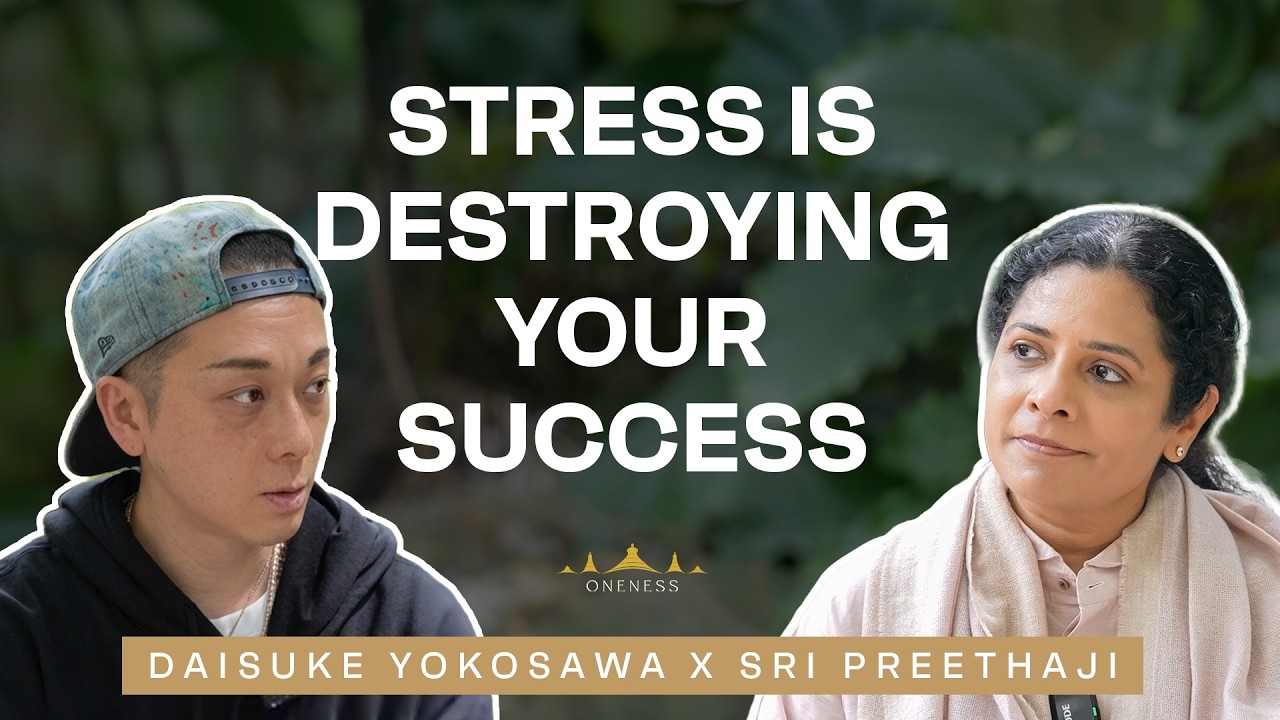
Daisuke Yokosawa recounts his discovery that the conventional belief—that pressure and stress are prerequisites for business success—fundamentally misses a higher operating system available to all professionals. Through the Oneness path, he uncovered a calm, clear space within himself that not only relieved internal strain but catalyzed genuine abundance: better business results, deeper friendships, and authentic daily joy. This shift rewires how we approach ambition, decision-making, and resilience in competitive environments.
For most of Daisuke's career, he operated under an unexamined assumption: pressure was the engine of success. Weakness, in this framework, meant calm. The louder the internal chatter, the more urgency and focus one commanded; the faster the heartbeat before a big decision, the more prepared one supposedly was. This belief system runs deep in corporate culture, particularly in high-stakes industries where volatility and speed appear to reward those who can endure the most stress.
Daisuke's insight—that this model is fundamentally incomplete—emerges not from theory but from lived experience. He did not arrive at a Zen retreat to learn about meditation; instead, he walked the Oneness path and discovered something that looked like the opposite of weakness: a stable, luminous, actionable clarity that made every outcome easier to navigate. The paradox is the crux: the mental and emotional space he cultivated through inner work did not reduce his capacity to succeed; it magnified it.
The transformation Daisuke describes operates on multiple levels simultaneously. At the neurological level, a calm mind processes information more efficiently. Fear, urgency, and constant vigilance flood the nervous system with cortisol and adrenaline—useful for a few seconds in genuine crisis, but counterproductive for sustained problem-solving, creativity, and interpersonal sensitivity. When pressure is the norm, the brain essentially lives in a low-level threat state, which narrows perception and calcifies reactive patterns.
By contrast, a mind anchored in inner calm can hold complexity without fragmenting. In business, this means the ability to see multiple stakeholder perspectives simultaneously, to notice emerging market signals others miss, and to respond to setbacks without shame or defensiveness. Daisuke's experience suggests that this is not a trade-off—gaining peace while sacrificing edge—but an upgrade to a higher-fidelity operating system.
The clarity he mentions is equally specific. Decisions made from a clear space tend to align with actual values and long-term vision, rather than reflexive reactions to short-term fears. Many professionals mistake the absence of anxiety for the absence of commitment; Daisuke's testimony suggests the opposite. Calm clarity often produces stronger conviction because it is not contaminated by ego-defense mechanisms or scarcity thinking.
The description notes that this inner shift began to impact "everything—from business to friendships to daily joy," which hints at a non-linear feedback loop. Business success in the traditional sense—revenue, growth, client satisfaction—improved not because Daisuke worked harder, but because his presence changed. A leader operating from genuine calm tends to inspire confidence in teams; clients sense authenticity rather than desperation; negotiations flow more naturally because there is less performative posturing.
Furthermore, the removal of internal noise creates space for strategic thinking that pressure-driven urgency crowds out. When you are not consumed by the next quarterly target or reputation anxiety, you notice longer-term patterns, invest in genuine relationships with collaborators, and make decisions that compound over years rather than optimize for immediate relief.
Daisuke's description of "outer abundance" following inner clarity points to a subtle but critical principle: outer reality is not separate from inner state, but continuously responsive to it. This is not magical thinking. It reflects the way confidence, clarity, and ease naturally attract opportunity and reciprocal commitment from others. A person who has resolved internal conflict becomes a more attractive partner, mentor, and leader—not through manipulation, but through genuine presence.
One of the most telling parts of Daisuke's testimony is the impact on friendships. Professional relationships often become transactional or strained when both parties are operating from pressure and scarcity. When a leader is always in crisis mode, their presence in relationships becomes about extraction—needing validation, reassurance, or instrumental support. By contrast, a person anchored in calm can show up with genuine interest, availability, and the kind of presence that deepens bonds.
This is not soft or secondary to business success; it is foundational. The strongest networks, the most reliable collaborations, and the most creative partnerships emerge from relationships built on mutual respect and ease rather than transactional need. Daisuke's discovery that inner calm improved his friendships suggests he became less reactively needy and more genuinely generous—a shift that naturally magnetizes stronger relationships.
The initial belief that "calm felt like weakness" deserves scrutiny. In a world that valorizes busyness, decisiveness, and visible effort, the interior silence and receptivity of a calm mind can appear passive. Yet Daisuke's outcome—sustained business success paired with deepened relationships and daily joy—suggests a different definition of strength altogether.
True strength, in this view, is the capacity to remain unshaken by external volatility while maintaining clear intention. It is the ability to disappoint someone without rage, to lose money without existential panic, to receive criticism without identity fracture. These qualities require far more stability than the hair-trigger reactivity that pressure cultures often celebrate as "high performance."
From this angle, the cultivation of inner calm is not a retreat from ambition but a maturation of it. An ambitious person operating from calm is typically more effective, more creative, and more resilient than one driven by fear. The pressure-success narrative conflates urgency with urgency-responsiveness; Daisuke's testimony suggests that urgency is often orthogonal to effectiveness.
Daisuke's journey was catalyzed by walking the Oneness path, a spiritual framework centered on inner awakening, non-duality, and the dissolution of the artificial separation between self and world. This path is not about belief adoption but direct realization—an experiential discovery of the spacious awareness that underlies the thinking mind and the body.
Through practices rooted in this teaching, practitioners often report access to a clarity and peace that was always available but obscured by habitual thought patterns and conditioned identity. For Daisuke, this access was transformative precisely because it was not an intellectual shift (adding a new belief system to the old one) but a fundamental reorientation toward a dimension of being already present.
The key insight is that this clarity is not foreign to professional life; it is, in fact, the condition under which the highest forms of professional excellence naturally flourish. A surgeon needs this kind of calm to perform. A negotiator benefits immensely from it. An entrepreneur building something genuinely innovative requires the kind of vision-clarity that emerges from a quieter mind.
Perhaps the most overlooked metric in Daisuke's testimony is the mention of "daily joy." Success cultures often treat joy as a luxury or endpoint—something you earn after grinding long enough. His experience suggests that joy is actually a by-product of alignment between inner and outer life, between stated values and actual behavior, between what the mind claims to want and what the deeper self is seeking.
A person living in constant pressure is structurally prevented from accessing joy; the nervous system cannot simultaneously maintain threat-response and easeful appreciation. By cultivating inner calm, Daisuke apparently resolved this conflict. Business became not an arena of suffering punctuated by distant rewards, but a natural expression of his clarity—and therefore intrinsically satisfying.
This has profound implications for sustainability. A career or business built on pressure and denial of joy is ultimately a borrowed-energy model; it runs until the body or psyche breaks. By contrast, a professional life anchored in clarity and aligned with authentic joy can sustain at high levels for decades without burnout.
Daisuke's journey invites a personal inquiry: What beliefs about pressure and success am I still carrying? Where am I confusing urgency with importance, or stress with commitment? If you recognize yourself in the old paradigm—pressure as prerequisite—the next step is to become curious about the alternative rather than dismissive of it.
The Oneness Movement, which hosted this talk, offers a structured entry point for those interested in exploring the path Daisuke walked. The core practice is simple but profound: learning to access and abide in the clear, spacious awareness that is your deepest nature. From that ground, decisions flow with a different quality, relationships deepen, and abundance—material, relational, and experiential—becomes a natural outcome rather than a hard-won achievement.
The invitation is to test this for yourself. For one week, notice where you are operating from pressure versus clarity. Observe what happens to your effectiveness, your relationships, and your sense of daily ease when you can touch even briefly into a calmer mental state. The proof, as Daisuke's life suggests, lies in lived experience, not ideology.