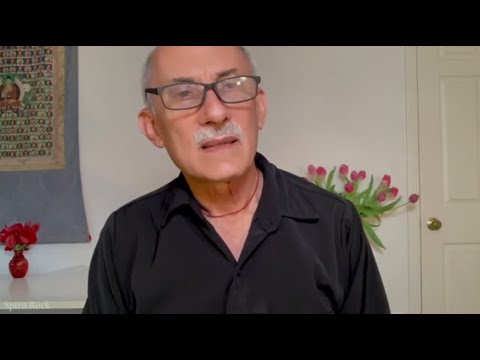
In conversation with Ocean Robbins, Jack Kornfield addresses the oldest spiritual question—why suffering exists—and reframes it through Buddhist understanding of duality, form, and emptiness. Rather than treating spiritual practice as escape from difficulty, Kornfield teaches that the path involves meeting both calm and storm with presence and a loving witness. He explores how ordinary life becomes sacred through attention, how consciousness works as a mirror, and how fear and grief can be held with compassion rather than reactivity. The spiritual journey is not about achieving an ideal self but about reclaiming dignity and nobility of heart while inhabiting the full spectrum of human experience.
What Draws People to Meditation and Mindfulness
Jack Kornfield's entry into mindfulness came through a lived question about suffering. Early spiritual seeking often begins when someone encounters pain that ordinary answers cannot resolve—loss, mortality, injustice, or the simple fact of aging and change. Rather than bypassing these realities, Kornfield suggests that Buddhism offers a direct approach: to investigate suffering itself, not escape it. This inquiry, rooted in the Buddha's First Noble Truth, opens a gateway that many people walk through when they finally stop running from what hurts.
Why Is There Suffering in the World?
One of the deepest questions Kornfield addresses is not abstract philosophy but the lived weight of pain. As he notes: "Life is extraordinarily beautiful, and it's an ocean of tears." This paradox sits at the heart of Buddhist teaching. Suffering is not punishment or error—it is woven into the fabric of existence itself because the universe is constructed of opposites. Birth and death are not separate; light cannot exist without darkness. Form itself requires emptiness. This is not pessimism; rather, it is clarity about how reality works.
In Buddhist understanding, the cause of suffering is not suffering's existence but our resistance to it. When we cling to what is temporary, demand that life conform to our preferences, or deny loss and change, we create the friction that becomes pain. The second arrow—the suffering we add through judgment and struggle—often wounds more than the initial circumstance. Recognizing this structure doesn't make suffering vanish, but it removes the layer of shame and resistance that compounds it.
How Do Form and Emptiness Create the Dance of Duality?
Kornfield teaches that duality—the existence of opposites—is not a flaw to overcome but the engine of creation itself. "You can't have form without the emptiness from which it comes," he explains. This is not metaphorical. Every object, every moment, every breath contains both: the apparent form and the spaciousness that allows it to exist. This applies to emotions, thoughts, and experiences as much as to physical matter.
This understanding shifts how we relate to difficulty. If storms are inseparable from calm, grief from joy, then the spiritual task is not to eliminate one pole. Instead, it is to develop the capacity to meet both without contraction. A person who has only known calm and learns to navigate a storm has actually expanded in consciousness. Duality ceases to be a problem when we stop demanding that reality be simplified into the parts we prefer.
The Recycling Nature of the Universe and Renewal
Kornfield points to the recycling nature of the universe—how death feeds new life, how endings become beginnings, how the very atoms in our bodies have cycled through countless forms. This is not meant as comfort rhetoric but as direct observation. When someone dies, they do not disappear; they transform. Energy and matter persist, only taking new shapes. This perspective can ground people in a larger view when they are caught in the grief of a particular ending.
For spiritual practitioners, this understanding counters the fear of permanent loss or the sense that life is running out. The universe does not work on a logic of scarcity but of continuous transformation. What we perceive as endings are turning points in a larger dance. This does not eliminate the real pain of separation or the legitimate grieving process, but it places those experiences within a cosmos that is fundamentally alive and renewing.
How Can Ordinary Life Become Sacred?
One of Kornfield's central teachings is that we do not need to achieve special states to live a sacred life. Sacredness is not reserved for monks in caves or extraordinary moments. Rather, it emerges through presence and attention to what is already here. When you truly notice the light on water, the taste of an apple, the warmth of another person, the ordinary becomes luminous.
This requires only one thing: meeting life with awareness rather than autopilot. Mindfulness is not a technique for achieving something other. It is a simple return to direct perception. Through this lens, washing dishes, walking, or sitting with grief all become opportunities to practice. The sacred is always available because presence is always available. Kornfield teaches that consciousness itself is the magic—the capacity to witness and reflect what arises is itself the deepest miracle.
What Does It Mean to Cultivate a Loving Witness?
At the core of Kornfield's teaching is the cultivation of a loving witness—an inner presence that can hold experience without getting swept away by it or hardening against it. This is not dissociation or spiritual bypassing. Rather, it is the development of a part of consciousness that can observe with kindness rather than judgment.
When fear arises, a loving witness does not say "I should not be afraid" or "Fear is weakness." Instead, it turns toward fear with the same tenderness you would offer a frightened child. This internal shift—from rejection to compassionate meeting—changes the entire quality of the experience. Grief does not disappear, but it is no longer compounded by the shame of grieving. Anger does not vanish, but it is no longer fused with the righteousness that feeds reactivity.
Kornfield emphasizes that this witness is not something you must manufacture. It emerges naturally when you stop the habit of identification with each passing thought and emotion. You are not your fear; fear is something arising in awareness. You are not your grief; grief is something the heart holds. This simple shift in perspective—from "I am afraid" to "fear is present"—opens space for response rather than reactive collapse.
Why Spiritual Practice Is Not About Achieving an Ideal Self
A critical teaching Kornfield offers is a warning against using spiritual practice as a weapon against yourself. Many practitioners fall into the trap of creating an ideal version of themselves—the perfectly calm, perpetually enlightened self—and then judging the actual self as inadequate. This defeats the purpose entirely.
"It's important to not use spiritual practice to set up an ideal or judge yourself. Sometimes you need to shut down, and then you open again. So the spiritual path is really about being with both the calm ocean and the storm." This is a direct permission to be human. On some days, the nervous system needs to downregulate. On others, we have capacity for deeper work. Both are part of the path.
The spiritual life is not a linear climb toward purity. It cycles and rhythms. You open and close, contract and expand. A mature practice honors this rhythm rather than fighting it. This takes pressure off the practitioner and aligns effort with actual human physiology and psychology rather than fantasy.
How Can We Hold Fear and Grief Without Being Consumed?
Kornfield teaches specific ways to meet heavy emotions. The loving witness provides the container. But within that, there are concrete practices. One is to recognize that fear and grief, while painful, are also expressions of love—fear often masks care, and grief arises from attachment to what or whom we have valued. Reframing these emotions as love makes space for them differently.
Another practice is the body scan. Fear and grief live in the body as sensation. When we meet them through breath and somatic awareness rather than story, they often shift and soften. The narrative mind can trap us in cycles, but the body knows how to move through waves of emotion if given conscious attention and compassion.
Finally, Kornfield emphasizes that holding these emotions does not mean acting from them. You can acknowledge fear without letting it control your choices. You can feel grief without it defining your identity. This distinction between feeling and being is crucial for moving from reactivity to response-ability—the ability to respond with integrity rather than impulse.
What Is the Role of Original Dignity in Spiritual Awakening?
Throughout his teaching, Kornfield points toward what he calls the nobility of heart and original dignity. These are not qualities you earn through practice or achievement. They are intrinsic to your nature. The work of awakening is not to become someone new but to reclaim what was always there beneath conditioning, trauma, and social pressure.
This is a profound shift from self-improvement to self-remembrance. You do not need to fix yourself into worthiness. Rather, you need to remove the layers of shame and doubt that obscure an inherent dignity. Meditation and presence serve this uncovering. When you sit in awareness, even briefly, you encounter a consciousness that is clear, open, and untouched by the stories you have been carrying. This recognition is healing not because it fixes problems but because it restores your relationship to yourself.
Where to Go From Here
Kornfield's teaching in this episode is an invitation to stop compartmentalizing your spiritual life. The sacred is not found by rejecting the difficult or chasing peak experiences. It emerges through your willingness to meet yourself—all of yourself—with kindness and presence. Begin with the simplest practice: when difficulty arises, pause. Notice what is present without immediately pushing it away or grasping for solutions. Ask yourself: Can I meet this with the same tenderness I would offer a friend in pain? This single question, returned to repeatedly, is the doorway. The calm ocean and the storm are both the path. Your job is to learn to navigate both with an open heart.