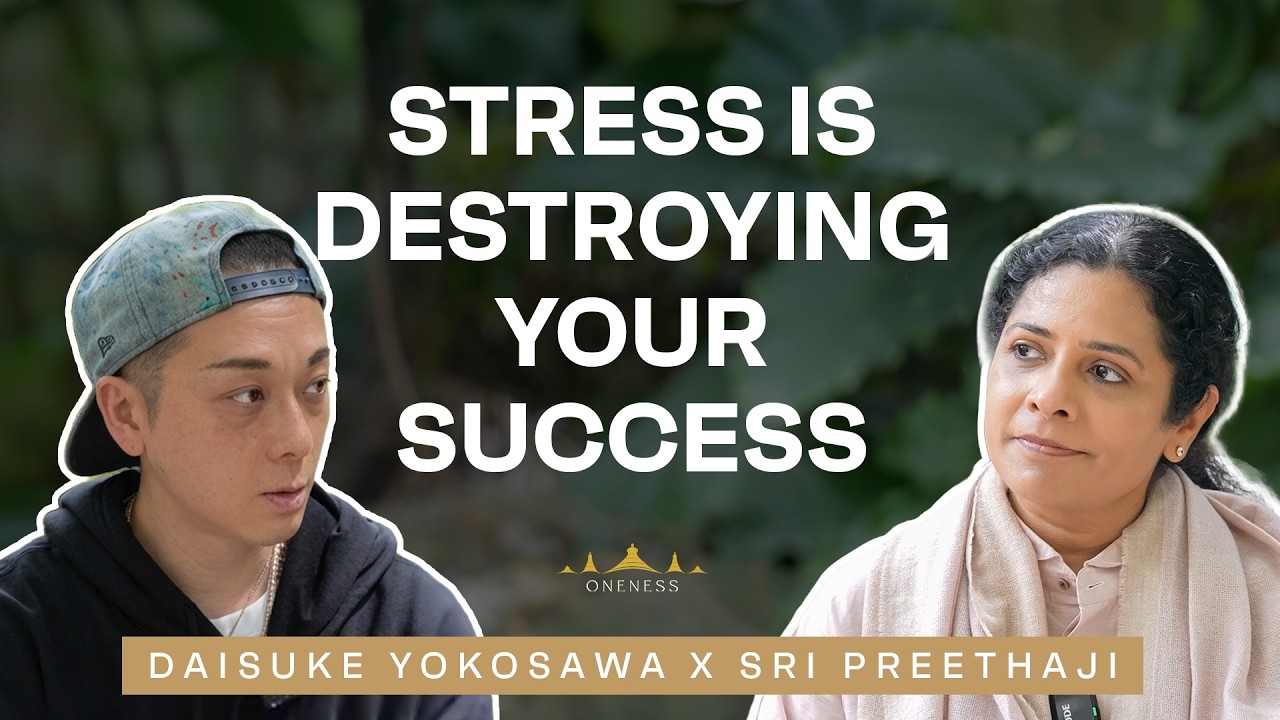
Ashwin's testimony demonstrates a fundamental shift from a stress- and success-driven life to one guided by compassion, peace, and authentic connection—a transformation attributed to Oneness practice. The talk illustrates how moving beyond constant striving and competition toward a unified consciousness changes not only internal experience but also interpersonal relationships and sense of purpose.
What Does It Mean to Live Beyond Stress and Striving?
Most modern lives are structured around achievement metrics: career advancement, financial security, social status, and personal accomplishment. The nervous system becomes calibrated to constant striving—a state of perpetual evaluation against external benchmarks. Ashwin's initial condition reflected this common pattern: driven by goals, competing with others, measuring worth by success.
Living "beyond stress and striving" does not mean abandoning responsibility or purpose. Rather, it refers to a fundamental rewiring of motivation and identity. Instead of deriving self-worth from external validation or achievement, a person's sense of peace and direction emerges from an internal anchor—what the Oneness tradition calls a connection to the unified field of consciousness. In this state, actions still flow, but they flow from presence and compassion rather than fear of inadequacy or hunger for recognition.
Ashwin's transformation suggests that this shift is not theoretical but experiential. By engaging with Oneness practices—which typically include meditation, energy transmission, and immersion in a community aligned with non-dual awareness—the nervous system recalibrates. The stress response that once seemed necessary for survival becomes recognizable as a limitation rather than a requirement.
How Does Oneness Practice Redirect Inner Experience?
The Oneness movement, stewarded by Sri Preethaji and Sri Krishnaji, teaches that human suffering stems largely from a sense of separation: from others, from life itself, and from one's own wholeness. This perceived separation creates the psychological friction from which stress originates. When you believe you must defend a separate self against a hostile world, vigilance becomes chronic.
Oneness practice addresses this at the root. Through meditation and grace-based transmissions, practitioners report a direct experience of interconnection. This is not merely intellectual philosophy but a lived shift in perception. When Ashwin describes his life as now "guided by compassion, peace, and deeper connections," he is speaking to a perceptual reorganization: he experiences others not as competitors or strangers but as expressions of the same unified consciousness.
This reorganization has practical implications:
- Release of comparison: If all consciousness is fundamentally one, comparing your performance to another's becomes nonsensical. This alone dissolves a major source of workplace and social stress.
- Shift in motivation: Actions cease to be driven by ego protection and become aligned with what serves the whole. Work becomes service rather than self-defense.
- Emotional regulation: Without the constant background hum of inadequacy, the nervous system settles. Reactive emotional storms become less frequent and intense.
- Relational depth: Connection with others becomes genuine rather than transactional, because the perceived boundary between self and other softens.
What Changes in Relationships When You Stop Striving?
The description notes that Ashwin's relationships have shifted alongside his inner world. This is crucial: Oneness is not a solipsistic enlightenment but one that necessarily reconstructs how you show up for others. Stress-driven people often relate from a place of performance, protection, or hierarchy. Conversation becomes about positioning. Even in intimate settings, there is an underlying evaluation: "Am I impressing? Am I safe? Where do I stand?"
When striving dissolves, so does this relational posture. Ashwin's report of "deeper connections" suggests that he is now present with others without the noise of self-evaluation. This allows genuine listening, genuine care, and genuine seeing of the other person. Paradoxically, by ceasing to strive for connection through performance, authentic connection becomes possible.
This also shifts how difficulties are navigated in relationships. A stress-driven person tends to defend, blame, or withdraw when threatened. Someone anchored in Oneness—in the understanding that conflict arises from the illusion of separation—can approach relational friction as an opportunity for deepening understanding and compassion. The other is not an adversary but a mirror and teacher.
How Does Oneness Address the Root of Stress?
Conventional stress management often treats symptoms: meditation for anxiety, exercise for cortisol, breathing techniques for the nervous system. These have value but remain surface-level. Oneness teachings suggest that chronic stress is not primarily a physiological problem but a metaphysical one—rooted in the false sense of separation.
Ashwin's journey implies a different approach: instead of managing the symptoms of a separate self, he dissolved the illusion of separation itself. This is not accomplished through willpower or cognitive reframing alone, but through direct transmission and grace—a core teaching in Sri Preethaji and Sri Krishnaji's work. Grace, in this context, means that the shift in consciousness is not earned through effort but is given when conditions align.
The practices of Oneness—which include group meditations, personal sessions with teachers, and immersion in the philosophy—create those conditions. The community aspect is significant. When many nervous systems attune to unified consciousness together, the individual's nervous system has permission to relax into a new configuration.
What Does a Life Guided by Peace Look Like in Practice?
Ashwin's transformed life is described as guided by "compassion, peace, and deeper connections." This is worth unpacking in concrete terms. A life guided by these qualities differs markedly from one guided by success metrics:
- Decisions: Instead of "Will this advance my career or status?" the question becomes "Does this align with compassion? Does this serve?" This can lead to different career choices, boundary-setting, and resource allocation.
- Time and energy: Without the constant pull of self-improvement or competition, time becomes available for presence. Relationships, creativity, and simple being receive energy previously consumed by striving.
- Response to failure or setback: When identity is not invested in achievement, failure loses its existential threat. It becomes information, not verdict.
- Engagement with life: Paradoxically, a life guided by peace is often more engaged, not less. Without the noise of self-doubt, actions flow with clarity and commitment—but without attachment to outcome.
This is not passivity. Ashwin presumably still works, still engages in the world. But the quality of engagement has shifted. His actions are no longer contaminated by fear or ego-defense. This typically results in greater effectiveness, not less, because presence and compassion are more intelligent than anxiety and self-protection.
Where to Go From Here
Ashwin's testimony is an invitation, not a guarantee. The Oneness teachings are explicit that such transformation is possible for anyone willing to engage with the practices and philosophy. If you resonate with his experience—if stress and constant striving feel like a cage rather than a necessity—exploring Oneness practices, meditation, and community immersion may open the door to a different life. The shift from separation to unity consciousness is not theoretical but experiential; it must be lived to be understood. Start with curiosity, attend teachings or meditations, and allow grace—if you believe in it—or the neuroplasticity of contemplative practice, if you prefer neuroscience language, to work.