Transcript
[0:00] It's not an accident that people like
[0:02] Peter Thiel and Elon Musk and the
[0:05] authoritarian forces that surround them
[0:08] do relate to that model. The reason they
[0:10] don't want everybody to have health
[0:12] care, they don't want everybody to have
[0:14] good education is because they are
[0:15] trying to make their crowd {quote} the
[0:17] fittest in order to survive. And it's a
[0:20] very dark amoral at best, you and I
[0:23] would agree immoral perception of
[0:25] things. I want to go back a little bit
[0:27] because I think that people are feeling
[0:29] the chaos that you describe. And you
[0:33] also say that it's in the air, people
[0:35] can feel it. I think what's so exciting
[0:38] about your book also, however, first of
[0:40] all,
[0:41] everybody nobody jump off
[0:43] stay with this interview because there's
[0:45] a there's a lot of hope on the other
[0:47] side of this. Yes, we have to
[0:49] acknowledge
[0:51] the the unsustainability of the model
[0:54] that we currently embrace.
[0:56] But we also in doing so will come to
[0:59] realize in your book is full of
[1:01] information about the ways that we
[1:03] change this trajectory. Now, in the book
[1:06] you are a cellular biologist. You come
[1:09] at this from a scientific perspective.
[1:12] Um when you were talking about Darwin a
[1:15] few minutes ago, if I understand the
[1:17] book, Darwin was not wrong to point out
[1:21] that evolution occurs.
[1:23] >> Oh.
[1:24] >> Right?
[1:25] >> Yes.
[1:25] >> Right, it's not like he was all wrong.
[1:27] You're just saying, if I understand
[1:30] correctly or correctly if I'm wrong,
[1:32] that evolution is affected by
[1:34] consciousness in a way that he had no
[1:37] idea. Is that correct?
[1:38] >> That's 100% correct. And let me just
[1:40] say, when you say evolution there's two
[1:43] parts, A B. A, did evolution occur? B,
[1:48] what was the mechanism of that
[1:50] evolution? So first of all, Darwin
[1:53] didn't come up with evolution. The first
[1:55] scientific theory of evolution was 50
[1:58] years before Darwin by a French guy
[2:01] called
[2:04] Oh, my head just went lost. Uh
[2:07] Jean-Baptiste
[2:09] Lamarck.
[2:11] And Lamarck Abe showed scientifically
[2:14] evolution occurs. So, part one dealt
[2:16] with. Part two, and this is important,
[2:20] uh Lamarck saw that organisms fit the
[2:23] environment. Polar bears are in the
[2:26] Arctic, not in Africa.
[2:29] Uh roses grow in the intermediate zone,
[2:32] but they don't grow in the Arctic. Uh
[2:35] and his point was clear.
[2:37] There must be a connection between the
[2:39] environment and the genetics that allow
[2:43] organisms to adapt
[2:45] to the environment. And uh
[2:49] so, he was talking about an interaction
[2:52] environment organism.
[2:54] Darwin's theory was based on random
[2:57] mutations.
[2:59] Random means accidental mutations. So,
[3:01] there was a primitive organism. Its
[3:03] mutation There were mutations all
[3:06] through this. So, its progeny were a bit
[3:09] different. And then they reproduced, and
[3:12] then they had
[3:13] you know, the runt of the litter, so to
[3:16] speak, who was different. And evolution
[3:19] was a whole bunch of these random
[3:21] accidents, which begs the question, then
[3:25] why are we here? And if you look at it
[3:28] from Darwin's point of view, hey, it was
[3:30] a whole bunch of accidents. That's how
[3:32] we got here. And I go, wow,
[3:34] this again was wrong. Every organism in
[3:38] the garden when introduced, and this is
[3:41] the point, every organism introduced
[3:44] into the environment, the garden, the
[3:46] function of it was to maintain balance
[3:50] in the garden.
[3:52] And we're the only organism introduced
[3:55] that has the power to really help
[3:57] maintain the balance, but without
[3:59] awareness, that power is being used
[4:03] incorrectly and and facing us. So,
[4:06] Darwin didn't discover evolution, and
[4:09] his mechanism is not in harmony.
[4:13] >> Okay. So, we have moved beyond Darwin,
[4:16] the title of your book. We're now in the
[4:18] the age of Bruce Lipton. So,
[4:21] tell us
[4:22] tell me a little bit more about how
[4:25] epigenetics works. You know, you
[4:27] reminded me when you said I can I keep
[4:29] hearing in my mind the Joni Mitchell
[4:31] song, "We have to get back to the
[4:32] garden." And it really gives deeper
[4:34] meaning to that because we have bought
[4:36] into a battlefield paradigm, and we need
[4:39] to move back to a garden paradigm. It's
[4:41] very profound, actually. How does a
[4:43] garden how do the different elements of
[4:44] a garden relate to one another? Now,
[4:47] when you talk in the book about how
[4:49] cells operate, can you give information
[4:54] here about the epigenetic
[4:58] influences? Kind of like I'm raising a
[4:59] children, and people talk about nature
[5:01] versus nurture. Where is
[5:04] what Tell us about how that works. How
[5:07] do cells
[5:09] literally change, and genes literally
[5:13] change
[5:15] through the application of changes in
[5:17] consciousness? How does this work
[5:19] scientifically? You talk about quantum
[5:21] physics. Tell us how that works.
[5:22] >> Okay. First of all,
[5:25] cells the genes don't activate
[5:27] themselves. They're blueprints to make
[5:30] parts of the body. So, a blueprint
[5:33] cannot turn itself on or off. It
[5:35] requires an architect. I say, "Well, how
[5:37] does it work?" I say, "The mind has a
[5:40] vision. Let's say love.
[5:43] And the brain's job is to convert that
[5:47] vision into complementary chemistry. So,
[5:50] if you're in love, you're releasing
[5:53] dopamine pleasure, oxytocin bonding with
[5:56] your lover. You're You release
[5:58] >> helium toes. It's like yeah.
[6:02] Yeah, go on.
[6:02] >> And you release growth hormone which
[6:05] enhances your vitality and that's why
[6:07] people
[6:08] glow. They're so healthy when they fall
[6:11] in love because the chemistry coming
[6:13] from the brain goes into the blood and
[6:16] then here's the connection. The
[6:18] chemistry in the blood goes to the cells
[6:21] and the chemistry selects the genes that
[6:25] match the chemistry.
[6:28] So, in other words, love chemistry
[6:29] activates healthy genes. Fear chemistry
[6:34] actually shuts down the system as we try
[6:38] to get into protection. So,
[6:41] the important part about this is growth
[6:44] is go to a stimulus, arms open, take it
[6:47] in. Love, nutrients, arms open, take it
[6:51] in.
[6:52] Protection is the opposite, go away from
[6:56] the stimulus and close yourself down
[7:00] from the threat that you see.
[7:03] Well, the point is this, you can't be
[7:05] going to a stimulus and away from it at
[7:07] the same time. You can't be open and
[7:10] closed at the same time. So,
[7:14] an organism and especially human is
[7:17] either in growth or in protection but
[7:21] cannot be in both at the same time.
[7:23] Doesn't work. So, the more protection
[7:25] that we seem to require, the more we
[7:29] shut ourselves down. A very important
[7:33] part of this is that I was going to tell
[7:36] a story um
[7:38] Millennials are younger, remember? I
[7:39] remember
[7:41] uh, bomb shelter tests when I was a kid
[7:44] uh, and we go into the bomb shelter
[7:46] because we thought some Russians were
[7:47] going to drop a bomb on us. And we sit
[7:50] in the bomb shelter.
[7:51] >> We just We were told to get under our
[7:53] desk.
[7:54] >> Get under the desk.
[7:55] >> Like that was going to fix it.
[7:57] >> Forget that.
[7:58] >> your desk.
[7:59] >> [laughter]
[7:59] >> And
[8:00] the Russians are bombing us. Get under
[8:02] your desk.
[8:04] >> Yeah, I remember that. We had to go into
[8:06] the basement of this building built 100
[8:09] years before and it was like the
[8:11] scariest place in the world and sit
[8:13] there with your hands over your head.
[8:16] Okay. But the point about it is this.
[8:20] Consider a community is working,
[8:22] everything's going on, the school, jobs,
[8:25] everything's great. The siren goes off.
[8:29] And that says go to the bomb shelter. I
[8:31] say, so we all go to the bomb shelter. I
[8:33] say, what about the job? I said, no more
[8:34] job. What What about the the school? No,
[8:37] no, no more school. In the bomb shelter,
[8:40] we're in protection here, okay? I say,
[8:44] and then uh, in those days then we had
[8:46] the all clear and about 15 minutes later
[8:50] we're out of the bomb shelter and life
[8:52] comes back.
[8:54] Here's the issue, think about it. What
[8:56] if you went into the bomb shelter and
[8:58] there was no all clear?
[9:01] I say,
[9:03] you you will die.
[9:05] >> [laughter]
[9:05] >> Bomb shelter. You can't go
[9:07] >> Okay, hold on. I need to stop you for a
[9:08] minute.
[9:09] >> Yeah.
[9:09] >> Bruce,
[9:10] I I I want to make sure we all follow
[9:12] you. So, what I hear you saying, tell me
[9:15] if I'm correct, is that there are two
[9:17] realms of the chaos and the
[9:19] destructiveness that we are experiencing
[9:21] today.
[9:22] >> Yes.
[9:22] >> One is the outside level of things, the
[9:25] fact that we're using the resources of
[9:27] 1.6 planets when in fact we only have
[9:29] one planet and all of the associated and
[9:32] inevitable
[9:34] um,
[9:35] decline that results from this. But now
[9:38] you're saying that there is a
[9:39] concomitant, almost like a parallel
[9:41] level of shutdown, which has to do with
[9:45] our emotional and psychological reaction
[9:48] to all the stresses that the outer chaos
[9:51] uh
[9:52] has produced, and that's what you were
[9:54] speaking to now. Am I correct?
[9:56] >> 100% and recognizing that as the chaos
[10:00] has been building, the healthcare crisis
[10:03] has been building right along with it.
[10:06] So, you can map out
[10:07] >> Because of so much chronic
[10:09] >> with stress.
[10:11] >> And that's because of how much chronic
[10:14] illness is produced and increased not
[10:17] only because of outside factors, which
[10:19] we understand environmentally, etc., but
[10:21] also because of the fear and the
[10:23] helplessness
[10:24] >> Yes.
[10:24] >> that we are experiencing.
[10:26] >> Yes.
[10:27] >> Okay. Right back at you.
[10:28] >> Okay. So, now,
[10:29] uh so, if
[10:31] uh science has recognized, published
[10:33] research, NASA,
[10:35] that is I want to emphasize
[10:38] the science recognizes, they say that
[10:41] within 10 to 20 years, more likely 10,
[10:46] uh civilization is facing an
[10:50] irreversible
[10:51] collapse.
[10:53] It says, "Not sustainable. You can't
[10:56] keep doing this. It has to law.
[10:59] It has to end." Now,
[11:01] civilizations have come and gone before.
[11:03] Many civilizations, the Roman
[11:05] civilization was here and gone. Uh uh
[11:08] actually, uh Great Britain
[11:10] uh was the big civilization, and that
[11:12] collapsed, and the US took over, and
[11:15] that is in the process of collapse. And
[11:18] I guess, "Well, what what's important? A
[11:20] civilization collapses, the people don't
[11:22] die. They change the way they are
[11:25] living, okay?
[11:27] And uh and
[11:28] >> [clears throat]
[11:29] >> the if I could say a very interesting
[11:31] story, uh uh a caterpillar for a
[11:34] butterfly is very voracious. It goes on
[11:37] a plant where it will eat all the leaves
[11:39] off of the plant, okay?
[11:41] When the food is gone, then what happens
[11:44] to the caterpillar? It goes into a
[11:46] cocoon.
[11:47] And I said, "Then what happens?" He
[11:49] said, "Well, a caterpillar is made out
[11:51] of billions of cells. Biologically, a
[11:54] cell is a miniature human and has a
[11:56] whole life thing going. So, I said, "The
[11:59] community of cells making a caterpillar,
[12:01] when the thing was eating, everybody was
[12:04] working, digestive system, muscle
[12:06] system, immune system, everything was
[12:08] working.
[12:10] But when the food ran out,
[12:12] there was
[12:13] no more work. The cells were out of
[12:15] work.
[12:16] And when they were in that cocoon, the
[12:19] former community of cells fall making
[12:21] the caterpillar fall apart, a soup of
[12:24] cells. And then within that soup of
[12:27] cells, there are specialized cells
[12:30] called imaginal cells.
[12:32] Now, the significance that
[12:35] imaginal is like imagination, but it's
[12:37] also
[12:38] an immature insect is called imago. So,
[12:42] these are imaginal cells inside the
[12:45] population. I said, "What about them?"
[12:47] They have a vision.
[12:49] They have a way out. And they say, "Take
[12:52] this disorganized bunch of cells out of
[12:55] work and build something new, a new
[12:59] civilization."
[13:00] They built a a butterfly.
[13:04] I said, "So, why?
[13:06] Caterpillar, most voracious,
[13:08] turns into the butterfly, which hardly
[13:11] even touches the planet, okay?
[13:14] Civilization is in a caterpillar stage.
[13:19] The falling apart
[13:21] is happening. Mary Ann is one of the
[13:23] serious imaginal cells in that offering.
[13:27] There's a better way of surviving on
[13:30] this planet. And with the help of
[13:32] imaginal cells, we can redirect that out
[13:37] of work hopeless population into
[13:40] something that says, "Oh my god,
[13:42] something new, something better,
[13:44] something more beneficial for all of
[13:46] us."
[13:47] And if I have a moment, I want to talk
[13:49] about young people because well, I'm a
[13:51] old guy. So, young people are 40 years
[13:54] old or younger. And they have a a
[13:57] hopeless hopeless feeling about they
[14:00] can't get a job, they have no money, the
[14:02] American dream doesn't exist,
[14:05] and they're out of work. And I try to
[14:08] I want them to know something.
[14:10] They're going to play the most important
[14:13] role in the evolution of this planet. I
[14:16] go, "Why?" They're not connected to the
[14:20] system that is collapsing.
[14:22] >> They're not even 20th century people.
[14:24] >> Yeah. They're They're They're They're
[14:26] >> They're not in the Matrix. Mhm.
[14:28] >> Go ahead, my friend.
[14:30] >> No, that's all. I was just agreeing with
[14:31] you. They're not even 20th century
[14:33] thinkers.
[14:33] >> Yeah.
[14:34] >> So, they can imagine something different
[14:36] more easily.
[14:37] >> Yeah. And the beautiful part is the
[14:39] corporations that are destroying us are
[14:42] failing. They will be failing. And all
[14:45] new technology, all new corporations are
[14:49] evolving at this very minute. And most
[14:52] of them have to do with what?
[14:53] Maintaining the garden. Keeping us in
[14:56] harmony without destroying the garden to
[15:00] keep us. So, the young people not
[15:02] connected to the old system are the ones
[15:06] that are open to a new career, a new
[15:10] job, a new way of supporting a
[15:13] civilization that is evolving with that.
[15:17] And so, I just wanted to give them the
[15:19] fact that yeah, it looks like hell out
[15:21] there, but the reality is it's opening
[15:25] up a future
[15:27] where we can all thrive, not survive,
[15:30] but we can be like the butterfly. We can
[15:34] We can thrive into this planet.
[15:37] >> You know, I've heard this phrase
[15:39] chaotic, the idea that this is a chaotic
[15:41] time, that out of the chaos there will
[15:43] come a new order. And as you said
[15:46] before, well, the civilization of Rome
[15:48] did
[15:49] decline and end, but Rome still exists.
[15:52] And the great empire age of the English
[15:55] British civilization ended, but they're
[15:56] still in England and it's actually
[15:59] in its humility, one could argue
[16:00] actually even
[16:02] displaying something more beautiful to
[16:04] the world. I think what a lot of people
[16:06] feel Bruce, and I think all of us
[16:08] probably do at some point, is yeah, I
[16:10] can embrace the idea that ultimately
[16:13] ultimately things will be okay. The
[16:16] planet might not have to throw off this
[16:18] predator species for 200, 300,000 years.
[16:21] However, I think the fear that people
[16:24] feel is a little more short-term and
[16:25] immediate. Uh as you were saying before,
[16:28] is AI going to take my job? How am I
[16:30] going to feed my children? Where do I
[16:33] go, etc. What How How do you speak to
[16:37] that in terms of the changes in our
[16:39] belief system that give us more than
[16:41] hope for the long term, that give us
[16:43] strength and power as well as hope for
[16:45] the short term?
[16:46] >> Well, this is what's missing.
[16:49] And we go back to the idea of the
[16:50] garden. A garden is the ultimate of
[16:53] community. Every Every organism in that
[16:57] garden is in harmony with each other.
[17:00] We have to not depend on the central
[17:04] government.
[17:05] And the corporations should come and
[17:07] help us. That's not the Today's world,
[17:10] to my mind, is corrupt. Uh I say, "So,
[17:13] what will I do?" I say, "Cultivate a
[17:17] community. Start living with harmony
[17:20] with the people around you. Everybody in
[17:23] community can support each other. Some
[17:26] people will do this job and others will
[17:29] do this job and bartering, uh
[17:32] exchanging,
[17:34] helping, and supporting.
[17:36] Uh this is what will hold people
[17:39] together. It's like a family that is
[17:42] bigger as a community. Uh and if you
[17:45] were in a community where the vision is,
[17:48] "Let's help each other."
[17:50] Then, no matter what the problem is on
[17:53] the outside, the community will survive.
[17:57] And as communities evolve, they'll join
[18:00] other communities. The net result is
[18:04] when all humans recognize we're all part
[18:08] of the same community. Uh right now, uh
[18:12] humans see themselves as separate from
[18:14] each other. That is a programming that
[18:16] happened. Uh the simple reason is this.
[18:19] Each human is a powerful creator. You as
[18:24] an individual are creating your life
[18:27] with your consciousness. Now, if you
[18:30] would have good programming, you're
[18:31] going to have a good life. You have bad
[18:33] programming, you're in trouble at this
[18:35] moment. Uh the fact of a booklet of uh
[18:39] classic book called Rich Dad Poor Dad
[18:43] revealed how programming, when you were
[18:45] a kid,
[18:46] determines the outcome. You grew up in a
[18:49] rich family, you'll tend to stay rich.
[18:52] You grew up in a poor family, and you
[18:54] will sense it's you'll tend to stay
[18:56] poor. I go, "Why?" Okay, and here's the
[18:59] issue. People have no vision of it, but
[19:01] here it is.
[19:02] The brain is a computer.
[19:05] Best most powerful computer humans have
[19:08] ever come across. I go, "So, what?" I
[19:10] said, "But as a computer, it functions
[19:13] just just like our uh laptop." I go,
[19:16] "Why? Is there a connection?" I go,
[19:19] "You can buy a brand new laptop, and if
[19:22] it didn't come with a program, you can
[19:24] boot it up, but you can't do anything.
[19:26] It won't work." So, before you can use a
[19:29] computer, you have to put programs in
[19:33] it, okay? Now,
[19:35] a child is born into a complex
[19:37] situation, a family with dynamic
[19:40] community with dynamics. Each have rules
[19:44] of how to live. I said, "How's an infant
[19:47] going to learn the rules of being in a
[19:50] family or a community?" And the answer
[19:52] is this, the first seven years of a
[19:55] child's life, the brain is not in
[19:58] consciousness,
[20:00] it's in a lower activity, a lower
[20:02] vibration called theta.
[20:05] I said, "What? Theta? Oh, that's
[20:06] imagination."
[20:08] That's how young kids can live in the
[20:11] real world and the imaginary world at
[20:13] the same time. But, theta is hypnosis. I
[20:17] go, "What does that mean?"
[20:20] You observe your parents.
[20:22] Generally, if you're a boy, you observe
[20:25] your father's behavior and download that
[20:28] while in hypnosis. You observe your
[20:30] mother, that is a future context of what
[20:34] a partner would look like, okay?
[20:37] You observe your community, and you
[20:40] learn what you can do and what you can't
[20:43] do. These are programs, okay?
[20:47] Now,
[20:48] unfortunate part,
[20:50] more than 60% of those programs are
[20:53] disempowering or self-sabotaging
[20:55] beliefs. That we engage these programs,
[20:59] it actually takes away our power. It
[21:01] wasn't an intention, they have been
[21:03] programmed. And as a child, when you see
[21:06] them, you are watching their program and
[21:10] downloading that. Uh so, for example,
[21:13] there's no gene that causes cancer.
[21:15] There's not one gene that causes cancer.
[21:18] So, where does cancer come from?
[21:20] Example,
[21:22] they followed the faith of children,
[21:24] infants adopted into families where
[21:27] there's cancer running in that family.
[21:30] The adopted child will get the same
[21:33] family cancer, but it comes from totally
[21:37] different genetics.
[21:39] It's the programming.
[21:41] Cancer is not from genes, it's from
[21:43] living out of harmony.
[21:46] Uh and this is empowering idea because
[21:49] it says
[21:50] it's not killing the cancer cells that
[21:52] prevents cancer. Prevents cancer is
[21:56] learning to live in harmony outside of
[21:59] the stress and the fear, which is the
[22:03] generator
[22:04] of cancer, because environment
[22:06] influences our genetics, okay? So, the
[22:10] whole idea about all this is
[22:13] we're moving into another place.
[22:16] And the programming that you are
[22:18] playing, now listen,
[22:21] all of us,
[22:23] we have been given programs in the
[22:25] subconscious. They're habits. You don't
[22:28] have to think about them. They're good
[22:30] habit. You learn how to walk before
[22:32] you're two. You could be 102, you're
[22:34] still using the same program you got
[22:37] from before you're two.
[22:39] But what if you have a bad habit? I got
[22:41] Here's the problem.
[22:44] 5% of the day,
[22:46] your life is coming from the part of the
[22:49] mind called the conscious mind. That's
[22:52] connected to your spirituality, your
[22:54] source, your identity, and it's the
[22:58] creative mind. If I ask somebody, say,
[23:01] "Tell me what you want."
[23:03] The answer comes from the conscious
[23:05] wishes and desires. That's That's what
[23:07] it represents.
[23:09] But, the conscious mind can think. I go,
[23:11] "So, what?"
[23:13] Well, thinking is not looking out at the
[23:15] world. Thinking is going inside for a
[23:19] thought.
[23:20] So, the moment you are thinking, you are
[23:21] not paying attention to what's going on.
[23:24] Oh, yeah, but if you're in the car and
[23:26] you say, "I'm going to I guess you
[23:28] I'm at the store. I'm going to do this."
[23:31] I go, "The moment you were thinking,
[23:33] you were no longer driving a car." I go,
[23:36] "But, it was going okay." I go, "Here it
[23:39] is, friends. This is it."
[23:41] When you are thinking,
[23:43] the subconscious programs become
[23:46] autopilot.
[23:48] They take over. You taught your
[23:51] subconscious how to drive the car.
[23:54] When you are thinking, the subconscious
[23:56] is autopilot, okay?
[23:58] Now, here's the problem. This is We cut
[24:00] into a point.
[24:02] How much time does the average person
[24:05] think?
[24:06] 95%
[24:08] of the day. I say, "What does that
[24:10] mean?"
[24:12] 95%
[24:13] of the day, your behavior is controlled
[24:17] by the programs you downloaded from
[24:20] other people.
[24:21] It's not you. It's not your wishes and
[24:23] desires. Why? Conscious mind is not even
[24:26] paying attention. This is why I tell
[24:29] people, "Oh, you have a friend. You know
[24:31] your friend's behavior very well.
[24:33] And you happen to know your friend's
[24:35] parent. And what do you know, you see
[24:36] your friend has the same behavior as the
[24:39] parent. So, you offer,
[24:41] "Hey, Bill, you're just like your dad."
[24:44] I said, "Back away from Bill." And you
[24:47] know why? Cuz I know what Bill said or
[24:50] will tell you. He's going to say, "How
[24:53] can you compare me to my dad? I'm
[24:55] nothing like my dad." I go, "Is this
[24:58] interesting?" Everybody else
[25:02] can see Bill's behaviors like his dad.
[25:04] >> Yeah.
[25:05] >> The only one that can't see this Bill,
[25:07] and then I'll have to live with this.
[25:10] We're all Bill.
[25:12] Every day, we're not playing wishes and
[25:15] desires, we're playing programs. And we
[25:18] can't see it. Why?
[25:21] Well, you're not paying attention.
[25:22] You're inside. So, whatever program is
[25:24] coming out, you're the only one that
[25:26] can't see it. And since most of them are
[25:28] negative, imagine life is a struggle.
[25:33] >> Well, that's why a spiritual practice is
[25:35] so important because in that meditative
[25:36] state, uh whether it's the workbook for
[25:39] Course in Miracles or TM or any other
[25:40] serious spiritual practice, you are
[25:43] literally thinking from different brain
[25:44] waves in which the kind of
[25:45] transformation of our subconscious
[25:47] thought forms can uh can occur. I want
[25:50] to go back a little bit to when you
[25:51] talked about the imaginal cells, the
[25:53] imaginal soup turning into the
[25:54] butterfly. The one place where I think
[25:57] the analogy gets a little more
[25:59] complicated is that there is not an
[26:01] active force trying to trip up the
[26:05] butterfly during its birth process. Now,
[26:07] you did say in the book they don't all
[26:09] make it.
[26:10] >> Yeah.
[26:10] >> But I think in our case, even though
[26:12] we're trying to emerge from the imaginal
[26:14] soup to the butterfly, we do have all
[26:16] these forces, corporate, economic,
[26:18] political, et cetera, which are trying
[26:21] to stymie us. Now, and that that does
[26:23] make it a that the more of a challenge.
[26:26] Um you um were talking earlier about
[26:29] how, you know, give up politics, give up
[26:32] uh thinking the corporations are going
[26:34] to change, give up the economic system,
[26:35] and go into community.
[26:37] So, I want to take that on a little bit.
[26:39] >> Yes.
[26:40] >> Um I fear I fear, Bruce, that's a little
[26:42] bit of a of privilege talking, and I'll
[26:44] tell you why. If you look at, let's say,
[26:47] Nazi Germany,
[26:48] and you look at people throughout Europe
[26:50] when Hitler began marching, who went out
[26:52] into the country? The Nazis went out and
[26:55] found them.
[26:56] The Nazis searched them out.
[26:58] So, the idea that our just acting in
[27:01] community
[27:03] sounds great until you remember that
[27:06] there are some forces who won't like
[27:08] that, who will see it see those things
[27:10] as generative, and you'd be the first to
[27:12] be targeted. So, I would suggest,
[27:16] much like when you talked before about
[27:18] corporations changing, I would suggest,
[27:20] because one of the things I've seen in
[27:22] my career, which has been very, you
[27:23] know, you and I have been in the same
[27:24] transformational field. There has been a
[27:27] tendency in the transformational
[27:29] community over the last few decades. You
[27:30] and I have both been part of it. To be
[27:32] very apolitical because of people
[27:35] saying, "Politics is not where it's
[27:38] going to be healed." Well, I think you
[27:40] and I would agree, no, it's not where
[27:41] it's going to ultimately be healed, but
[27:43] it's where we could die before we even
[27:45] have a chance to heal it if we don't
[27:47] recognize that some people, and all of
[27:51] us to some extent in in in the sense of
[27:53] just standing up as good citizens,
[27:56] will see every sector of society as part
[28:00] of the zone. You know, it's like when
[28:02] Gandhi said, "Is not politics a part of
[28:04] dharma, too?" Now, I'm not trying to
[28:06] talk about politics specifically. I'm
[28:08] just saying that I think we have to be
[28:10] open to the revolution of consciousness
[28:12] within every sector and not leave any of
[28:15] them out just saying, "No, we have to
[28:17] just go form our own communities."
[28:19] Wouldn't you agree with that?
[28:20] >> 100%. And the idea is there are
[28:23] extremes. Everything has a polarity to
[28:27] it, okay?
[28:29] And unfortunately, politics wants to
[28:32] take us to one pole or the other pole,
[28:35] but the only valid place is in the
[28:38] center between polarities because both
[28:42] sides have something to offer. And if If
[28:45] only look at one side, then you're
[28:48] missing the point of the other side.
[28:51] This is interesting.
[28:52] >> Okay, but let's talk
[28:54] I I think that the initial founding
[28:56] vision of this country did support the
[28:58] garden theory. Because the reason,
[29:01] according to Jefferson and others, that
[29:03] we needed public education, the reason
[29:06] we needed a free press, and the reason
[29:08] we needed the right peaceful right of
[29:10] assembly, was in order to guarantee that
[29:13] all voices would be heard, and the
[29:15] theory was then the truth would rise to
[29:17] the top, which is garden-like.
[29:20] So, this idea of the polarity, the
[29:23] extreme polarity, which has so messed us
[29:25] up, has to do with the corrupting
[29:27] influence of money, the corrupting
[29:28] influence of political parties, and so
[29:30] forth. So, the initial founding vision
[29:34] was more garden-like than battlefield.
[29:37] >> The original There were scientists,
[29:40] Jefferson and Franklin, as scientists.
[29:44] And
[29:45] And they were guided
[29:49] They were
[29:50] >> Pardon? I'm sorry.
[29:51] >> They were guided by who? The Native
[29:53] Americans. I guess so what?
[29:55] >> That's what I was just saying.
[29:56] >> The Native Americans saw a garden and
[29:59] owned that they were gardeners
[30:03] in the environment. So, that
[30:05] consciousness was instilled
[30:08] in America's founding fathers.
[30:11] I mean, Native American philosophy and
[30:14] politics is built into our own
[30:17] Constitution and our own Declaration of
[30:20] Independence.
[30:22] And we have lost that
[30:24] because
[30:26] too many Europeans came
[30:29] into the New World.
[30:31] Why did people come to the New World? It
[30:34] was called the Age of Enlightenment. I
[30:36] go, "What was that?"
[30:39] A philosophy that came out that of a
[30:41] utopian possibility where people can
[30:44] live in harmony and peace and all that.
[30:47] And I go, "Yeah,
[30:48] uh
[30:49] who is writing this?" Well, one of them
[30:52] of the leaders was a guy called
[30:54] Rousseau.
[30:56] And Rousseau talked about a utopian
[30:59] world. You know what? He was reporting
[31:03] on Native American culture.
[31:06] And when people started connect with
[31:09] that, then they Europeans People don't
[31:12] think all slavery uh
[31:14] without change. I go,
[31:16] "Europe people were slaves. No change.
[31:19] What?" They either work for the baron,
[31:23] the one with the money, or they didn't
[31:25] have a job.
[31:27] Uh and therefore they were always living
[31:30] under the control of the baron at that
[31:33] point. Uh and yet then many of them went
[31:36] to the new world. Why?
[31:39] There was no stopping them. There was no
[31:41] upper class, no lower class, which was
[31:44] built into Europe. So, uh uh
[31:47] unfortunately, if you were born in the
[31:49] upper class, you were always upper
[31:51] class. If you were born in the lower
[31:53] class, you were always lower class. But
[31:56] when they went to the new world, no
[31:59] class.
[32:00] And they lived with the natives. Yes,
[32:02] Mary Ann.
[32:04] >> We have unfortunately regressed, and we
[32:07] have recreated a condition uh the
[32:09] conditions of aristocracy with the
[32:11] corporatocracy and the oligarchy,
[32:13] obviously. But I think also that our
[32:15] founders, of course, considered
[32:16] themselves enlightenment thinkers.
[32:18] That's what they actually called
[32:19] themselves and wanted to be. And they
[32:22] the whole idea of the enlightenment was
[32:24] the power of the individual, which would
[32:26] be freed from the superstition and the
[32:28] dogma of religion and old forces. And I
[32:31] think that that's what you're saying
[32:32] today is that we can free ourselves of
[32:36] the chains that are imposed upon us by
[32:39] old think.
[32:40] Um and there is always that force which
[32:43] draws us back into domination rather
[32:45] than partnership, uh into
[32:48] um
[32:49] uh
[32:50] fear rather than love. And uh am I
[32:53] correct to say
[32:55] um
[32:56] in sort of wrapping this up that you
[33:00] feel
[33:02] that on a genetic level, as well as an
[33:05] emotional and psychological, because
[33:07] that's what I got from your book, that
[33:09] at this point scientific evolution and
[33:11] spiritual evolution are in partnership.
[33:14] Is that correct?
[33:15] >> 100%. And get you know, people say I'm
[33:17] spiritual, but they don't get it. Let me
[33:20] tell you from a scientific point of
[33:22] view, spirit is a scientific truth. I
[33:26] say, "How?"
[33:27] Uh listen, you should see terminology.
[33:29] One of the factors you cannot exchange
[33:32] your organs with some other person. You
[33:34] can't transplant a kidney into somebody.
[33:37] Why? Their immune system will look at
[33:40] the foreign transplant and say, "That's
[33:42] not us."
[33:43] And will eliminate it. So, the immune
[33:46] system can see
[33:48] your identity separate from anybody
[33:52] else. Anybody else puts your organ into
[33:54] your body, the transplant will be
[33:57] perceived as foreign
[33:59] and then destroyed.
[34:01] Well, now here comes the issue. The
[34:02] immune system sees physical things. I
[34:04] go, "Whoa.
[34:06] Viruses, bacteria, parasites. Yeah.
[34:09] What is it seeing when it says, "I am
[34:12] different in identity than the cells of
[34:16] somebody else? I have a different
[34:19] identity."
[34:20] Where is identity? And it's like very
[34:23] quickly, on the surface of our cells,
[34:26] there are protein receptors.
[34:29] We have receptors on our surface, eyes,
[34:32] ears, nose, taste. These are receptors
[34:35] read the environment.
[34:36] There's a set of receptors on our cells
[34:39] with the exception of red blood cells.
[34:42] They have none of these self-receptors.
[34:45] That's what they're called. Red blood
[34:47] cells don't have them. That's why we can
[34:49] transfuse blood as long as you get A
[34:52] blood type. But a kidney, a lung, or any
[34:56] organ has cells with a nucleus and they
[35:00] have these antennas, receptor, receiver.
[35:04] And name of them?
[35:06] Self-receptors.
[35:08] I go, "So what?" They download a signal
[35:12] that nobody in the world other than you
[35:16] can download. No two people in the world
[35:19] have the same set of self-receptors.
[35:23] They're downloading an environmental
[35:25] signal of what? Self.
[35:28] I go, "So what?"
[35:30] I'm not in here.
[35:32] I'm a broadcast. Bruce is a broadcast. I
[35:36] have a set of antennas
[35:38] I have. You don't have mine. I have
[35:40] mine. Mary Ann has hers. You have your
[35:43] own. I say, "So I'm downloading Bruce."
[35:46] To give you an analogy, imagine my body
[35:49] as a television set. And I'm showing you
[35:52] the Bruce show right now. I go, "Yeah."
[35:56] I say, "Where's the broadcast?" I say,
[35:59] "Oh, the broadcast is in the energy
[36:02] field."
[36:03] We are downloading an energy field,
[36:06] which in quantum physics
[36:08] is the same definition of spirit. Energy
[36:11] field, spirit all have the same
[36:13] definition. So quantum physics
[36:15] recognizes each [clears throat] of us is
[36:17] downloading an identity of who we are. I
[36:21] go, "So what?" Well, if you're watching
[36:23] a TV and it breaks, TV is dead. I go,
[36:26] "Yeah."
[36:28] Did the broadcast die? No.
[36:31] Broadcast is always there.
[36:34] And I say, "So what?"
[36:35] >> And that's why physical that's why
[36:37] physical death is just a dropping of a
[36:39] suit of clothes, but consciousness
[36:41] continues. So, is the ultimate point
[36:45] that we can now download the
[36:47] consciousness of we as opposed to just
[36:50] me, a consciousness of a world in which
[36:53] we are living in the garden rather than
[36:55] a battlefield, that we can surrender a
[36:58] consciousness which is obsolete and
[37:00] unsustainable, and it is the causal
[37:03] level of the unsustainability of the
[37:04] world today, and embrace instead a new
[37:08] consciousness in which we are living in
[37:10] the garden, in which we are living in
[37:11] sacred connection with nature, sacred
[37:14] connection with each other and a higher
[37:15] power in order that the world of effect
[37:20] outside us will change automatically and
[37:22] accordingly. Is that the Is that the
[37:24] goal?
[37:24] >> destination. The destination
[37:27] Let me tell you um an infant when it is
[37:29] born is born with a consciousness of
[37:33] love.
[37:34] It's born with that. An uh uh an infant
[37:37] can determine whether an individual is
[37:40] very positive or very negative because
[37:43] they feel the vibration.
[37:45] Harmony is when the energy vibes are
[37:48] resonating in harmony.
[37:50] Negative vibes cancel vibes. So, uh you
[37:54] can feel a good vibes means you're
[37:56] around things that have the same energy
[37:58] as you.
[38:00] Bad vibes are when you feel your energy
[38:03] dissipating because the energy outside
[38:06] of you is canceling. It's called
[38:09] destructive interference.
[38:12] Uh and you can feel good or bad. Well,
[38:15] that is foundation from every organism,
[38:18] and a baby is only born with that. No
[38:21] other thinking, logic, reason. It can
[38:24] tell if an energy is in harmony or
[38:27] energy is out of harmony. It will move
[38:30] toward, of course, the growth. But, do
[38:34] you remember that 7-year program?
[38:36] You can change the the baby who came in
[38:40] was love.
[38:41] And create programs of fear and bad
[38:44] juju. Yes.
[38:46] >> [laughter]
[38:47] >> I have a couple of uh precious
[38:49] granddaughters, one and three.
[38:51] And the 3-year-old, about 2 years ago,
[38:55] I was I can't even remember what it was,
[38:57] but I was a little bit I don't know. I
[38:59] thought her mother I think I wanted her
[39:01] mother to teach her say please and thank
[39:03] you faster or something like that. I
[39:04] can't remember.
[39:06] And
[39:07] as I would have these conversations
[39:10] with her mother, there were times when I
[39:12] felt the baby was giving me a little
[39:14] side eye. Like, I don't know if I
[39:18] totally trust this person.
[39:20] >> [laughter]
[39:20] >> I mean, it was really bizarre. Like, she
[39:22] was picking up. Like, I don't know about
[39:25] this one. And then when I sort of
[39:27] relaxed more into it, I saw that change.
[39:29] But, it was spooky. It was like, this
[39:31] kid is picking up something that's going
[39:33] on in these conversations.
[39:35] Bruce, I can't thank you enough. I'm
[39:38] I've always been your big fan. And um I
[39:40] want to make sure everybody that you
[39:41] know, you know, because he also wrote
[39:44] best-selling uh books The Biology of
[39:46] Belief. That was a very big one.
[39:48] Spontaneous Evolution and The Honeymoon
[39:51] Effect. And now his new book, very big.
[39:54] Rush and buy it. It's a little bit you
[39:56] know, rush by it. But, you know, uh
[39:59] you'd probably get a lot out of this
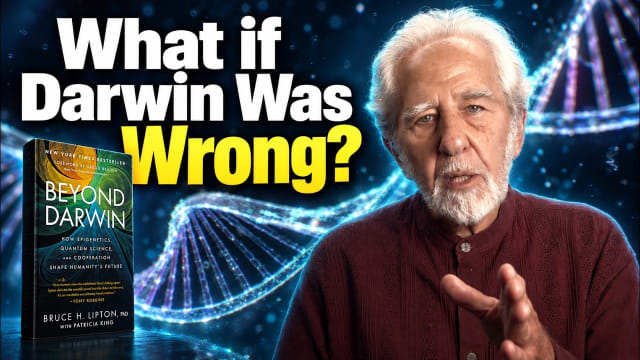
[40:00] book. I know I did. Beyond Darwin: How
[40:02] Epigenetics, Quantum Science, and
[40:05] Cooperation Shape Humanity's Future in
[40:08] 2026. We are really getting beyond this
[40:11] binary is it scientific or spiritual? Um
[40:15] we realize that the brain and the heart,
[40:17] uh
[40:19] share a connection much deeper than the
[40:21] old matrix
[40:22] allowed us to
[40:24] recognize. And Bruce Lipton is one
[40:26] leaders in sort of putting it all
[40:28] together for us.
[40:30] Bruce, I'm I'm thrilled that uh um
[40:34] your your voice is just it's always been
[40:36] important, but there's a particular a
[40:38] resonance and thank you for everything
[40:41] that's in this book. Is there anything
[40:44] any last comments that you want to make?
[40:45] We'll put all the information about your
[40:47] website and everything.
[40:49] >> Yes, I would like
[40:50] >> Any last comments?
[40:51] >> comments for the end. Number one,
[40:54] I want to appreciate you Marianne as
[40:56] being one of the imaginal cells that can
[40:59] help us move from this old world into a
[41:02] new world. It's very important for me
[41:04] because you can you have a voice that
[41:07] can go out. Number one. Number two,
[41:10] I want to thank the audience because the
[41:14] audience that is here now is open to
[41:18] giving a new idea, giving a new story,
[41:21] help me move from here to another place.
[41:24] The audience represent cultural
[41:26] creatives, people looking for a better
[41:30] way. They are the seeds of the future.
[41:34] So audience
[41:36] >> thank you very much.
[41:37] Just remember this evolution is
[41:40] participatory.
[41:42] Don't wait at home and think it's going
[41:44] to happen one day. We have to live it
[41:47] every day. And
[41:50] listen to Marianne, she's got the story.
[41:54] >> Right back at you Bruce. And everybody,
[41:56] I think the point that Bruce just made
[41:57] is so important. Each and every one of
[42:00] us is has to be the imaginal cell. Each
[42:02] and every life, the Course of Miracles
[42:04] says all of the children of God are
[42:06] special and none of the children of God
[42:07] are special. We all have have our part
[42:10] to play. And I think that we began today
[42:12] with Bruce talking about this kind of
[42:14] victim mentality, this sense of
[42:16] powerlessness, so many ways that we're
[42:18] told we're damaged, we're not good
[42:20] enough, um,
[42:21] that actually is not as humble as it
[42:23] appears. In a way it's arrogant because
[42:25] if you are a divine creation, how can
[42:27] you not have the potential, uh, for
[42:29] perfection, power, strength, goodness,
[42:31] and beauty, and creativity? So, thank
[42:34] you for reminding us. Thank you for
[42:35] informing us, Bruce. And, uh, I agree
[42:38] with you. Uh, people can only speak, uh,
[42:42] as deep as the listening
[42:44] uh, of the audience is. And I think
[42:46] today, particularly because of the
[42:48] chaos, there is a new appreciation
[42:51] because there's a realization that the
[42:53] old way has taken us to where we are.
[42:55] It's like in AA when they say, "Your
[42:56] best thinking got you here." So, I know
[42:59] you feel as I do, "Oh, there's a whole
[43:00] new listening." So,
[43:03] let's go for it, right?
[43:04] >> Thank you.
[43:05] >> God bless you, sir. Thank you so much.
[43:07] Okay, everybody. See you later.