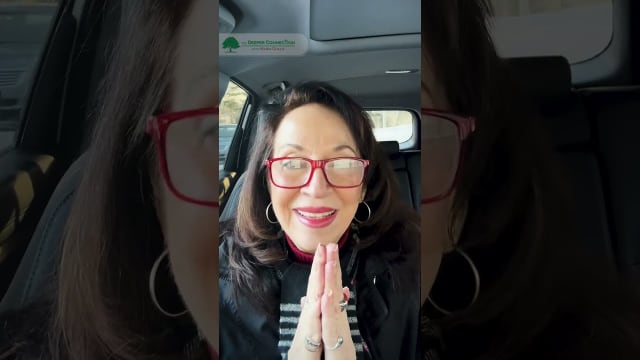
It is the week before Thanksgiving in 2016, a fall day, and a spiritual director sits in front of her camera greeting people she calls her "cell friends." Maria Gullo leads the Deeper Connection, a contemplative Christian prayer ministry, and she opens by thanking the people who have gathered with her from wherever they happen to be in the world. Then she names the thing most of us quietly carry into any season of thanks: sometimes gratitude does not rise. Her teaching on that problem is disarmingly direct. If gratitude won't come, ask for it. Say the honest sentence, that you are not feeling grateful right now and would like to receive it, and trust that God will pour it into your heart. From there she moves into a prayer she has adapted, the Prayer of St. Francis, which she reads slowly with listeners' eyes closed and their breath deepened. What follows is a close look at that teaching, why asking is more than a comforting platitude, and how the prayer itself is built to change the position of the heart.
Gullo does not pretend the obstacle is imaginary. She names the reasons plainly: "it could be a trauma or crisis or an illness of our of a loved one or maybe something's not going well at work." That honesty matters. A great deal of popular gratitude advice assumes the feeling is a switch you can flip if you just count your blessings hard enough. Gullo's view is different. She treats the absence of gratitude as information about the state of a life, not a moral failing to be corrected.
Her response is to change the direction of the effort. Rather than forcing the feeling up from inside, you bring the lack to God. In the video she models the sentence itself: "I'm not feeling grateful right now, but I would truly like to... I would like to receive that from you." At 1:19 she makes the promise that gives the practice its spine: whenever you don't feel gratitude, "you can ask for it," and God, "who has created this benevolent universe for you, will pour out gratitude into your heart."
"Whatever and whenever you don't feel that gratitude, you can ask for it. Simply ask God." (Maria Gullo, Deeper Connection video, November 2016)
What makes this more than wishful thinking is the posture it asks for. Asking requires admitting you are empty. It moves gratitude out of the category of an achievement you must produce and into the category of a gift you can receive. For anyone who has ever felt guilty about not feeling thankful on a holiday, that shift can be enormous. The feeling is still absent, but its absence is no longer a verdict on you. It becomes a sentence you say out loud to the one you believe can supply what you lack.
The second movement of the teaching begins at 1:53, when Gullo turns from the large, painful things to the ordinary ones. "Maybe the big things are not going well," she says, "but perhaps it's the small things that we so take for granted." Her list is deliberately mundane: food in the refrigerator, hot running water, heat, the ability to get up and stand on both feet and walk. She adds the people within earshot, a face on a screen, and the voices of grandchildren.
There is a craft to this kind of attention. Gratitude for big events tends to be episodic. It arrives with a promotion, a recovery, a wedding, and then it recedes. Gratitude for a working tap or a warm room is structural. It is already present in the background of a life, and the discipline is simply to notice it. Gullo's phrasing is careful on this point. "Whatever the simplest thing is," she says, "sometimes just settling on that and just recognizing that and receiving that is enough." The word that matters there is "enough." She is not asking listeners to inflate small comforts into grand miracles. She is asking them to stop walking past what already holds them.
For a practitioner, this is a usable instrument. When the request to God feels abstract, the small inventory gives it something concrete to land on. You name the refrigerator, the water, the legs that carry you, and the gratitude you asked for has a shape. It is also worth noticing how the two movements connect. The first asks for a gift you lack. The second teaches you to see the gifts you already have. Together they keep the practice from becoming either self-pity or false cheer.
Before she reads a single line of the prayer, Gullo makes a claim about method that is worth taking seriously. At 3:07 she says she always tells people that the heart's position is the foundation of prayer, "because it is." Her explanation is direct: "It's not so much our words but the positioning of our hearts." Her instructions are equally physical. Take a deep, cleansing breath. Close your eyes. Feel yourself in the space you are in. Let your presence be in the presence of the Living God.
This is the part of the video that a musician might recognize as a discipline of tone before technique. A player can know every note and still sound hollow if the instrument isn't warmed, the breath isn't set, the attention isn't in the room. Gullo treats prayer the same way. The words of the Prayer of St. Francis are important, but they are meant to be carried by a settled, open state. She is careful to say that she does not have the prayer memorized and will read it aloud, and she invites listeners to read along in spirit, "if you would just open up your hearts and minds." The reading is not a performance. It is a shared act of being in one place at one time.
Gullo introduces the piece as "a prayer I adapted," which tells you something about her approach. She is not reciting a fixed text to be checked off. She is shaping an inherited form to fit the people in front of her. Its opening addresses God as "source of life, source of love," and then asks a question that reverses the usual direction of prayer: "may I be your messenger in a world that's in desperate need of you?"
Read through, the prayer moves in a clear arc. It asks to become an instrument of peace in a world of "division and discord," to bring love into "anger and hatred," to bring compassion where there is "hurt and suffering." It asks to be a voice of hope in darkness and joy in sadness. Then it turns inward and corrects itself. Rather than seeking its own comfort, the speaker asks to show mercy and to be a comfort to others. Rather than needing to be heard, or needing to be right, the speaker asks for "patience understanding and a willingness to listen."
The final stanza is the most compressed, and it is where the teaching about gratitude returns in a deeper key. "All I desire is already provided for me," the prayer says, and then: "it is in giving that we receive, in forgiving that we are set free, and in dying to self that we are born into our true eternal life." Gullo closes with "let it be so, let it be now, let it be amen." The whole arc fits her opening claim. You do not generate gratitude by effort alone. You receive it by giving, by forgiving, and by loosening the grip of the self that keeps insisting it is owed more.
"It's not so much our words but the positioning of our hearts." (Maria Gullo, Deeper Connection video, November 2016)
Near the end, at 6:08, Gullo points listeners to Insight Timer, a mobile meditation app, where she has recorded six or seven tracks, including the prayer of Saint Francis and other prayers the community has prayed together. She notes that the app holds a very large library of guided meditations, and that searching her name brings up her recordings. She closes with a Thanksgiving blessing and the phrase "until we pray again."
The strength of a teaching like this is that it does not need a special setting to work. There is no required liturgy, no ritual object, no credential needed to practice it. You need a breath, a closed or lowered gaze, a plain request to God for the gratitude you lack, and an honest look at the refrigerator, the running water, and the people in the next room. Gullo's proposal is that the gap between wanting to be thankful and being thankful can be bridged by asking. That is a small claim, and it is also the kind that many people spend years discovering on their own.
If this teaching speaks to you, start small and keep it honest. Try Gullo's own sentence the next time gratitude feels locked: name the absence, and ask to receive what you cannot produce. Then take inventory of the ordinary things that are already holding you up, and let one of them be enough. When you are ready, read the Prayer of St. Francis slowly, with a deep breath before the first line, and pay attention to where the prayer asks you to move from wanting comfort to offering it. The video is short, roughly seven minutes, but the practice it describes is one you can return to every day, in any season, including the weeks when thanks does not come easily.