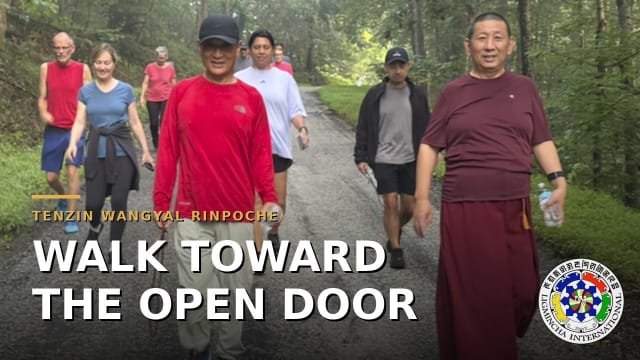
Tenzin Wangyal Rinpoche opens this guided meditation with a question most of us would rather keep at arm's length: if the great moment of death arrived today, would you be ready? Recorded at Serenity Ridge Retreat Center during the October 7, 2026 retreat "Being Present to the Moment of Death: Wisdom, Medicine, and the Journey Through the Bardo," and published by Ligmincha International, the talk works through a simple and demanding inventory. It asks us to look at what we grip on the outside, our possessions, status, connections and life stories, and what we grip on the inside, our roles, responsibilities and sense of identity. Drawing on the Bardo prayer, a chant of dissolution and transition that Rinpoche sings near the midpoint, the session treats letting go not as a morbid exercise but as a practice that returns space, time, energy and peace to the living. It is a meditation for a quiet afternoon, and for the rest of the week.
The phrase is a deliberate metaphor. A traveler who is packed has decided what to take and what to leave behind. Rinpoche asks listeners to make that same decision about their inner life before it is forced on them. He frames it as two linked questions: am I ready, and if not, what do I need to attend to so that I can be?
He is careful about the method. He does not ask for a quick yes. He asks for a pause, full attention in the body, and a willingness to stay with the question long enough for something real to surface. The meditation's first section is largely silence broken by his gentle prompts, and the emphasis is on depth rather than speed.
"If one does not feel I'm packed, I'm ready. Then let's look at it closer. What are the things?"
— Tenzin Wangyal Rinpoche, guided meditation, Ligmincha International (5:14)
That instruction matters. Readiness is not a feeling you either have or don't. It is a set of specific attachments, and the work is to name them.
The central teaching here is what Rinpoche calls grasping for permanence. In the Bardo teaching he draws on, he explains, we grasp at the outer world, "our possession, our status, our connection, our story," as though these things will last forever. Grasping, in this sense, is less about wanting things than about quietly assuming they will remain. The house, the reputation, the relationship, the narrative we tell about ourselves all carry an unspoken guarantee that they will not change.
On the inside, he says, we cling to our identity, our role, and our responsibilities. "I'm not ready to let go of it" is his own example of the voice that arises here. The prompt he offers is to narrow it down: what exactly is the reason? Not a general reason, but the specific one, reflected on until a few clear answers emerge.
His point is that the grip itself is the source of suffering. He puts it plainly near the end of the reflection:
"Nothing stays forever like that. Expecting is the source of suffering. So I'm ready to let it go."
— Tenzin Wangyal Rinpoche, guided meditation, Ligmincha International (11:54)
Notice that he does not say that everything we love is bad to love. He says that it is bad to expect that it will stay the same. Expectation of permanence is what turns change into loss.
The inner section is the most pointed part of the talk. Rinpoche asks listeners whether they are ready to let go of their roles, and then sharpens the question: it is not usually the role that is the problem, but the way we carry it. Sometimes the way we do our jobs, parent, care for others or run our households is draining, stressful, exhausting, even making us sick.
He names specific patterns. We may feel that others need us to grip things more tightly, control more, or be present all the time. "They don't need to be grasp as much but you do," he says, and "They don't need your presence all the time but you do. You feel you think you do." The insight is uncomfortable but precise. Much of what we call responsibility is a need to be indispensable.
"Not only it draining you, it drains others. Family members, friends, coworkers, colleagues, employees."
— Tenzin Wangyal Rinpoche, guided meditation, Ligmincha International (8:54)
He links these two kinds of grasping, outer and inner, to health and well-being. Exhaustion, losing motivation and losing hope are the symptoms he associates with a life that is held too tightly. The question he leaves listeners with is how these grips affect their sense of being alive.
Rinpoche is explicit about the payoff. When we loosen our grip on outer possessions and inner roles, we "feel more space, time, energy, peace." He describes this as becoming "more alive, more simple, more joyful." He points to the joy of embracing new things, the resilience of facing new challenges, and the excitement of discovering something unfamiliar. Those, he suggests, are the experiences that make us feel alive, in contrast to the focus on identity and story that keeps us static.
The practical edge comes in his suggestion that this is not a single sitting. He describes the reflection as a few simple questions to carry through the rest of the retreat week and into everyday life, both formal sitting and informal moments. The answers, he says, should stay with you.
Around the 13-minute mark, Rinpoche begins to sing the Bardo prayer. He describes it as a prayer of dissolution, transition and change. Change, he notes, happens constantly, every day, but the largest transition is the one at the end of life. The chant is offered as a way to become familiar with that transition before it arrives, so that the listener can feel comfortable with the idea and move through it with a sense of peace and compassion.
The transcript of a sung passage is hard to follow, so this guide does not attempt to reproduce the lyrics. Rinpoche invites listeners to follow the translation if they wish, but also simply to listen to the sound. That emphasis is worth taking seriously. The meditation is not asking you to parse doctrine. It is asking you to let a chant do what words in ordinary speech cannot: slow the mind and make the idea of dissolution sensory rather than abstract.
After the prayer, Rinpoche guides a sequence of dissolution. Listeners are asked to feel the elements of earth, water, fire, air and space dissolving. The body's energy dissolves into breath, and breath dissolves into consciousness. He invites the mind to rest in that clearing, in peace, and then to enter what he calls the inner essence and inner refuge.
"Enter into inner essence, inner refuge. In this vast sky of being, in that clear light awareness, in that union where warm peace is present as if it's last moment of our transition life, feel that peace."
— Tenzin Wangyal Rinpoche, guided meditation, Ligmincha International (25:07)
For a beginner, the practical move is simple. Sit comfortably. Let the sense of the body become less solid, then less dense, then more like breath. When thoughts about the past or future arise, return to the image of the elements loosening. You are not trying to force a particular experience. You are rehearsing an openness that the prayer describes.
The session closes with a dedication, in which Rinpoche asks that the practitioner's experience and realization of wisdom may increase. A dedication is a traditional way of turning the merit of a practice outward, and it gives the whole session a sense of direction beyond the individual.
The most useful way to approach this video is to treat it as a set of questions rather than a single session. Begin with "Am I packed?" and give it a few minutes of honest attention. Make a short written list of outer things you grip, such as possessions, status, connections and stories, and a second list of inner things, such as roles, responsibilities and identity. Then narrow each list to the one or two grips that feel most important, and ask what it would mean to hold them more lightly.
Next, notice where your roles drain you or the people around you, and whether you are being needed in ways that are not truly needed. Finally, return to the Bardo prayer as a practice of familiarity. Listen to it several times, follow the translation if it helps, and let the sound do its work. Over time, the question of readiness becomes less frightening and more like a companion. Rinpoche's own image is the one that closes the meditation: resting in the vast sky of being, feeling the warm peace that is available now, not only at the last moment.