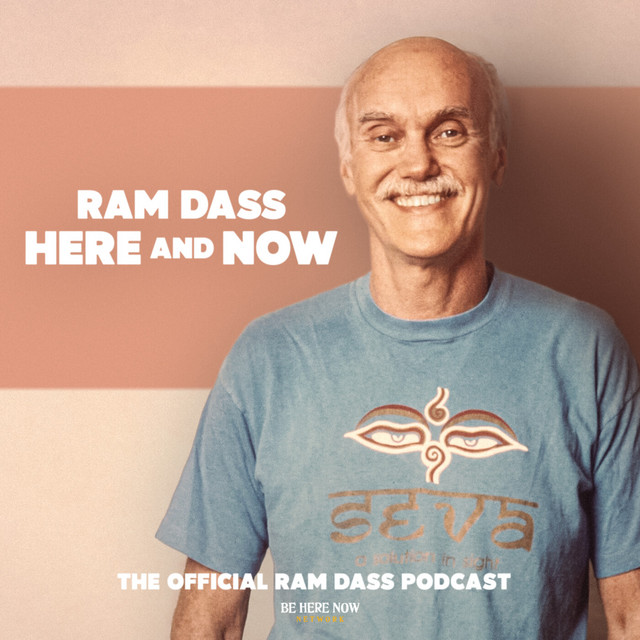
In a 1980 address to the American Psychological Association in Montreal, Ram Dass presents a lived case study of altered consciousness—from his Harvard years and early psychedelic research with Tim Leary, through intensive work with consciousness-altering chemicals, to his spiritual practices in India. His core insight: psychedelics and meditative work don't detach you from emotional experience; instead, they create a paradoxical expansion where you become less identified with emotional states while simultaneously more fully present within them. This shift from identification to witness consciousness transforms the texture of moment-to-moment living and opens questions about the nature of reality itself.
Ram Dass grounds his exploration in concrete biography. As a professor at Harvard, he inhabited a world of rigorous psychological study—the conventional framework for understanding mind and behavior. His encounter with Tim Leary catalyzed everything. Leary's work with psychedelics at Harvard represented one of the first systematic academic investigations into consciousness-altering substances within institutional settings. For Ram Dass, this meeting opened a door that would not close. What began as intellectual curiosity became methodical experimentation and, ultimately, a complete reorientation toward the nature of consciousness itself.
The first psychedelic experience was pivotal. Rather than a footnote or passing episode, Ram Dass describes it as propelling him into years of sustained research with consciousness-altering chemicals. This was not casual recreation but deliberate exploration—what he calls becoming "a master of getting high." The commitment was rigorous: Ram Dass wasn't sampling experiences casually but systematically investigating what these states revealed about the structure and capacity of human awareness. Each session became data, each dissolution of ordinary perception a question posed directly to the nature of mind.
Here lies the paradox that Ram Dass places at the center of his inquiry. The conventional view assumes that altered states either overwhelm emotion with intensity or suppress it with detachment. Ram Dass describes something more subtle and more profound: "I found myself becoming less identified with my emotional states and my psychological qualities and characteristics, and perplexedly enough, at the same moment, more involved with them. I seemed to be living more fully in the moment of the feelings, and yet, at the same moment, being more spacious around them."
This is not dissociation or numbness. The emotional content remains vivid, immediate, textured with full feeling-tone. But something shifts in the observing capacity. Instead of being the emotion—conflated with anger, fear, joy, or sorrow such that the emotion and self are one unit—consciousness expands to contain the emotion. You become a witness to your own states rather than their puppet. This distinction matters clinically and existentially. It means the person retains agency and awareness even in the midst of strong feeling. The emotion flows, but you are not drowning in it; you are not identified as it.
Ram Dass notes what he calls "the horrors of coming down." This is the difficult inverse of the expanded state—the return to ordinary consciousness, to the contracted identification with emotional and psychological content that ordinarily feels natural and inevitable. Coming down from profound expanded states reveals by contrast how much of ordinary consciousness is a contraction, a narrowing of awareness into identification with thoughts, feelings, and the story-self. The body aches, the mind clouds, the spaciousness collapses. This experience of descent becomes itself a teaching: it shows that the expansive awareness accessible in altered states is possible for human consciousness, which means the ordinary narrow identification is not inevitable or ultimate.
Through years of research with psychedelics, Ram Dass developed a specific capacity: the ability to empty the mind and become more of a witness to experience. This is not merely intellectual understanding but a trained competency—something built through repeated practice within the psychedelic state. Each session strengthened the observer function, the part of consciousness that could stand back and perceive the flow of mental content, sensation, emotion, and perception without being sucked into identification.
This witnessing capacity is not unique to psychedelics, but psychedelics accelerate and clarify it. In ordinary consciousness, the witness is faint, easily overwhelmed by identification with thought and feeling. Psychedelics crank up the volume. The boundary between observer and observed becomes so clear that it cannot be denied. You see yourself thinking rather than being your thoughts. You observe emotions arising and passing rather than being locked in them. This is elementary to contemplative traditions, but lived in the psychedelic state with such intensity that the possibility becomes undeniable.
The benefit outlasts the chemical. Ram Dass's description suggests that the repeated experience of witnessing during altered states trained and stabilized this capacity even in ordinary consciousness. The mind becomes habituated to standing back, to observing, to not immediately identifying. This is the genuine contribution of psychedelic research to consciousness studies: not a drug-induced high, but a reorganization of the mind's basic stance toward experience.
The journey to India represents a shift from chemical to traditional spiritual methodology. Ram Dass encountered a guru—a teacher steeped in practices and lineages that had been refining consciousness work for centuries. One pivotal moment encapsulates the meeting of worlds: Ram Dass gave his guru psychedelics. This is not incidental. It suggests Ram Dass approaching his teacher not with blind deference but with genuine curiosity and a desire to see how the psychedelic experience might land in someone who had achieved realized states through non-chemical means.
The response of the guru to the psychedelic experience became itself a teaching. Rather than being overwhelmed or disoriented, the realized teacher seemed to treat the altered state with equanimity—neither clinging to it nor rejecting it. This suggested to Ram Dass that mastery of consciousness extended beyond the psychedelic route, that there were other means of accessing and stabilizing expanded awareness that didn't depend on chemical triggers. The guru's steadiness in the face of profound alteration demonstrated that consciousness transformation was possible through practice, discipline, and grace in a traditional lineage.
In India, Ram Dass' experience of time began to shift fundamentally. This is subtle but significant. In ordinary Western consciousness, time is a constant arrow—linear, measurable, never still. The sense of being trapped in sequential duration is so complete that it feels like the fabric of reality itself. But intensive practice with a guru, exposure to teachings rooted in non-dual awareness, and sustained meditation began to loosen this grip. Ram Dass describes the shifting perception of time as a sign of consciousness touching different layers or planes of reality.
Ram Dass closes his address by introducing the notion of different planes of consciousness. This is not metaphorical fantasy but a working map derived from both personal experience and traditional teachings. If consciousness can shift radically with psychedelics—if time can feel different, if identification can become witness-awareness, if emotions can be felt fully while spaciousness opens around them—then these shifts point to the existence of different modes or dimensions of consciousness.
The planes are not reached by going up in some mystical direction but by shifting the fundamental operating parameters of awareness. Different planes might be characterized by different relationships to time, different density or permeability of the sense of self, different degrees of separation between subject and object, different qualities of knowing and being. Psychedelics can access some of these planes dramatically. Traditional meditation and guru practice access them more gradually and, Ram Dass suggests, more stably.
The significance is not that planes exist as metaphysical facts independent of consciousness, but that consciousness itself has a vast range of possible configurations—many of which Western psychology had not traditionally mapped or validated. By presenting these experiences to the American Psychological Association, Ram Dass was asking the scientific community to expand its model of the human mind to account for the full range of consciousness available to human beings, not just the narrow band of ordinary waking awareness.
The practical upshot of all this research—psychedelic, meditative, and traditional—is a transformed relationship to the basic texture of living. Ram Dass emphasizes that the shift from identification to witness is not cold or detached. Paradoxically, as identified-ness decreases, presence and involvement deepen. You feel emotions more fully, more vividly, because you are not bracing against them or trying to control them. The spaciousness around emotional states is not indifference; it is a vastness that can hold feeling without being consumed by it.
This has implications for psychological suffering. Much distress comes from identification—from the belief that I am my anxiety, I am my anger, I am my shame. When consciousness shifts to witness mode, the experience remains but the identification loosens. The anxiety is felt but not believed to be your permanent truth. The anger flows but doesn't define your essential nature. This is not suppression or denial but a more spacious and ultimately more sane relationship to the full range of human emotional experience.
Ram Dass's presentation to the American Psychological Association in 1980 was not a retreat into mysticism but an invitation to psychology to take seriously the data of altered consciousness. His argument rests on lived experience examined with rigor: psychedelics can be research tools that reveal the plasticity and vast potential of human consciousness. Meditation and guru practice offer sustainable methods for accessing and stabilizing expanded awareness. The convergence of these paths points to a consciousness that is far less fixed and far more capable of transformation than ordinary perception suggests.
For anyone interested in the practical transformation of consciousness—whether through meditation, psychedelics, or traditional practice—the key insight is the possible shift from identification to witness. This shift is not theoretical. It can be directly experienced, sustained, integrated into daily life. Ram Dass's work suggests that the highest opportunity available to human beings is not to escape consciousness but to expand it, to learn to inhabit the full range of what awareness is capable of, and to let that expanded awareness reshape how we live, feel, and understand reality.