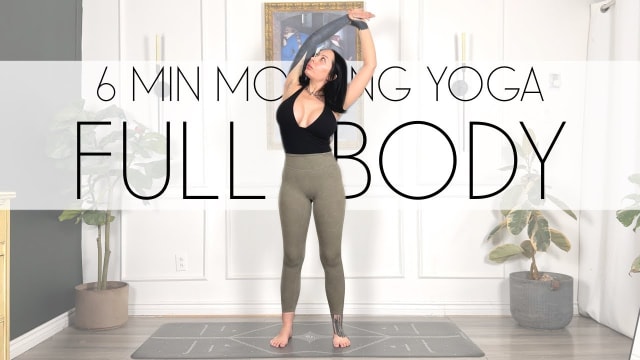
A five-minute morning class asks very little of you and gives back a surprising amount of structure. The video, posted to the Yoga With Bird channel and running just under five minutes, begins with the body lying on the floor, rocks the knees and hips to loosen the lower back, folds into a happy baby pose, rolls up to a seated position, and then moves through side bends and twists paced to the breath before closing with hands at the heart. It is a short, deliberately gentle sequence built on a simple idea: wake the body in stages, moving from the least demanding position to the most upright one, so that the day begins with warmth rather than a jolt.
The class opens on the back. At the start, the instructor invites the viewer to take a big stretch and yawn, and to wiggle the fingers and toes before doing anything else. That opening cue, at about the 0:13 mark, sets the tone for everything that follows: nothing here is meant to be forced. The first real movement, around 0:38, is a gentle side-to-side rocking of the knees, rolling over the glutes and the lower back. Many people wake up stiff in exactly that area, and a slow rock is one of the simplest ways to introduce motion there without asking the muscles to work hard.
From there the class moves into happy baby. Around 1:36 the knees are drawn toward the chest, the knees splay open, the hands grab the outer edges of the feet, and the soles are brought together. The instructor then suggests rocking gently from side to side, saying this "will help massage the muscles along the spine." That is the instructor's own description of the movement, and it is a useful way to understand the pose: the rocking is doing as much of the work as the position itself.
"Feel free to modify or skip any poses that don't feel right today."
— the instructor, at the top of the class (0:08)
Starting supine is a choice worth noticing. Lying down removes the need to balance, which means the nervous system and the joints can ease into movement without the demands of gravity pushing back. Rocking in this position is a low-stakes way to test how the body feels this morning. If the lower back is tight, the class gives it a chance to speak up before anything more demanding arrives. If it feels fine, the rocking simply becomes pleasant. Either way, the first few minutes are about finding out what the body is ready for.
There is also a practical logic in the order. The floor work warms the big muscle groups of the hips, thighs, and back while the body is still horizontal, and it does so with minimal risk of a sudden pull. By the time the class asks for a seated position, the spine has already been moved in several directions and the hips have already been opened, so the upright work does not arrive cold.
This is the quiet hinge of the class. Around 2:38, the instructor asks the viewer to grab the backs of the thighs and, using the core, rock all the way up to the seat. Rolling up from the floor is a movement many adults rarely do on purpose, and it asks the abdominal wall and the spine to organize themselves in sequence. The instructor pairs it with an explicit exit: "if this doesn't feel okay, just come up however you'd like." That line matters. A flow like this is only useful if the person doing it is willing to adapt, and the cue gives permission to choose a different route up.
Once seated, the class shifts to what it calls a comfortable seat "whatever that looks like for you." That phrase is a reminder that a seated position is not one fixed shape. Some people will sit cross-legged on a cushion, others on a chair, others with the back against a wall. The benefit of the seated stretches does not depend on a particular posture, only on being upright enough to lengthen the sides of the torso and rotate the spine.
The seated portion is built around breath. At about 3:08 the instructor asks the viewer to inhale the hands overhead, then exhale into a side stretch toward the left, with the option to come down onto the left forearm while the right fingertips reach over. The pattern repeats to the right, then into a twist toward the left, with the instructor noting "just twisting to your own ability." Each movement is held for a full breath cycle, and the cue is always the same: inhale to reach up, exhale to move.
Pairing movement with the breath is one of the oldest tools in yoga, and it does a practical job here. The exhale tends to let the torso soften into the side bend, and the inhale gives a moment to lengthen before the next exhale. For a morning practice, that rhythm does two things at once. It takes the body from horizontal to vertical in small increments, and it gives the mind a steady beat to follow, which is often what a groggy person needs more than any particular stretch. The side bends stretch the sides of the torso, a region that holds a lot of tension from sleeping in one position. The twists rotate the spine, which is often the most useful movement for shaking off the stiffness of a night in bed.
The class is careful to keep the twist optional and self-paced. That restraint is worth copying. A morning practice that pushes deep rotation on an unwarmed body risks strain, and a gentle twist after the floor work is a much safer way to explore the same movement.
The final cue, at about 4:45, asks the viewer to exhale and bring the hands to the heart center, then offers a brief thank-you and a closing "Namaste." The gesture gives the body a clear signal that the practice is finished, which can help the transition back to the day. It is a small ending, but a deliberate one. Five minutes is enough to move through the whole body, but not enough to leave you depleted, and the closing pause allows you to notice how you feel before you get up.
The channel's description frames the class as a way to "start your day on a positive note" and to "wake you up and promote energy." Those are fair aims for a practice this short. The class does not claim to do more than that, and that modesty is part of what makes it easy to repeat.
Three things stand out. First, the sequence is ordered from floor to seat, which is a sensible way to build any short practice. Second, the instructor repeatedly gives permission to modify, skip, or come up in your own way, and that permission is the most important safety feature in the video. Third, the breath is treated as the timing system for the whole class, which is a good habit to carry into any movement practice.
A caution is also warranted. The video's own disclaimer advises consulting a physician before beginning any exercise program, and it asks viewers to work within their own limits and stop if anything causes pain. Anyone with a back injury, recent surgery, or a condition that affects balance or mobility should check with a clinician before attempting floor work and rolling up to sit. Movement should feel like a gentle stretch and a warming, never like sharp pain.
If this class felt like a good start, the best next step is simply to repeat it for a week and notice what changes. Pay attention to how the lower back responds to the knee rocks, whether the happy baby feels different on different mornings, and how the breath-paced side bends land once the body has warmed up. If you find yourself wanting more time, the same arc of floor, roll-up, and seated work scales easily to a longer session. And if you want to understand the logic behind the sequence more deeply, focus less on any single pose and more on the order: start where the body is easiest to move, then build upward with breath as the guide.
A five-minute practice will not transform anyone's morning on its own. What it can do, done consistently and gently, is give the body a reliable way to say good morning before the rest of the day begins.