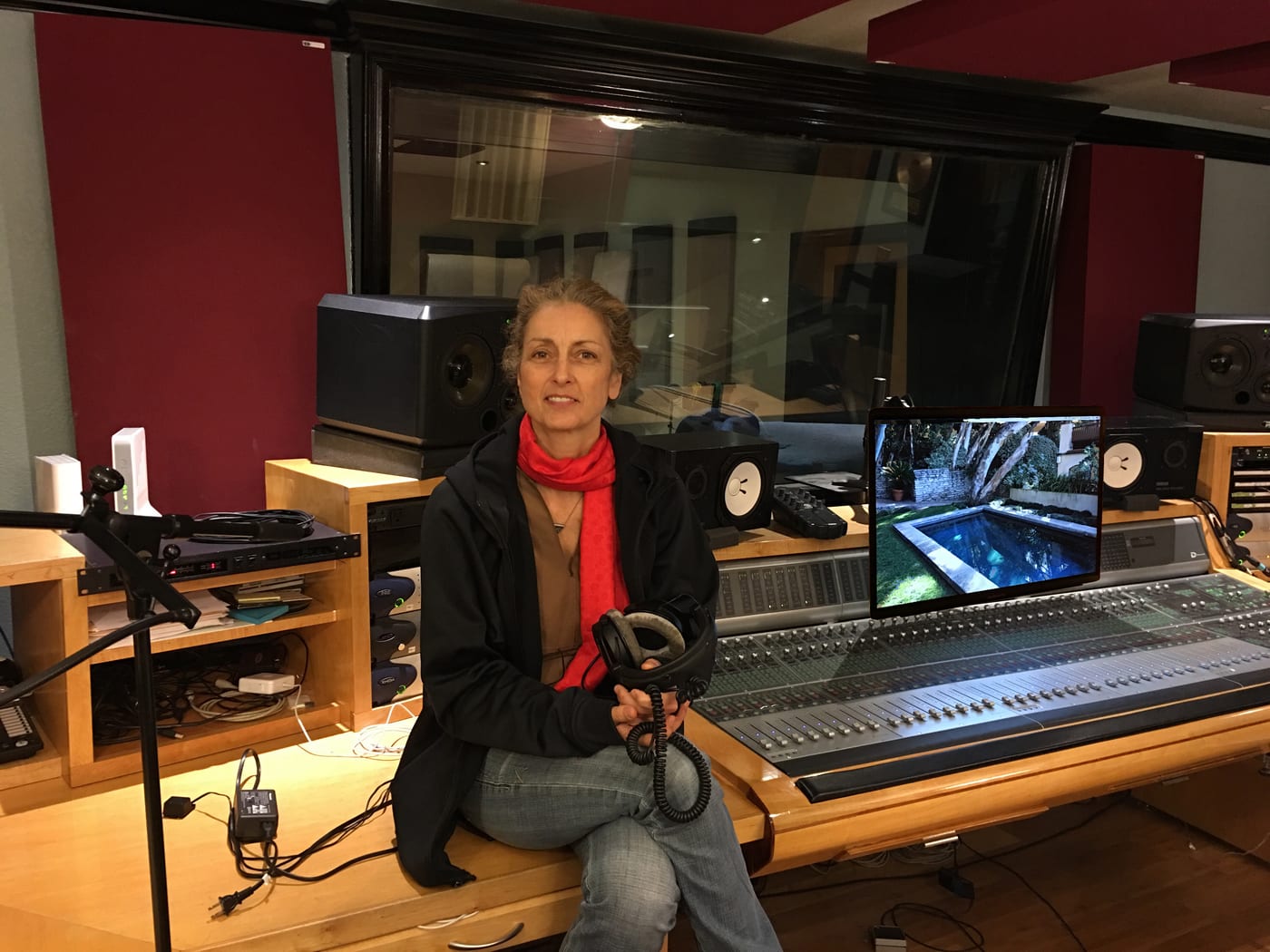

The core of Wah!'s music is Sanskrit mantra sung over harmonium, with her own voice carrying the melodic lines and the call-and-response shape of kirtan. Where a traditional kirtan might rely on unamplified room singing, her sound is warmer and more produced. In her online kirtan concerts she adds Ableton Live to the vocals and harmonium, so the layers are assembled electronically rather than played by a large ensemble. The result sits closer to a modern studio recording in places than to a hand-drum-and-harmonium circle.
Tempo shifts with the project. Her album It's Friday Night gathers mid-tempo mantra, a pace that rewards steady repetition rather than build-and-release drama. The Healing Concert moves slowly, matched to its slow-moving laser lights and projections. The High Energy Dance and Instrumental Mixes Vol. 2, from 2018, push the pulse harder for a more physical kind of listening. Underneath some of this work is a rock-band instinct: since 1997 she has played bass guitar with her joyful rock band at yoga festivals and centers around the U.S.
Her work belongs to bhakti, the devotional path in which sung names of the divine carry the practice, and her form is kirtan, the call-and-response chanting of India. The Sanskrit mantras on her recordings and in her online concerts sit within that devotional current, and the catalog titles show it: Prabhuji, DEVOTION, and the 2024 single Prano Devi Saraswati, which invokes a goddess by name. Ganeshaya, a 2019 single, is devoted to Ganesha.
No teacher or line of succession is named in the available material, so none is assigned here. Her website describes her as the first female to bring kirtan to the West in the 1990s. That is her own account, and it is best read as such. Her yoga-teaching frame and her sound-healing vocabulary extend the practice into wellness-world language, which some purists of Indian kirtan may see as a departure from older forms.
What sets her apart is the treatment of mantra as living material rather than fixed liturgy. The catalog reaches into rock, dance, and dub: the reggae-influenced Chill Yoga Music 2 pairs asana music with dub and reggae beats, and the 2018 Yellow Lakshmi remixes show her material being reinterpreted by others. Her Savasana CDs, which her bio says have sold over 100,000 copies worldwide, served the closing-relaxation side of yoga practice and the therapeutic market alike.
Her live format is just as distinctive. The Healing Concert, begun in 2012, combines projections, slow-moving laser lights, and live music, with the stated aim of inspiring world peace and peace within. It has been staged at science venues such as Fiske Planetarium, the Franklin Institute, and the Reuben H. Fleet Science Center. She has also performed at Omega Institute and the Globe Sound Healing Conference. Her books extend the idea: Healing: A Vibrational Exchange (2013) introduced the thinking behind the music, and Self Care offers tools such as tapping, meridian stimulation, breathing, and humming.
The record here is thin, and it is better to say so than to invent. Her joyful rock band is described only in general terms, so no individual players or producers can be named. The clearest named collaborator is the remixer Atom Smith, credited on the 2025 Ma Song remix. Beyond individual names, her Friday night online programs and the global community around them shaped It's Friday Night, so her audience is itself a kind of co-author of the newest record. Her work with visual and lighting design in the Healing Concert is another collaborative layer, though no designers are named.
Begin with Queen of Mantra, a 2019 eight-track album of Sanskrit mantra that presents the core kirtan sound without much else to distract. Its companion, Queen of Mantra (Instrumentals), released the same day, removes the vocals and lets the harmonium-led arrangements carry the mood, which makes the structure of the chants easier to hear. For something more recent, try It's Friday Night, released in June 2026, which marks 30 years in the music industry.
Expect repetition and devotional sincerity. The pleasure lies in staying with a phrase as it returns, not in variety. What may surprise you is the polish and the pulse: this is closer to a produced studio record, and at times a rock show, than to a hushed meditation. On It's Friday Night, one song is in English, the exception in a catalog otherwise sung in Sanskrit, and it is worth noticing as a deliberate change of language.
This is probably not the right door for listeners who want strictly traditional, unaccompanied kirtan, or fast electronic music, since the newest album is built around mid-tempo mantra. Those uneasy with sound-healing language will also find the books leaning on claims, such as vibrational exchange and meridian work, for which the available material offers no clinical evidence. Readers recovering from illness, injury, or trauma should treat Self Care as a complement to professional care.
Conscious music has a devotional wing and a wellness wing, and Wah! stands where they overlap. Compared with acoustic kirtan artists, she leans toward the studio, the band, and the multimedia stage. Compared with ambient sound-healing practitioners, she keeps the sung Sanskrit name and the call-and-response form at the center. The fan-made bumper sticker, "Less Stress More Wah!", suggests how personally listeners take her work.
Her roughly 67,775 Spotify followers point to a loyal niche audience rather than mainstream chart presence, and no awards or major press coverage appear in the available material. What the record does show is institutional trust: lectures at Princeton University and Loyola Marymount University, museum and planetarium stages, and a place at Omega Institute, where she is scheduled to appear in Rhinebeck, New York, on August 30, 2027. In a field that often prizes purity of form, her contribution is a willingness to let devotion meet amplification, remix, and light.