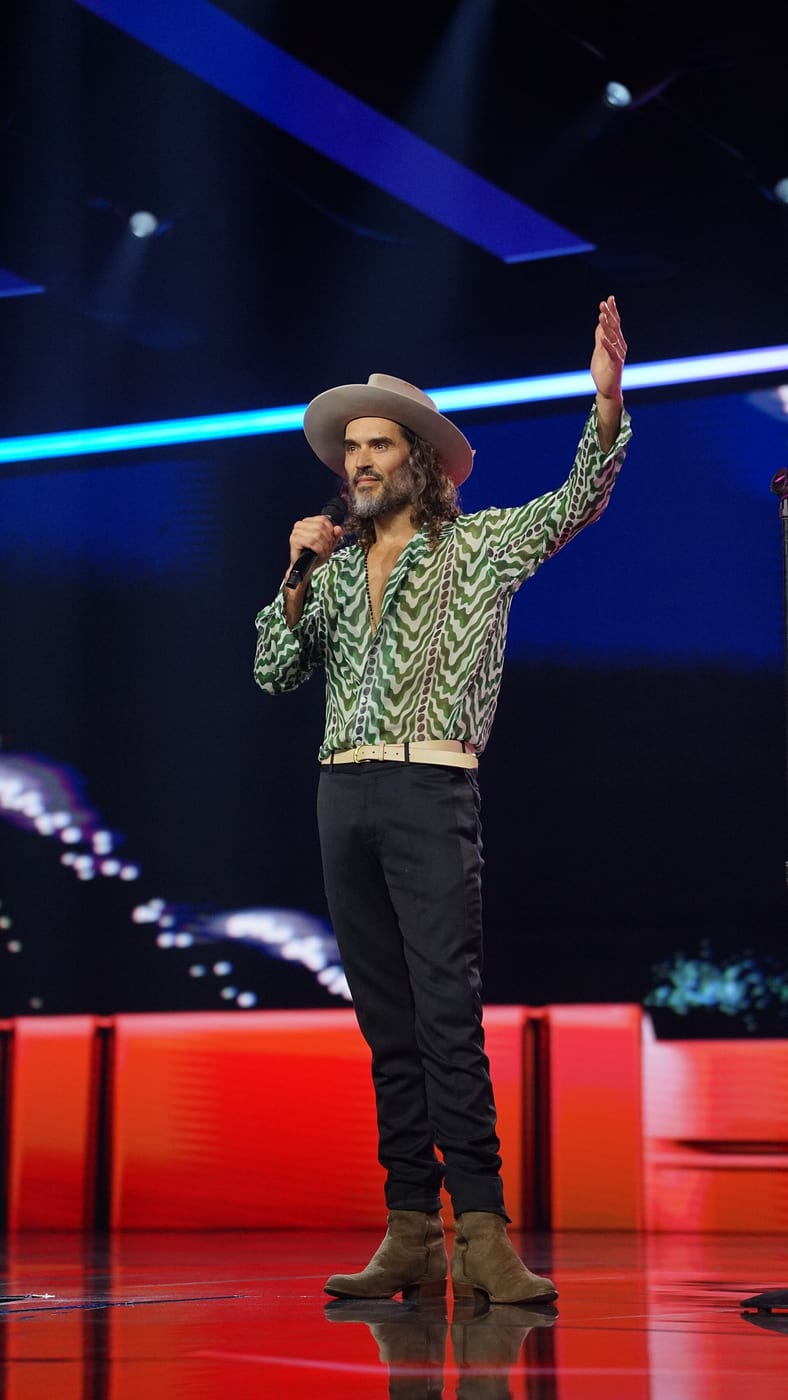

Russell Brand describes himself plainly. On his own website he says he is a comedian, and that he is interested in change. He says he is drawn to awakening, and that he feels people can approach it together because he has changed so much in his own life. Then he adds the line that frames everything else: he is still a comedian.
That sentence is a useful key to a career that has moved through stand-up, broadcasting, acting, podcasting and community-building. Throughout, he has kept comedy as his identity and turned it toward larger questions.
Brand was born in 1975 in Grays, Essex, England. He emerged in British stand-up in the early 2000s and became widely known as a stand-up comedian and presenter in the UK, working in radio and television. He has also worked as an actor and podcaster. The sources available here say little about his childhood or family, so this profile begins where the public record does: on stage.
The thread that runs through his work is recovery from heroin addiction. His 2004 stand-up show Better Now is his confessional account of that period, an unflinching telling that uses a comedian's timing without minimizing how serious addiction is. Audiences often cite it as the emotional foundation for understanding what came later.
This matters because of the way Brand's authority is built. He does not claim credentials, training or lineage in any spiritual tradition. What he offers is testimony: he lived through addiction, rebuilt his life, and speaks from that experience. The shift in his work, from pure comedy toward social commentary and personal transformation, grows out of that experience rather than a formal teaching path.
Brand's distinctive position is at the intersection of entertainment and earnestness. Many comedians keep an ironic distance from their subjects. Brand commits to his themes visibly: personal change, addiction, the systems that shape behavior, and the possibility of collective transformation.
His 2013 special Messiah Complex is the clearest example. It examines advertising culture and drug policy through the lens of figures such as Gandhi and Jesus, while keeping the comedic energy up. It is often described as the most ambitious of his specials and a bridge between entertainment and his deeper concerns. His other specials include Scandalous and Brandemic.
He is also not a spiritual teacher in the traditional sense, and he doesn't present himself as one. He doesn't claim to transmit practices or lead others from a position of mastery. His own phrase for the posture is "flawed but rising together."
- Stand-up: Better Now (2004), Messiah Complex (2013), Scandalous and Brandemic. The progression runs from personal testimony toward increasingly political social commentary.
- Podcasts: Stay Free with Russell Brand and Under the Skin with Russell Brand, which have become the main vehicle for his thinking. They work as extended dialogue rather than the compressed catharsis of an hour on stage.
- Audio and writing: His website offers a free audio book and a blog.
- Music: A secondary strand that includes the 2024 album How It All Started and singles such as "Revolution" (2023), "All Of Us Is One," "Ramblings from the Gospel of the Godless" and "Iron Gates Locking" (2026). These are best understood as supplementary to his comedy and conversation, and they echo the same themes in another format.
For newcomers, the podcast Stay Free is the most accessible entry point, since it shows his conversational approach, his guests and his preoccupations. Messiah Complex is the stand-up special to watch first. Better Now is the one to seek out for the roots of the story.
Today his work centers on conversation and community. He hosts Stay Free with Russell Brand and broadcasts live shows on weekdays on Rumble. His Awakened Wonders community on Locals carries extras, behind-the-scenes material and live Q&As. It is not a formal retreat, course or coaching program, and little is publicly specified about its structure, so the best way to learn more is through his website.
His YouTube channel frames the moment in his own words: "a time of incredible change and opportunity," in which people can learn from elders and grow together "in Good Faith, flawed but rising together." The language is aspirational, but it is consistently paired with humility about being unfinished.
One feature of his current work is unusually direct. He invites anyone who wants to change their life, or who is struggling with addiction, to write to him. He says that he and a team of volunteers will help, or point people to support, where they can. The volunteers are not presented as medical professionals; the offer is connection and direction-finding rather than treatment.
Brand reaches people who want comedy and conviction in the same package. The appeal is that he is not theorizing about addiction or change from a distance. He has lived through the struggle he describes and speaks about it with humor and sincerity intact. That gives his commentary on advertising, drug policy and corporate systems a weight that purely observational comedy often lacks, and it makes the link he draws between personal recovery and systemic change feel earned rather than abstract.
His work is also not for everyone, and a fair profile should say so. Listeners looking for escapist punchlines may find the earnestness didactic. People who are skeptical of recovery narratives or tired of awakening language from the many voices now using it may find his themes familiar rather than fresh. His music is not the place to find his major artistic statement.
Those caveats are part of what makes him interesting as a figure. He has moved from the compression of the stage to the long form of conversation, from performing for audiences to building something closer to a community, and he has done so while insisting that he is still a comedian. Whether one finds that blend compelling or exhausting, it is a distinctive and coherent project: a man who changed his own life, and who now keeps asking, publicly and with some humor, whether others can change theirs too.
His official website, russellbrand.com, is the central hub for news, essays, the audio book and a way to get in touch. The podcasts are available on major platforms, and his YouTube channel is regularly updated. No public tour schedule is currently listed, so the website is the most direct place to look for announcements.