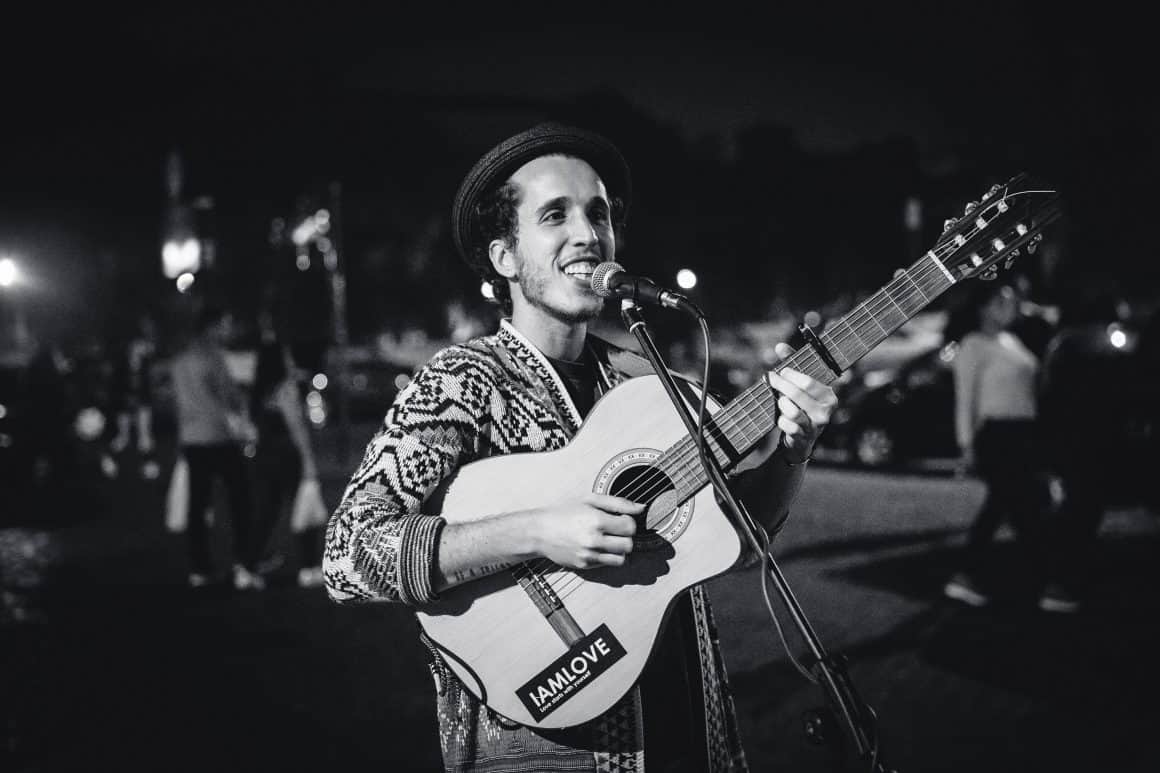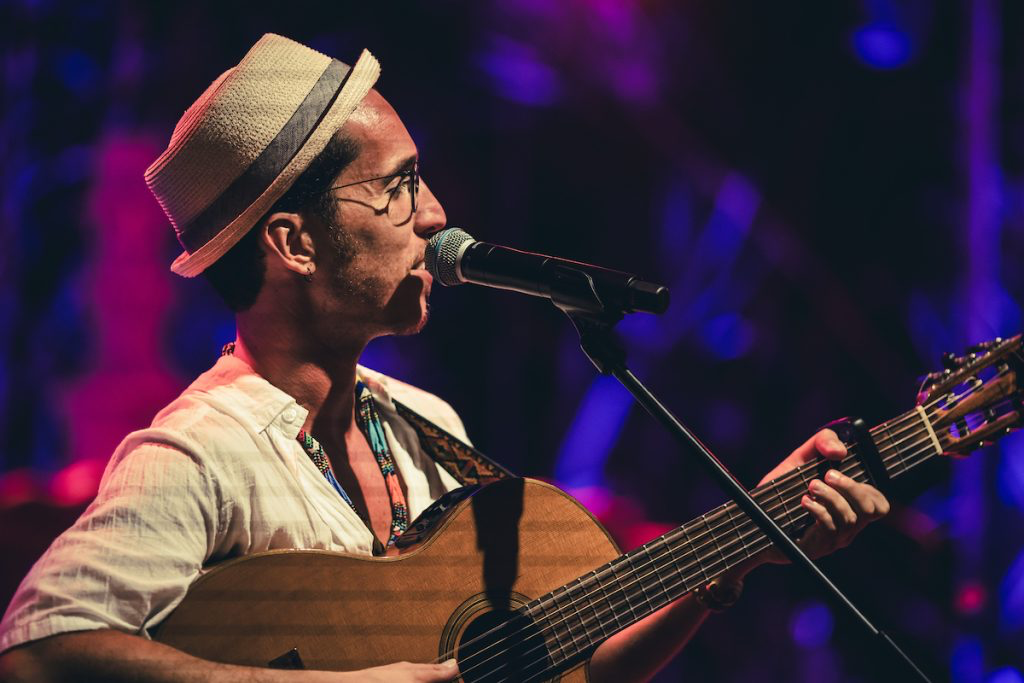
Roaman's music doesn't announce itself with gongs or harmoniums. There's no tabla pulse, no call-and-response chant structure, no obvious signaling that you've entered devotional territory. Instead, what arrives first is intimacy—a voice close enough to feel conversational, backed by acoustic guitar or minimal piano, sometimes layered with subtle electronic textures that shimmer rather than dominate. The tempo tends toward the unhurried: not quite ballad-slow, but spacious enough to let each word settle. This is music built for listening with your whole attention, the kind that asks you to lean in rather than wash over you.
The instrumentation reflects a singer-songwriter lineage more than a traditional sacred music one. Roaman works primarily with guitar, often fingerpicked in patterns that suggest folk and indie traditions—think early Sufjan Stevens or Iron & Wine's quieter moments, but with a lyrical focus that pivots toward emotional and social repair rather than narrative storytelling. When production enters the frame, it's textural: synth pads that hold space, vocal harmonies stacked into something choir-like but not liturgical, occasional percussion that pulses without driving. The overall effect is warmth without sentimentality, structure without rigidity.
If Roaman belongs to a tradition, it's not one with Sanskrit mantras or Sufi poetry at its root—at least not explicitly. Instead, their lineage is the emerging one of secular-sacred music: artists who treat emotional honesty and collective care as spiritual practice, who build ritual out of repetition and vulnerability rather than inherited form. This is the territory occupied by artists like Anais Mitchell, Hozier, and Gregory Alan Isakov—songwriters whose work carries devotional weight without religious framework, who understand that reverence can live in a metaphor about resilience or a bridge section that circles back like prayer.
Roaman's particular contribution to this sound is what they call "joy advocacy"—not joy as performance or positivity, but as a deliberate, almost radical act of attention. The music doesn't avoid difficulty; it meets it with a kind of tenderness that refuses to collapse into either despair or false hope. Lyrically, this means specificity: images drawn from lived experience, emotional states named plainly, questions left open rather than resolved. Musically, it translates to arrangements that breathe, that leave room for silence and second thoughts.
Unlike artists embedded in institutional scenes—kirtan communities, gospel choirs, Sufi gatherings—Roaman's collaborators exist primarily in digital and distributed networks. This is music shaped not by a single guru or musical director, but by the participatory culture of Patreon supporters, YouTube commenters, and newsletter readers who engage with works-in-progress and influence direction through dialogue. The shaping force here is the community itself, the ongoing conversation between artist and listener that replaces traditional lineage transmission.
This model also means Roaman's sound evolves in public. A song might appear first as a voice memo on Instagram, then as a Bandcamp single, then reworked after listener feedback. The creative process isn't hidden behind studio walls; it unfolds as a form of collective practice, with the audience participating not as consumers but as witnesses and sometimes co-creators.
Come to Roaman's music expecting intimacy before transcendence, conversation before catharsis. The surprise for many listeners—especially those familiar with more traditional conscious music—is the absence of obvious spiritual signifiers. There are no invocations, no language switches into Gurmukhi or Arabic, no instrumental breaks designed for meditative trance states. Instead, the spiritual work happens through attention: the way a melody circles back to reinforce a phrase, the way a lyric names something you hadn't found words for, the way the arrangement creates just enough container to hold difficult feelings without solving them.
The voice itself is central—clear without being polished, expressive without theatrical excess. Roaman sings like someone speaking an important truth to a friend, not performing for a crowd. This can feel startling if you're used to the vocal acrobatics of gospel or the deliberate monotony of mantra. Here, the human voice is neither instrument nor vessel but presence.
In the sprawling ecosystem of conscious music, Roaman occupies the space where indie folk meets emotional activism. They're adjacent to the mantra-electronica of artists like East Forest or Wildlight, but without the ceremonial framing. They share territory with the vulnerable songcraft of Lizzy McAlpine or Phoebe Bridgers, but with an explicit commitment to joy as practice rather than confession as catharsis. And they're part of the growing movement of platform-native artists building sustainable creative lives outside industry gatekeepers—closer in spirit to Amanda Palmer or Tash Sultana's DIY ethics than to any particular musical tradition.
What makes Roaman's contribution distinctive is the insistence that everyday emotional labor can be sacred work, that witnessing and being witnessed is its own kind of ritual, and that music built for community rather than commodity can still be rigorously crafted and aesthetically compelling. This is devotional music for the unchurched, mantra practice for the metaphor-minded, gospel for the group chat.