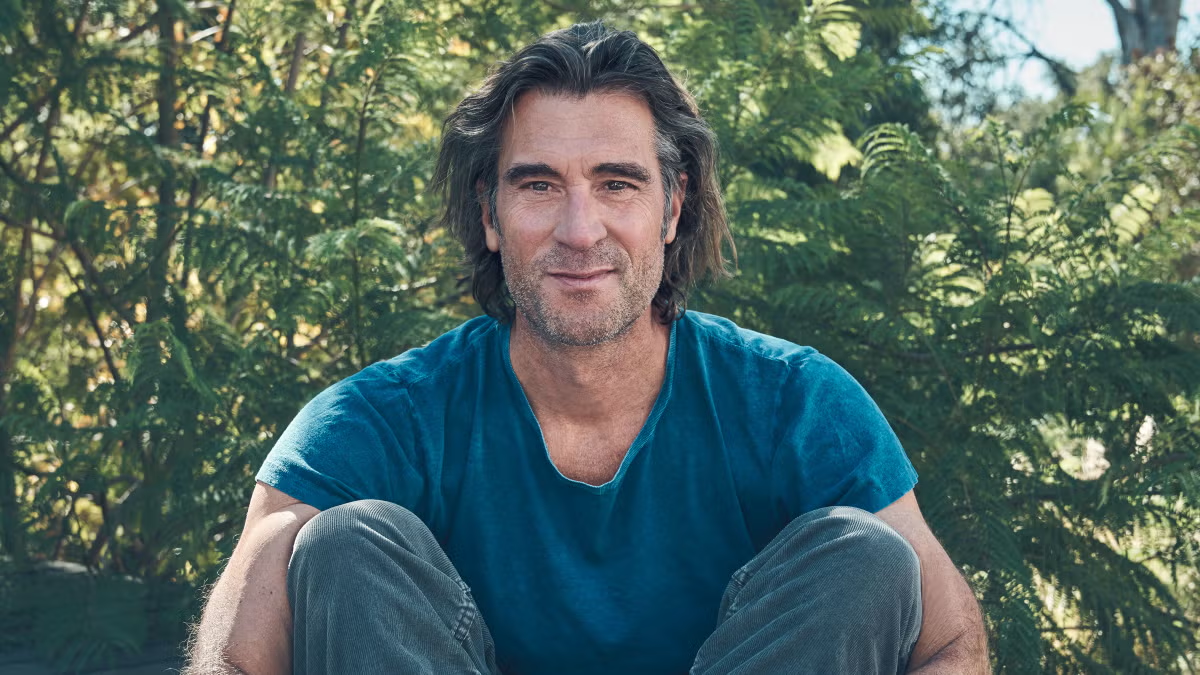

Rich Roll's story begins in Los Angeles in 1966, where he grew up in a household that prized both athleticism and creative expression. From an early age, he showed exceptional promise as a competitive swimmer—enough to earn a scholarship to Stanford University, where he continued to distinguish himself in the pool. For most young athletes, this would be the beginning of a triumphant narrative. For Roll, it was merely the prologue to a much more complicated journey.
What happened after his collegiate swimming career is the kind of arc that resists easy categorization. Roll descended into addiction, a struggle that would define his twenties and early thirties in ways that his youthful athletic achievements never suggested. The details of those years matter less than what they represented: a complete unraveling of the discipline and purpose that had once structured his life. It's a story he's been remarkably candid about, understanding that the depths of his struggle are inseparable from the credibility of his eventual transformation.
The pivot came at age forty, when Roll found himself overweight, unhealthy, and confronting the very real possibility of an early death. This wasn't a gradual realization but a stark, undeniable moment of reckoning—the kind that forces a person to either change fundamentally or continue down a path they know will end badly. He chose transformation, embarking on what would become a complete reinvention of his physical, mental, and spiritual life.
Central to this transformation was his adoption of a plant-based diet, motivated by both ethical considerations and the pursuit of optimal physical performance. But the shift wasn't merely dietary. Roll began exploring mindfulness practices, yoga, and various spiritual traditions that blended Eastern philosophies with his Western athletic background. What emerged was a holistic approach to wellness that refused to separate physical health from mental clarity and spiritual depth.
Most remarkable was Roll's decision to pursue ultra-endurance athletics—not as a former athlete attempting a comeback, but as a middle-aged man essentially starting over. He threw himself into some of the most punishing competitions in endurance sports, ultimately becoming a world-class ultra-endurance athlete. The irony wasn't lost on observers: here was someone who had squandered his athletic gifts in youth, now pushing his body to extremes most people half his age wouldn't attempt.
His accomplishments in this arena weren't just personal victories but proof-of-concept for the plant-based lifestyle he'd embraced. In a field dominated by conventional wisdom about protein, performance, and nutrition, Roll became a living counterargument, demonstrating that plant-based athletes could compete—and excel—at the highest levels.
In "Finding Ultra," Roll chronicled this journey from addiction to athletic achievement, but the book resonated because it was never just about sports. It was about the possibility of radical transformation, about refusing to accept that your worst moments define your potential. The title itself captured something essential: the idea that extraordinary capability exists within ordinary people, waiting to be discovered through commitment and courage.
The book established Roll as more than an athlete—it revealed him as a storyteller capable of articulating the internal dimensions of transformation that athletic achievement merely symbolized. This narrative gift would become central to his most influential platform.
The Rich Roll Podcast has become Roll's primary vehicle for cultural influence, a sprawling conversation encompassing health experts, spiritual teachers, fellow athletes, and creative thinkers. What distinguishes it from countless other wellness podcasts is Roll's genuine curiosity and his willingness to explore the intersections between physical performance, mental health, and spiritual development.
His interviews reflect the eclecticism of his own journey—one week a plant-based physician, the next a meditation teacher or ultramarathoner. The through-line isn't a rigid ideology but a commitment to exploring what it means to live fully, healthily, and consciously. He brings the zeal of the converted but also the humility of someone who understands how easily life can derail.
Roll's significance in contemporary wellness culture lies precisely in his refusal to stay in his lane. He's not just promoting plant-based eating or endurance athletics or mindfulness practices—he's advocating for an integrated approach that sees these elements as inseparable aspects of a well-lived life. In an era of extreme specialization and niche expertise, his generalist approach resonates with people seeking not just health tips but a coherent philosophy of living.
His audience skews toward people in their thirties, forties, and beyond—those old enough to have accumulated regrets, mistakes, and the sobering awareness that time is finite. To these listeners, Roll's story offers something more valuable than inspiration: evidence that it's not too late, that transformation remains possible regardless of how far you've strayed from who you hoped to be.
Today, Roll continues to occupy a unique space in the wellness landscape—part athlete, part philosopher, part journalist. He's become an important voice for a lifestyle that prioritizes what he might call holistic optimization, though he'd probably wince at the corporate blandness of that phrase. His commitment to plant-based living remains rooted in both performance and ethics, a combination that speaks to a growing number of people unwilling to separate how they eat from how they live.
What makes Roll matter isn't any single achievement but the coherence of his transformation and his ability to articulate it for others. He's proof that midlife doesn't have to mean decline, that our worst moments can become the foundation for our best work, and that discipline pursued with wisdom can lead somewhere beyond mere accomplishment—toward something that looks surprisingly like redemption.