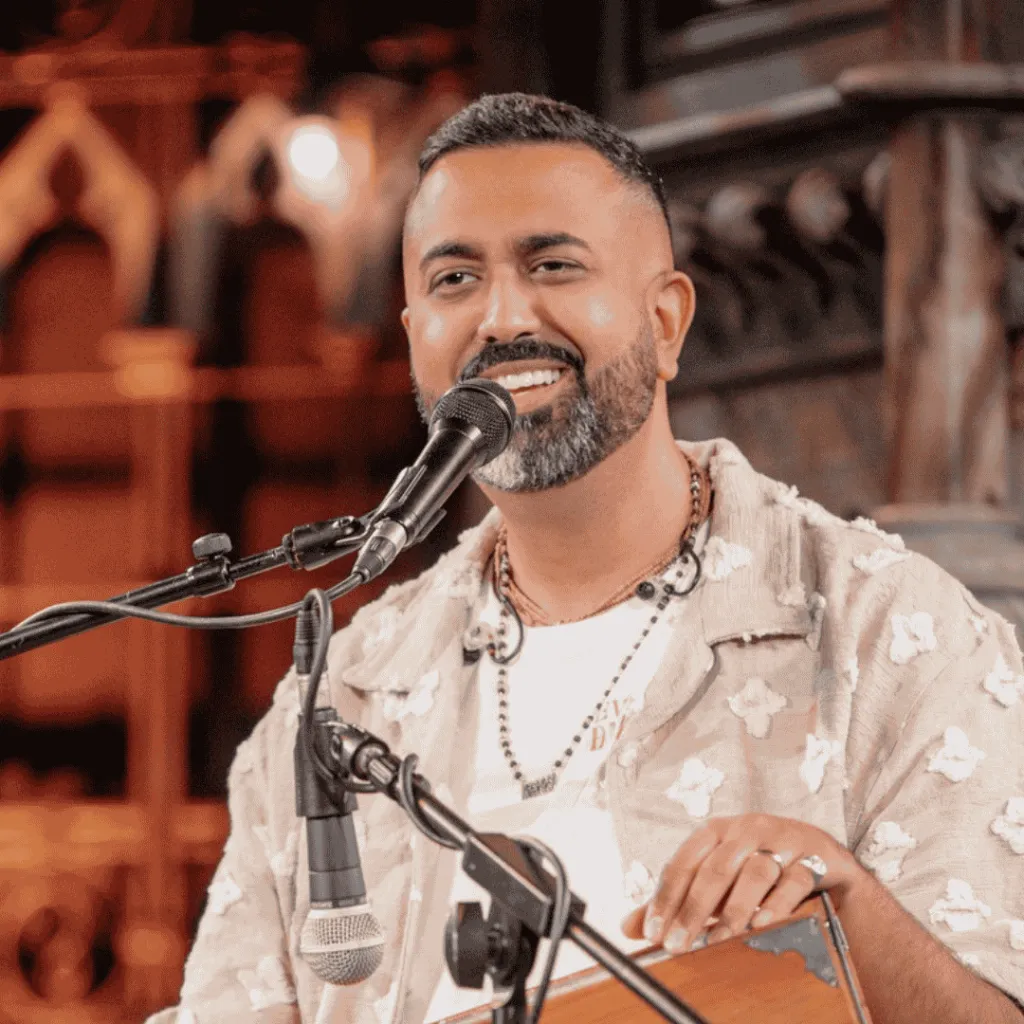

Radhika Das is a London-based musician, kirtan leader and bhakti yoga teacher whose work centres on mantra chanting and devotional music rooted in Hinduism. His website describes sixteen years of bhakti practice behind what he does, and that length of commitment shapes everything he offers: the songs, the live nights, the retreats and the teaching. The songs are sacred names set to melody, rather than spiritual atmosphere layered over a pop template.
His Spotify catalogue has around 88,300 followers, a substantial audience for devotional music. Yet the numbers describe only part of his reach. Much of his work happens in rooms, where a lead voice sings a phrase and a few hundred people sing it back.
The public materials do not document the details of his childhood, family or training, so this profile does not guess at them. What they do offer is his own account of where the work began. By his telling, he was fascinated by the power of sound from an early age: how a single melody could shift a mood, calm a restless mind or bring people together.
That curiosity is the thread through everything that follows. It is a modest origin story, with no dramatic conversion or named mentor attached, and it suits the work. His interest was in what sound does to people, and over time that interest found a home in a devotional practice.
The shift from fascination to vocation came through mantra meditation. In his words, sacred sound becomes a doorway to connection, healing and joy. He describes mantras as gifts of love that carry peace and presence wherever they are sung or spoken.
This framing matters because it places the practice in a devotional register rather than a purely technical one. The materials do not name a specific sampradaya or guru lineage, and it would be guesswork to supply one. What is documented is sixteen years of practice, mantra meditation as the method and kirtan in call-and-response as the form. Readers who want to know about formal teacher lineage are best served by asking him directly through radhikadas.com.
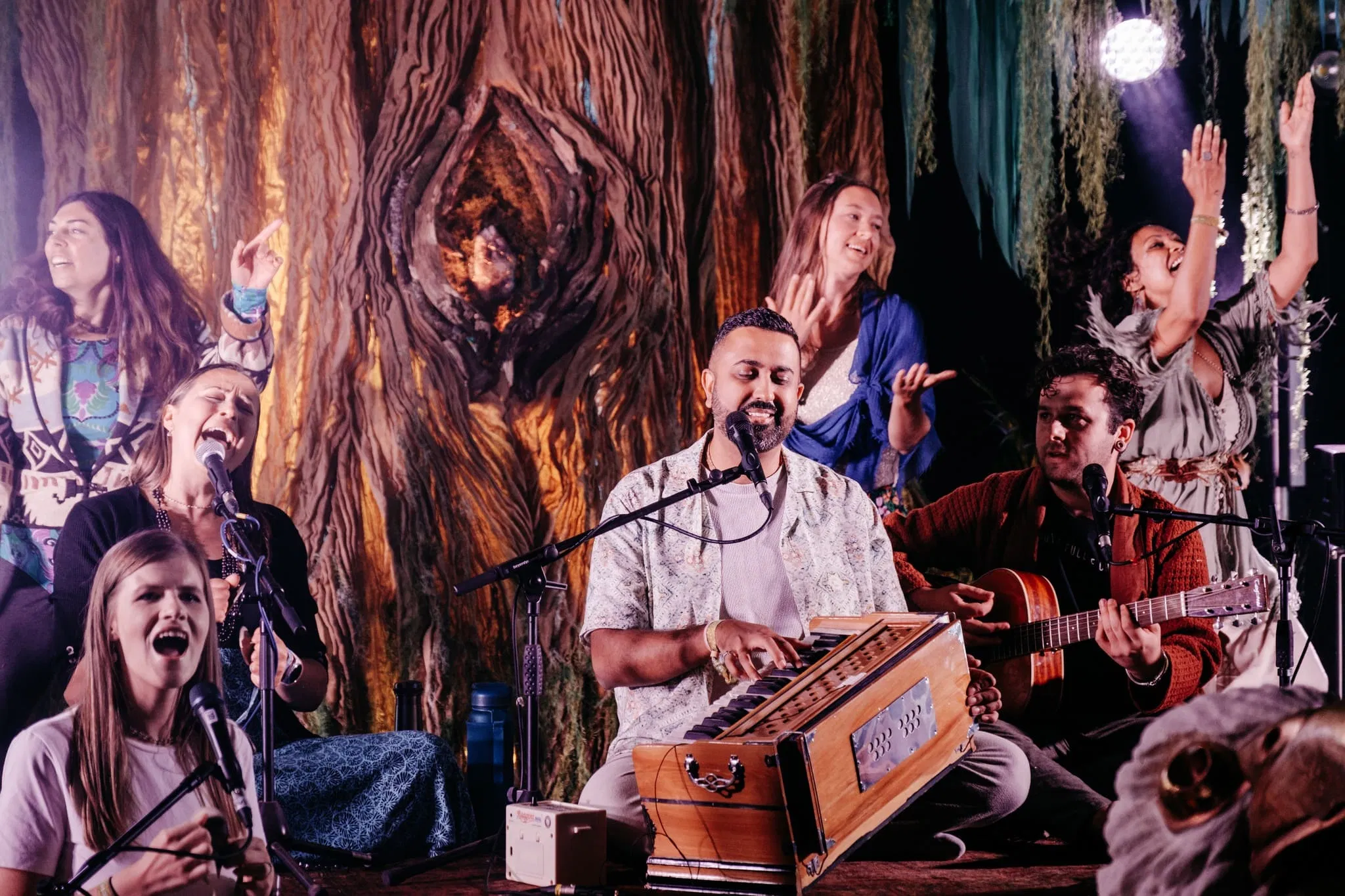
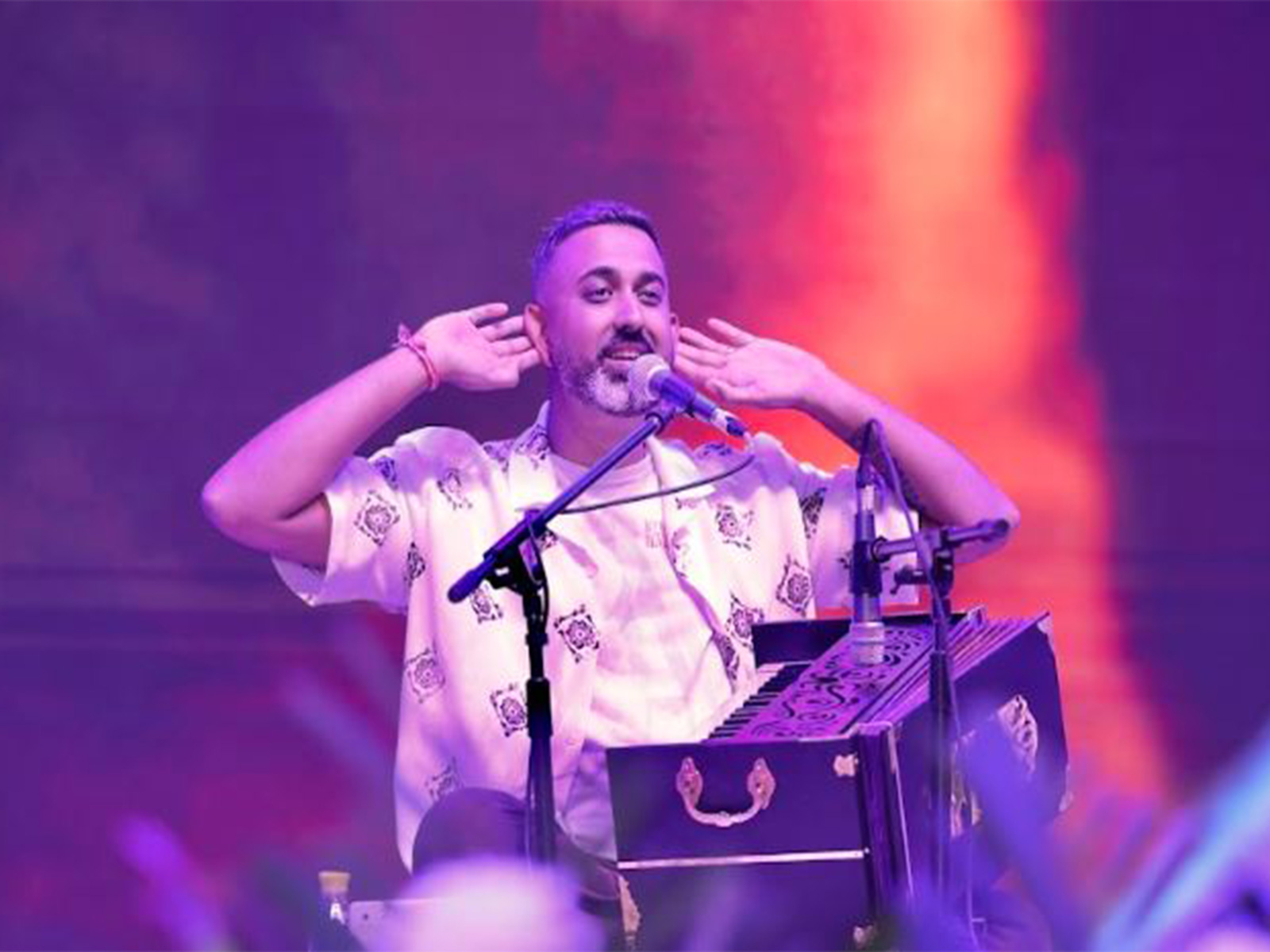
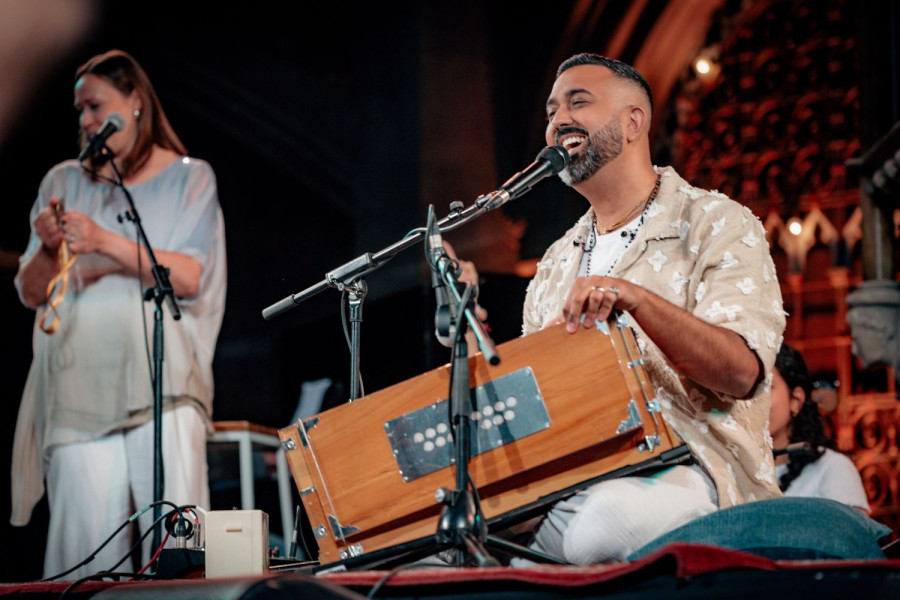
Radhika Das is known for leading live kirtan and mantra meditation in a call-and-response format, hosted at venues, festivals and studios. What began as small gatherings has grown into mantra meditation nights in London, New York, Mumbai and beyond. He leads them with a band of musicians, and he says thousands of people from all walks of life have come together through chanting, singing and dancing.
Many kirtan artists lean on ecstatic group singing. He pairs that with a structured teaching path running through Bhagavad Gita study, yoga asana and pilgrimage. The music tends to favour voice and repetition over harmonic complexity, with a lead voice carrying the melody while the band and the room answer. The materials do not name the instruments, though kirtan ensembles in this tradition commonly centre on harmonium, hand drums and cymbals. Pacing is deliberate, and a single mantra may run for minutes because the repetition is the point.
His stated aim is to help people explore deeply and find the light within them, and to create spaces where people can find shelter in sound.
The discography leans heavily on live recording, which is unusual and worth noting. The studio album Mantra, released in June 2025 with nine tracks, is the centre of the catalogue. Alongside it sits a run of live volumes: Heartland Live in 2022, Heartland 2 (Live) in 2022, Heartland 3 (Live) in 2023, Heartland 4 (Live) in 2024 and Heartland 5 (Live) in 2025. A separate release, Midnight 23/24 (Live), appeared in February 2024. Taken in order, the Heartland series shows how the band format has been refined over several years of nights.
Singles include Mantra over Mind from 2023, Ram Sita Ram from 2020, and the 2026 releases Sita Rama Jaya, Hara Mahadeva and Lightfall. Song titles such as "Shri Rama," "Radhe Govinda" and "Sri Narasingha" draw on Rama, Sita, Govinda (a name of Krishna), Shiva and the avatar Narasimha.
He is also the author of Mantra Meditation. The materials give no publisher or date for the book, so readers should confirm the edition before buying. He hosts the podcast For Souls' Sake, which features conversations on mantra, bhakti yoga and wellbeing.
His work reaches beyond the stage. He leads retreats and pilgrimages, including Vrindavan and the Govardhan Eco Village in India and a Bhakti retreat in Tuscany, Italy, blending kirtan, yoga asana and Bhagavad Gita study. Vrindavan is the town most associated with the childhood of Krishna, and these journeys tie the music to specific places rather than only to venues.
The teaching infrastructure is broad: workshops, a 100-Hour Kirtan Training for those who want to lead chanting themselves, SoulWise mentorship and online Bhakti Groups that give structure between events. The style is practice-first rather than academic. Students chant back rather than sit as listeners, and sessions feel closer to a sung satsang than a lecture.
The present moment is a busy one. The 2025 album and live release have been followed by the 2026 singles, and the touring calendar is wide. Listed dates include the Eventim Apollo in London on 18 October 2026, followed by Alhambra in Geneva on 21 October, Kirche Oberstrass in Zurich on 23 October and Het Zonnehuis in Amsterdam on 25 October. Later listings include Vrindavan on 25 November 2026, the Sivananda Ashram Yoga Retreat in the Bahamas in December 2026, Govardhan Eco Village in early January 2027, London again on 1 April 2027 and Casavecchia Villa in Tuscany on 26 June 2027. Listings can shift, so confirming with the venue or radhikadas.com is wise.
Since 2024 he has also worked with Jahnavi Harrison, the British mantra musician, BBC Radio presenter and Grammy-nominated artist, as a frequent co-vocalist and kirtan collaborator.
Radhika Das matters for the people he reaches and the way he reaches them. His audience includes those already drawn to bhakti, kirtan or slow sacred song, and newcomers who find in call-and-response a way into devotional practice that asks for participation rather than belief in advance. No formal background is required to join a night, though comfort with devotional language helps.
The work is not for everyone, and it does not pretend otherwise. Kirtan is repetitive by design, the Sanskrit names and Gita framing are devotional rather than neutral, and the live nights ask people to sing and dance. Listeners seeking a secular or purely aesthetic experience, or an academic treatment of Hinduism, may find it distant.
For those who stay, the appeal is consistency. The language and intention hold steady across a night, a retreat, a book and a podcast. In a landscape where mantra can drift into background sound, he treats it as song, offering and shared practice, and the room answering him is the clearest measure of his work.