
Released on April 1, 2022, "Mere Ram" is a single with one track, and it rewards the kind of attention usually given to a full album. This guide treats it that way: one piece of music, listened to closely.
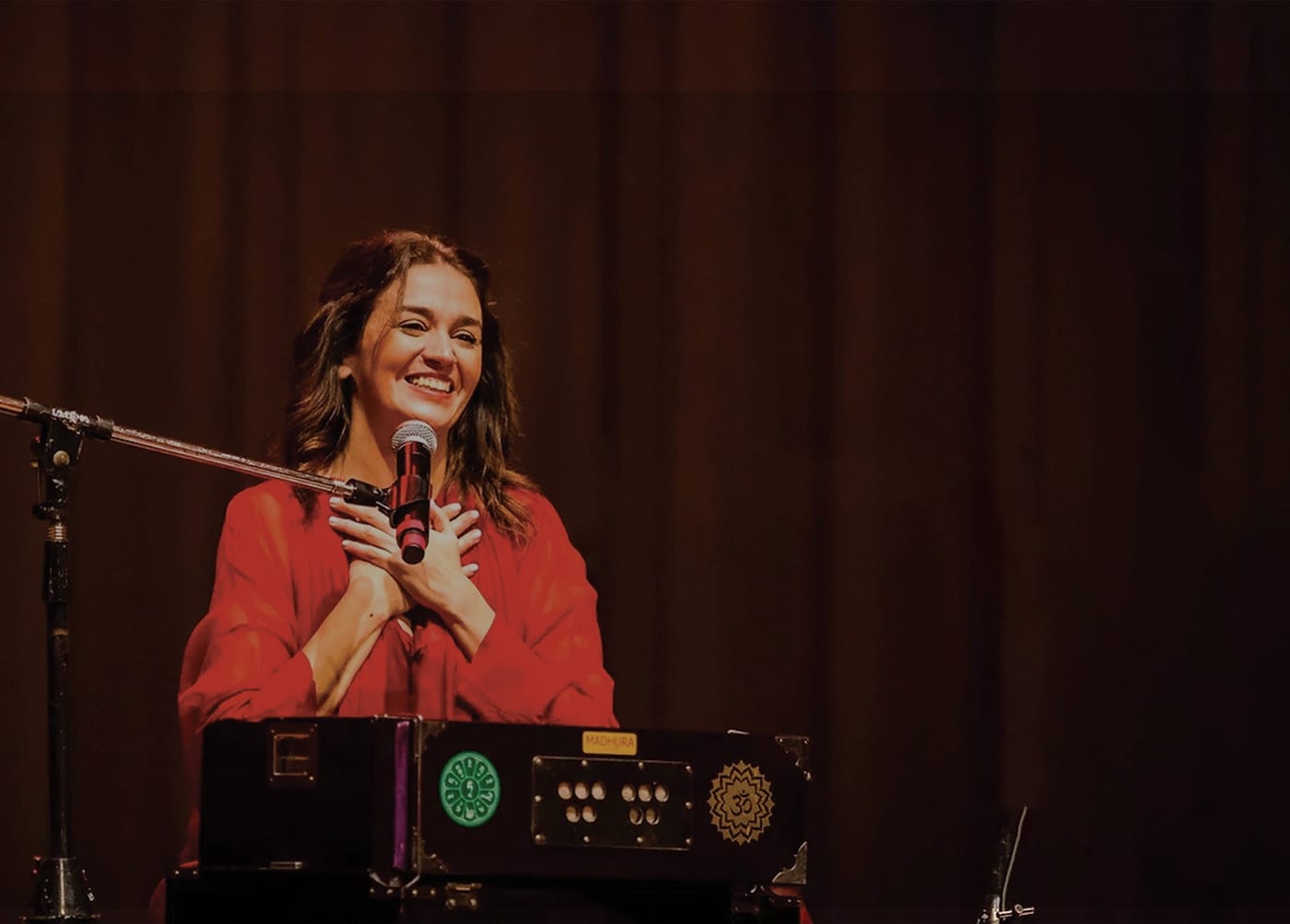
Prashanti Paz is a devotional singer, musician, writer and meditation teacher, born in Patagonia, Argentina, and now based in The Hague. Her path to sacred music ran through film. She studied in Buenos Aires, specialised in screenwriting in New York, and took her first film job in 1997 as a production assistant on Seven Years in Tibet. She moved to full-time sacred music and teaching in 2016.
By 2022 she had released the albums Inner Light (2017) and Into the Heart (2019), along with a run of singles. "Mere Ram" belongs to that singles stream, alongside "Ganesha Sharanam," which came out the same year. It sits between the two full-length statements, with Beyond arriving in 2023. Think of it as a single devotional gesture made in the gap between larger projects.
Her voice is the center of everything she records. It is described as luminous and soothing, an alto that favors clarity and restraint over display. Her recordings are built on minimal instrumentation: harmonium as the main accompaniment, occasionally sparse strings, and generous silence. There is no drum machine and no synth bed. The pacing follows the breath of chant practice, unhurried, with pauses that let syllables ring.
I can't give you a verified account of the specific arrangement on this track, so treat the above as the signature of her catalog rather than a track-by-track breakdown. The safest expectation is intimacy: a voice close to the listener, supported rather than surrounded.
There is only one: "Mere Ram." The title is a Hindi phrase of devotion, "my Ram," and the devotional address is the point of the piece. What makes a single-track release land is focus. With no sequencing to carry you, the whole experience rests on one repeated devotional idea and the quality of the voice delivering it. Her strength is making repetition feel like deepening rather than looping, and a lone track is the cleanest place to hear that.
If you want context from her wider catalog, "Ganesha Sharanam" (2022) and "Om Tare" (2023) show how she moves between Hindu and Buddhist material with the same calm approach.
Kirtan is the genre tag most often attached to her work, but her approach differs from the call-and-response group singing the word usually implies. Her versions are solo and introspective, closer to personal practice than to a communal circle. Her own foundation is explicitly Buddhist, rooted in Tibetan Buddhism, yet her catalog moves ecumenically across Hindu, Buddhist, Sikh and shamanic mantras. She grew up in an interfaith family, with a Jewish father and a Christian mother, and that sensibility shows in her range.
"Mere Ram" is one more example of that bridging. It uses the vocabulary of bhakti devotion, but filtered through a quiet, meditative voice rather than a festival energy.
This is for the listener who wants devotion without noise. If you are drawn to Krishna Das, who has said "I love Prashanti Paz's voice!", and want something more hushed and solitary, this fits. It suits someone in a reflective stretch of life: a period of grief, transition, or simply a need to slow down and feel something sincere.
It is less suited to anyone looking for high-energy group chanting, or for ambient music where the voice recedes into texture. Her voice is the subject here, not the wallpaper.
Give it a quiet slot, ideally evening, when the day's demands have eased. Headphones help, because the intimacy of the vocal and the silences between phrases are easy to lose on speakers in a busy room. Listen once without doing anything else, then again while sitting in meditation or at a small altar if you keep one. Because the release is a single track, you can repeat it in a sitting, which is how chant tends to work best: the second and third passes open what the first only introduces.
Let the pauses count as part of the music.