
Released on May 19, 2020, Lokah Samastah is a single, one track, and it arrives between the full-length albums Into the Heart (2019) and Beyond (2023). It belongs to what her catalog treats as the pandemic-era releases, alongside Coming Home and A New Day (both 2021). Those releases are supplementary to her core mantra albums, yet they matter for understanding how her work moved toward heart songs and contemporary composition.
Prashanti Paz is a devotional singer, musician, writer and meditation teacher, born in Patagonia, Argentina, and now based in The Hague. She turned from screenwriting to full-time sacred music and teaching in 2016. Seen against that path, this single is a small, focused offering made at a moment when many listeners were looking for steadiness.
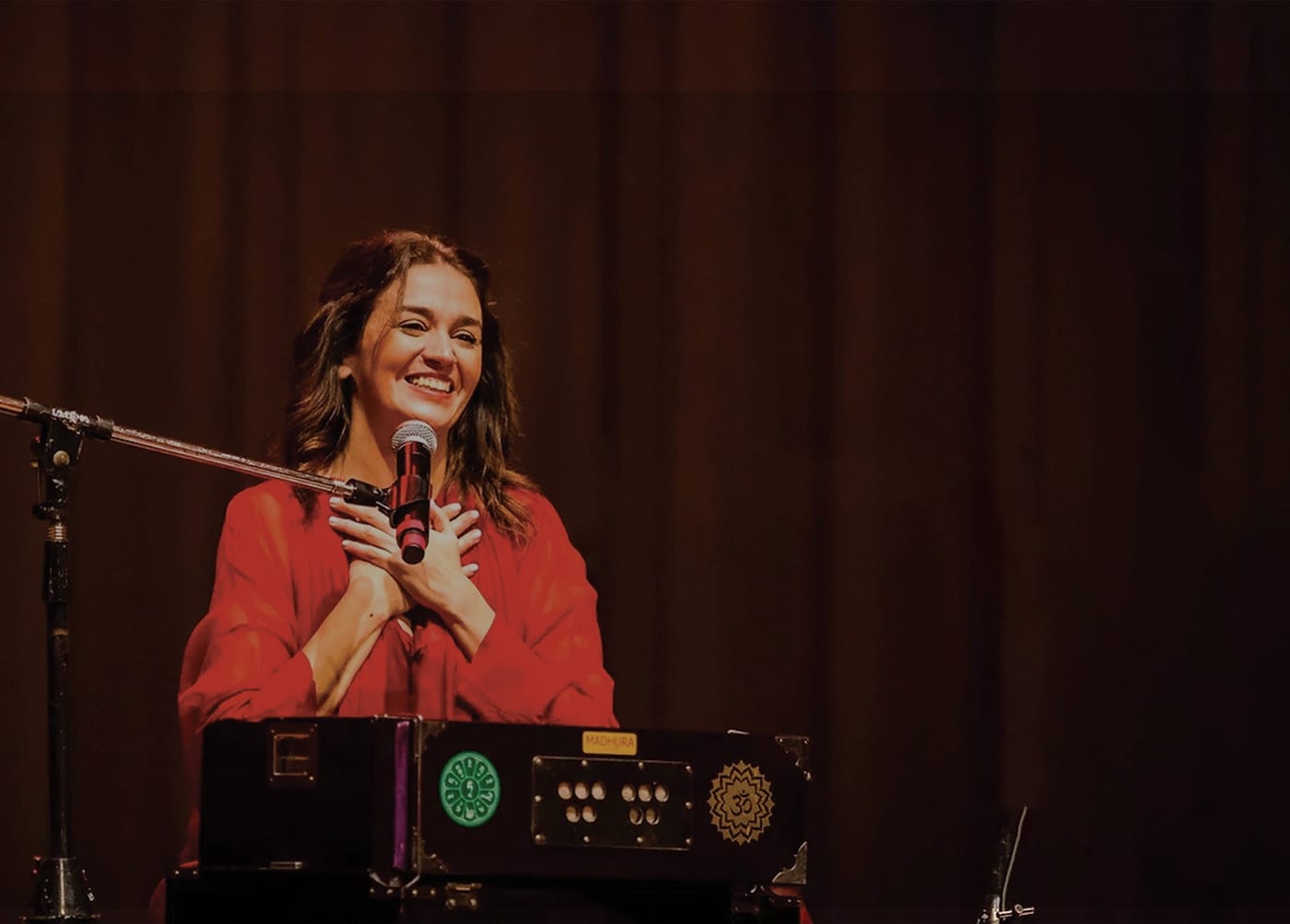
Because this is a one-track release, a guide has less ground to cover and can go deeper into it. Her records are generally built on a clear alto voice, often described as luminous and soothing, with harmonium as the main accompaniment and sparse strings on some tracks. Pacing follows the breath of chant practice: slow, unhurried, with pauses that let syllables settle. There is no drum machine, no synth, and no layered vocal looping in her aesthetic. I can't confirm the exact instrumentation of this particular recording, so treat the description as her general signature rather than a track-by-track credit.
The mood is prayerful rather than performative. Her singing prizes clarity of Sanskrit and emotional restraint over vocal display. The effect is less a concert than a quiet room in which a prayer is being said.
"Lokah Samastah." The single has one track, and it carries the whole release. The title phrase is the Sanskrit prayer commonly rendered as a wish for the happiness and freedom of all beings. Its power here lies in the match between text and delivery. A wish for universal wellbeing could easily turn grand, but her restraint keeps it intimate. The repetition does the work: the phrase becomes less a statement than a practice, widening gradually from the personal to the collective.
It is also the most direct expression of what she describes as her invitation to reconnect with inner peace, love and the oneness in all. It has been framed as a prayer for challenging times, and it has been used in group meditation settings, which suits a piece whose subject is shared wellbeing.
The label most often attached to her is kirtan, though her approach differs from the call-and-response group singing the word usually implies. Her versions are solo, carefully arranged and introspective, closer to personal sadhana than to a communal singalong. Her own foundation is Tibetan Buddhist, with over two decades of study, yet her catalog moves across Hindu, Buddhist, Sikh and shamanic mantras. That ecumenical outlook echoes her upbringing in an interfaith family, with a Jewish father and a Christian mother, where both traditions were honored.
Lokah Samastah fits that bridge-building character. The prayer for all beings' happiness is at home in many contemplative settings, which makes it an easy doorway for listeners who don't identify with any single path. Krishna Das has said, "I love Prashanti Paz's voice!", a sign of respect from within the kirtan world itself.
This single speaks most to listeners who want a short, gentle entry into her work, and especially to anyone carrying worry about the world, their community or people they love. It is a more emotionally accessible way in than some of the denser mantra albums, and it needs no Buddhist or Sanskrit background. Meditation teachers and group facilitators may find it useful as an opening or closing piece.
It will not satisfy anyone seeking high-energy group ritual, electronic-leaning meditation music, or lush production. Her arrangements are intentionally austere, and the voice and mantra are the center, not a background texture.
Give it your full attention at least once. Headphones suit it well, because the pauses between phrases and the small details of breath and harmonium are the point. Evening works especially well, when the day's noise has dropped away.
Try it as a bookend: play it before a sitting practice, then again afterward and notice what has changed. Or use it as a short ritual of its own, perhaps with a candle or a moment of silence, holding in mind the people and places you most want to wish well. Let the repetition carry you; there is nothing to analyze. When the track ends, stay with the quiet for a minute before moving on. That silence is part of the piece.
If it speaks to you, follow it with Into the Heart or her debut Inner Light, which show the deeper mantra practice behind this single.