
Anthony Paul Moo-Young was born in 1954 in Port Antonio, Jamaica, a coastal town where the Blue Mountains meet the Caribbean Sea. In his teenage years, he relocated to the United Kingdom, beginning a journey that would eventually lead him far from his island origins—not geographically alone, but into the depths of spiritual inquiry. The man who would become known simply as Mooji spent years navigating ordinary life in Britain before a transformative encounter altered his trajectory entirely.
That turning point came in India, in the city of Lucknow, where he met H.W.L. Poonja, known to devotees as Papaji. Poonja was himself a disciple of the legendary sage Ramana Maharshi, and carried forward the teachings of Advaita Vedanta—the non-dualistic philosophy that points toward the recognition of consciousness as one's fundamental nature. In Papaji's presence, Mooji underwent what practitioners describe as a recognition of the Self, an experiential shift that moved spiritual understanding from concept to direct knowing. This encounter became the foundation of everything that followed.
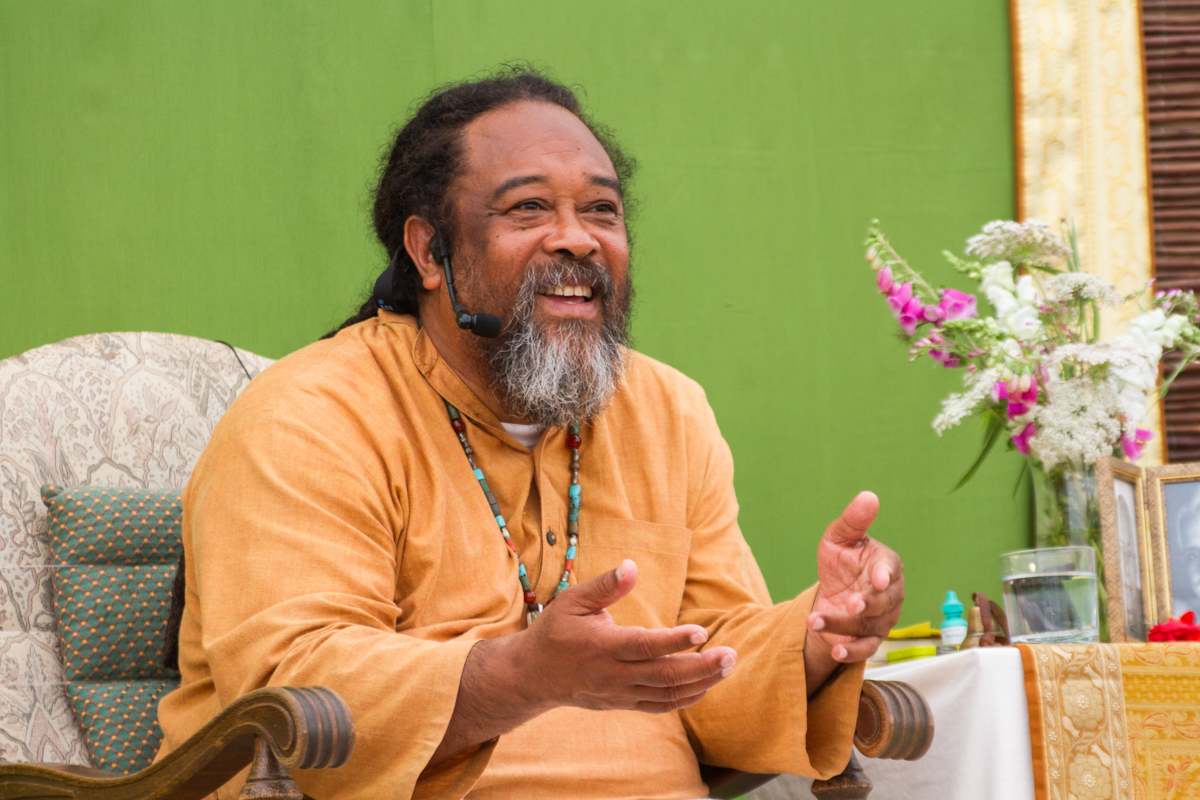
What distinguishes Mooji's work is not a system or methodology in the conventional sense, but rather a living transmission conducted through Satsang—literally "gathering in truth." In these sessions, seekers bring their questions, doubts, and spiritual struggles directly to the teacher, and Mooji responds in the moment, turning each inquiry into an opportunity for deeper recognition. There are no prepared lectures, no curriculum to advance through. Instead, each dialogue becomes a kind of spiritual laboratory where concepts dissolve under scrutiny and what remains is pointed toward directly.
His approach draws from a lineage that includes Ramana Maharshi and Nisargadatta Maharaj, teachers who emphasized self-inquiry as the most direct path to realization. Mooji frequently guides students through what he calls the "I Am" meditation and various self-inquiry techniques, asking questions that redirect attention from the contents of consciousness—thoughts, feelings, perceptions—to consciousness itself. "Who is aware of this thought?" becomes more potent than any answer one might formulate.
The atmosphere of his Satsangs balances rigorous investigation with something softer. Metaphor and humor appear frequently, tools for loosening the mind's grip on its certainties. Periods of silence punctuate the dialogue, and devotional kirtan music creates a container that holds both inquiry and surrender. This blend—the sharpness of Advaita inquiry softened by devotion and silence—gives his teaching a particular character, accessible yet uncompromising.
Mooji's teachings have found permanent form in several books compiled from transcribed Satsang dialogues. "White Fire," "Before I Am," and "Writing on Water" each capture the spontaneous exchanges between teacher and students, preserving the immediacy of spoken guidance in written form. These aren't systematic treatises but collections of moments—individual inquiries and the responses they evoked.
Beyond print, his presence has expanded dramatically through digital media. His YouTube channel has become a significant portal for his work, accumulating millions of views and introducing his teaching to seekers who may never attend a retreat in person. Video recordings of Satsangs circulate globally, creating what might be called a digital sangha—a worldwide community of practitioners connected not by physical proximity but by shared inquiry.
He has also released guided meditation albums that walk practitioners through self-inquiry practices, as well as devotional music recordings from Satsang sessions. Albums like "Breath of the Absolute" and "Satsang Is Here" feature the kirtan and devotional music that form part of the gatherings, offering another dimension of the teaching—one that bypasses language entirely.
Today, Mooji's primary base is Monte Sahaja in Portugal, a retreat center and community where extended gatherings occur and where a residential sangha has formed. He also maintains connections to the United Kingdom, where much of his earlier teaching took place. The retreat format allows for deeper immersion than brief Satsang sessions—periods of intensive inquiry, silence, meditation, and communal practice that span days or weeks.
This current chapter represents a maturation of his work from itinerant teacher to the establishment of a more permanent infrastructure for transmission. Monte Sahaja functions both as a practical center for retreats and as a symbolic anchoring point—a place where the teaching has taken root and where those drawn to it can return repeatedly.
Mooji's cultural significance lies in his ability to make an ancient, often obscure philosophical tradition accessible without diluting its essence. Advaita Vedanta can appear forbiddingly abstract or culturally distant to Western seekers, yet his conversational directness and warmth create a bridge. His Spotify following of over 33,000 listeners and substantial YouTube presence indicate a reach that extends well beyond traditional spiritual circles into the broader culture of mindfulness and self-inquiry.
He matters because he offers something increasingly rare: a teaching that doesn't promise techniques for improvement but points toward a recognition that what you seek, you already are. In a moment saturated with self-optimization and spiritual materialism, this message carries a particular weight. His work reaches those exhausted by seeking itself, those ready to stop accumulating practices and start questioning the one who practices.
The legacy taking shape is not one of institutional growth or systematic doctrine, but of countless individual recognitions—moments when the question "Who am I?" ceased being philosophical and became the doorway to something wordless and immediate.