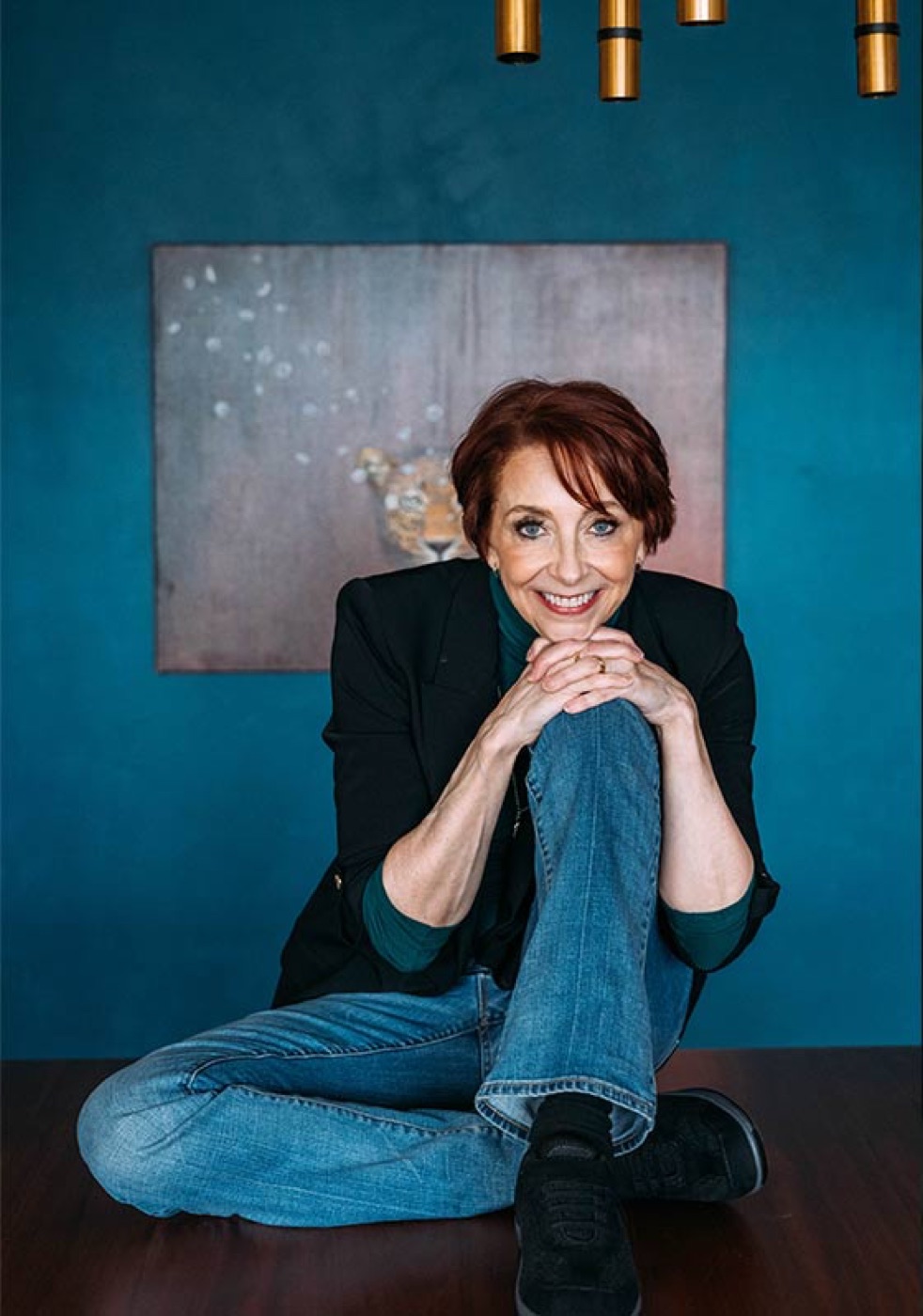

Martha Beck, PhD, describes herself as "author. speaker. wayfinder." Her teaching is difficult to place in the usual categories of meditation instruction or spiritual direction. It is closer to a practical, research-literate form of life navigation that borrows from contemplative practice without being organized around it. The profile below takes the work on those terms.
Her teaching comes in several formats, and each has a different texture. Her talks, which she has given hundreds of times, range from small corporate gatherings to arenas of thousands. They address finding direction and purpose, navigating change, finding clarity in chaos, and tapping creativity. The stated aim is that they be powerful, practical and entertaining, and the order of those adjectives is telling: the practical comes before the contemplative.
The Gathering Room, her weekly live conversation and podcast, is probably the most direct window onto how she teaches. It is conversational and less polished than her books. She works with guests or listener questions and applies her frameworks to real problems as they arise, so the thinking is audible in progress.
The annual nature-based retreats in South Africa (at Londolozi Game Reserve) and Costa Rica are the immersive form. They are small by design and built on the premise that change happens in the body, in community and in contact with the living world, not only in the head. Her ICF-accredited Wayfinder Life Coach Training is where the method is taught at depth, to people who will coach others in it.
Anyone expecting long silent sittings should adjust expectations. The materials describe a teacher who talks, tells stories and coaches, not one who primarily leads sustained meditation.
The organizing idea is Wayfinding, her term for navigating toward happiness and success in one's own life. Its central premise is that each person has an internal compass, her "North Star," and that growth consists largely of learning to read it and follow it, even when it contradicts outside pressure. Around that core sit several returning concerns: purpose and direction, change and transition, clarity amid chaos, creativity, and integrity, the subject of The Way of Integrity. Anxiety, approached through curiosity and creativity, is the territory of Beyond Anxiety. Her writing also carries a personal thread. She says she has never written to sell herself, only to save herself, and that writing is her favorite tool for working through her own suffering. Expecting Adam is the clearest example of that, a memoir about the birth of her son.
The work keeps returning to a few questions. What does your own sense of direction actually say, as distinct from what family, culture or habit says? Where are you living by someone else's definition of success? What would integrity require of you in a specific decision, whether a job change, a relationship conflict or a creative block? What happens if you meet anxiety with curiosity instead of avoidance? These are self-inquiry questions, but they are aimed at decisions, not at abstract insight. The student is asked to sit with them long enough to act.
Humor is central, and it is often self-deprecating. The stated effect is permission: students are allowed to be stuck, imperfect and human instead of performing enlightenment. Story does much of the teaching work, both her own and others', and the books read more like conversation than prescription. She blends science and spirituality openly, drawing on decision-making research, systems theory and contemplative practice. Silence and scripture are not prominent in the materials provided, and it would be inaccurate to describe her as a teacher who leans on either. Her tone is irreverent and intellectually serious at once, and she avoids the stock language of spiritual platitude.
It lands for people who want direction without surrendering their skepticism: readers and students who are wary of both pure materialism and pure mysticism, who respond to humor, and who are willing to do honest self-examination. It suits people facing concrete life questions about work, relationships and creative stalls.
It is a poor fit for several kinds of seeker. Someone wanting a single doctrine or a teacher embedded in a particular tradition may find it too eclectic. Someone wanting a step-by-step system or a charismatic figure to follow may experience the emphasis on personal discernment as extra responsibility, not relief. The irreverence can grate on those who equate serious teaching with a reverent register. And committed meditators seeking deep contemplative or renunciate practice will likely find the focus on everyday life too thin for their purposes.
The bio names no lineage, guru or teacher, and none should be assigned. What the verified sources do establish is a mixed inheritance: social science (three Harvard degrees, including a PhD), secular psychology, and a personal spirituality shaped by her upbringing in the Church of Jesus Christ of Latter-day Saints. Her father, Hugh Nibley, was a scholar and apologist within that church. She does not teach LDS theology, and her work is explicitly non-dogmatic. Wayfinding sits across several frameworks instead of within one tradition.
The fairest summary is that she is a bestselling author and coach (her books include Finding Your Own North Star, The Joy Diet and Expecting Adam, and she wrote monthly for O, The Oprah Magazine for nearly two decades) whose method is practical, humane and deliberately unaffiliated. That is a real strength for the right student and a real limitation for a different one.