
Lee Harris's teaching is built around a plain proposition: intuition and awareness are capacities that can be developed, not gifts handed to a few. Everything else in his output, from the monthly videos to the retreats, is arranged around that claim. He describes his approach as grounded and practical, and the format of his offerings bears that out. There is a free entry point, a paid membership layer, a body of recorded courses, and live events for those who want to be in a room.
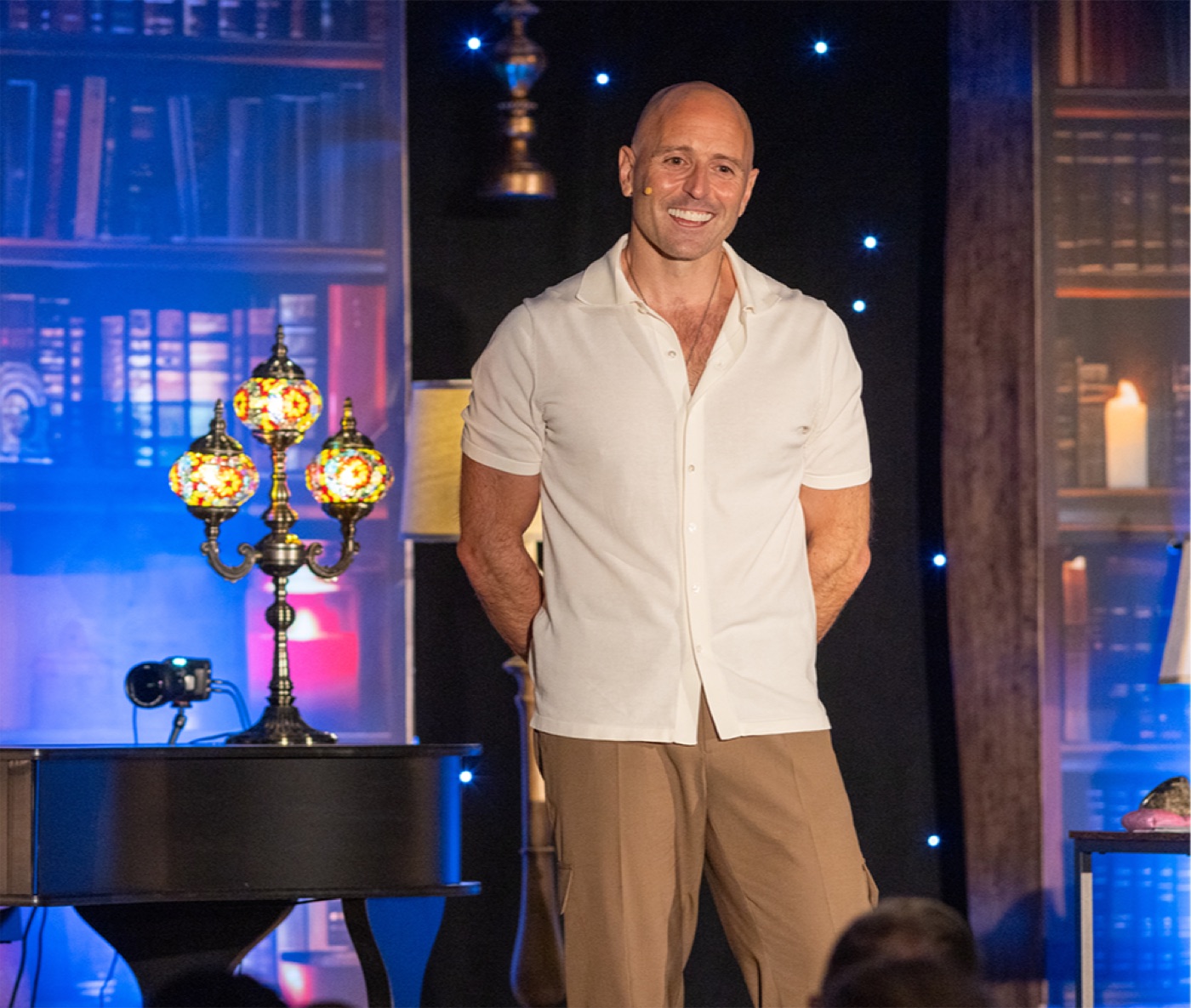
The live formats vary. His workshops and retreats, held in person around the world, draw on what the bio calls his insight into the energetics of emotions and on bringing spirituality into daily life in practical ways. The sessions are oriented toward application: what to do with a feeling, how to read your own state, how to carry the work into relationships and employment. The Portal, his global membership community, offers live, interactive teachings and practical tools, which is the closest remote equivalent. The larger theatrical events, the Big Love and Oneness Experience tours made with composer Davor Bozic, are a different animal. They blend channeling, humor, and music, and they have sold out. Anyone expecting a quiet seminar room should understand that these are staged, performed events as much as teaching sessions.
His channeled material comes through the Z's, the guides he channels, and appears in his books Energy Speaks, Conversations with the Z's, and The Future Human, published by New World Library. The channeling is a central method, not a decorative extra. A listener has to accept it as a working premise.
Several ideas recur. The first is the development of intuition and awareness as a refinable skill. The second is the integration of spirituality with ordinary life: work, creativity, relationships, money. The teaching resists the notion that a spiritual life is lived apart from these. The third is emotional literacy framed in energetic terms, meaning how emotions move, what belongs to you, and how to regulate your own state. His music reflects this directly, with mantra titles such as "I Release Any Energies That Are Not Mine."
A fourth theme is transformation understood as conscious growth available in the life you already have, rather than dissolution of the self. A fifth is creative and vocational empowerment. He mentors creatives, healers, and entrepreneurs, and the implicit message is that bringing your gifts into the world is part of the path. Finally, there is a steady emphasis on abundance and permission to receive, which will appeal to some students and strike others as the softest part of the program.
Working from the themes rather than from any quoted material, the questions his teaching raises are fairly clear. What in your emotional field is actually yours, and what have you absorbed? Where are you outsourcing your own discernment? What would it mean to live a soul-led life with clarity, rather than waiting for certainty? What gift are you withholding from the world, and what is the practical next step toward offering it? These are inferences from his stated focus, not transcribed prompts, but they follow from a body of work that keeps returning students to their own perception and agency.
The delivery is warm, direct, and unmystified. By the accounts available, he avoids romantic spiritual language and initiation mystique. Humor is part of the design, not an accident: the touring shows pair it openly with channeling and music, which suggests he does not treat the sacred and the funny as opposites. Music is the other pillar. He has been writing and producing since 1998, and his first album, Shapeshifting, came out in 2001. The recent devotional work is vocal-forward and mantra-based, with spare arrangements and repeated affirmations such as "I Am Peace" and "I Allow My Soul to Rise." It is built for use in meditation and energy work, not for virtuosity.
Scripture is not a feature of his delivery. He does not draw on a canon; the authority he invokes is the channeled voice and the student's own experience. Silence, as a formal element, is not something the available material describes, so it would be a guess to say how much space he leaves in a session.
It lands best for people the bio calls conscious, sensitive, and intuitive, who already accept energy as a working vocabulary and want practical tools rather than doctrine. It suits those wary of guru dependency, since the teaching is designed to be transparent and self-directed. Creatives, healers, and entrepreneurs seeking a spiritual frame for their work are an obvious fit, as are people who like to learn through several channels: video, books, music, community.
It will likely frustrate several kinds of seeker. Anyone who wants a teacher embedded in a formal lineage, with initiation and ritual precision, will find it loose. Skeptics of channeling will stall at the central premise. Listeners wanting secular psychology without spiritual language may find the vocabulary alienating. Those who prefer confrontational or deconstructive spiritual work may find the affirmation-heavy music and the emphasis on empowerment and abundance too gentle, even saccharine. The music, with its repetition and restraint, can sound undernourished to ears trained on denser production.
The bio names no lineage, school, or teacher, and nothing should be added. His own sources place the work outside traditional lineage structures: a contemporary blend of energy work, channeling, and the language of transformation coaching, rooted loosely in New Age spirituality and modern wellness culture. That is both its selling point and its limit. There is no inherited structure to lean on, no initiatory depth to grow into. What a student gets is a set of practices, a body of recorded material, and a teacher whose credibility rests on whether the work proves useful in practice.