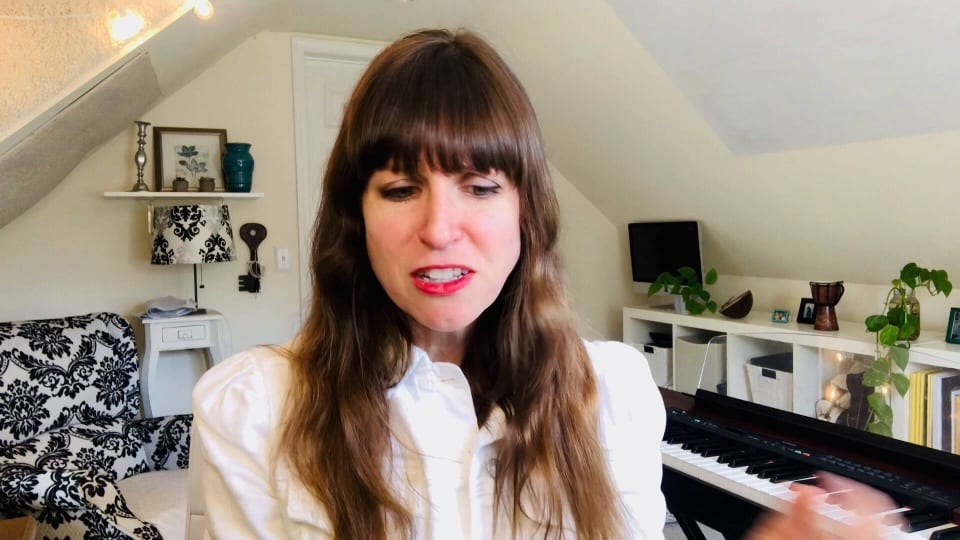

Cheryl B. Engelhardt is based in New York, and her career has rarely followed a straight line. She trained as a classical pianist and studied Biology and Music at Cornell University, then orchestration at Juilliard. Her working life began somewhere that training might not predict: a hip-hop recording studio in New York.
From there she moved through film, commercial, choral and theater composition. By her own account the path ran from classically trained pianist to jingle composer to touring rock musician. She scored commercials, trailers, films and meditation apps, wrote music for social justice choirs, and made four pop records before arriving at the territory where she is now best known, the crossover between New Age and classical music.
That résumé matters less as a list of credits than as a pattern. She learned how music works in several rooms: the studio, the stage, the choir loft, the scoring session. Her later restraint is the restraint of someone who knows what she is leaving out.
No single dated event explains her move into ambient and meditative music, but the thread she describes is consistent. She has spoken of living through anxiety and panic attacks and building practices to move through them. That experience shapes both her music and her teaching. She does not present herself as a distant authority on calm. She presents herself as someone who needed it.
Grief entered the work too. The Passenger was composed during a nine-day cross-country train journey, made after the loss of her friend and collaborator Kevin Archambault, who wrote the book for her musical Boiler Room Girls. The constraint of a moving train, a fixed span of days and a landscape passing by the window gave the project a shape that studio comfort might not have.
Her signature contribution is a particular kind of piece: music built to give a listener room. She says she makes music, often while traveling, to create an environment where listeners have their own experience. That is a quiet philosophy, and the music follows it. It favors acoustic instruments, especially piano, over heavy electronic texture, and it leaves space between notes. She describes her sound as the place where delicate meets epic.
The classical grounding shows. Where much ambient music comes from electronic experimentation, hers carries the harmonic and orchestral habits of a trained composer. Her voice, when it appears, tends to work as one texture among others rather than as a lead.
Luminary (2020). A solo-piano and ambient album composed during a residency in a mountain town in Greece, written to ease anxiety and offer focus. It reached #1 on the Amazon and iTunes New Age charts. For newcomers, it is the clearest statement of her aesthetic.
The Passenger. The train-composed album earned a GRAMMY nomination in 2022. It has been described as an ambient record composed, mixed and mastered entirely by women. It is the larger and more emotionally complex of her ambient works.
According to the Moon. A collaboration with the Australian artist Gem, which earned a second GRAMMY nomination in the Best New Age, Ambient, or Chant Album category.
Quantum Entanglement. An orchestral piece recorded with the Budapest Scoring Orchestra and conducted by Michelle Rakers, showing the full-ensemble side of her writing.
The Listening. A choral work inspired by Dr. Martin Luther King's 1967 speech "Beyond Vietnam," which won third place in the 2022 American Prize in Virtual Recordings.
Boiler Room Girls. A musical for which she wrote the music and lyrics, with book by Kevin Archambault.
Today her work runs on several tracks at once. She continues to compose and record, and she shares guided meditations and a daily practice through Insight Timer. She is also a certified trauma-informed success coach who mentors musicians one on one and in her mastermind, AMPLIFY.
She holds institutional roles as well. She is a governor of the New York Chapter of the Recording Academy and serves as a chair for commercial and contemporary repertoire in the Eastern Region of the American Choral Directors Association. These positions suggest a musician invested in the community around the work, not only in her own catalog.
It is worth being plain about what her teaching is not. Her sources name no guru or lineage, and her approach is not rooted in a particular religious or Eastern tradition. It is a synthesis of concert-music craft, contemporary trauma-informed coaching and lived experience of anxiety. Listeners looking for devotional chant or doctrine will not find it here.
With roughly 31,400 Spotify followers, Engelhardt is respected in her field but not a household name. Her audience tends to be people who seek her out: meditators, people managing anxiety, listeners of contemporary classical and ambient music, and fellow musicians.
Her significance lies in a few overlapping things. She brings real compositional training to a genre that sometimes runs on atmosphere alone. She treats wellness music as craft rather than backdrop. And she insists, through her own history, that difficulty such as panic, grief or a career that refuses to stay in one lane can become material for the work.
Her music is not for everyone. Anyone wanting rhythm, drive or dramatic film-score energy will find the ambient records sparse. But for listeners who want a quiet, carefully made space, her catalog offers one. Luminary is the natural place to start, and The Passenger is the natural second step, once you want to hear what she can do with grief, distance and a long train ride.