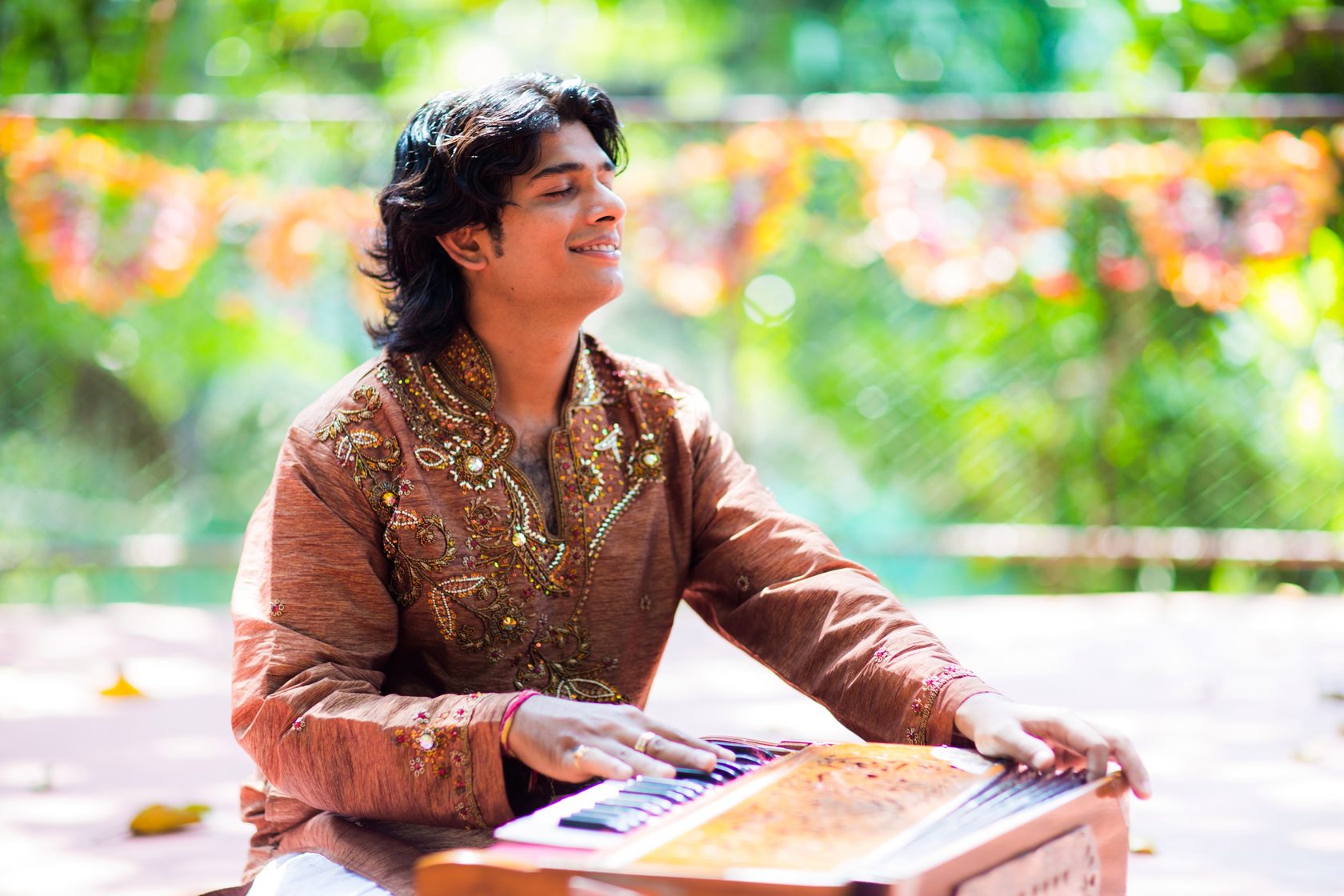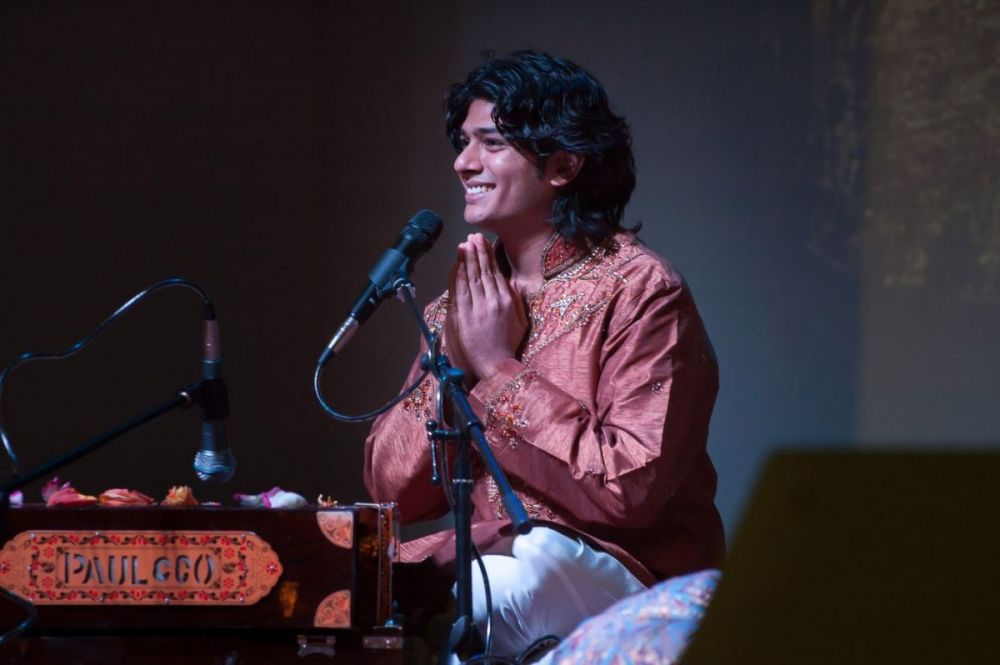

Bittu Mallick's voice enters with the kind of gravitas that suggests generations behind it—because there are. Thirteen, to be precise. His sound doesn't announce itself with Western-style melodic hooks or verse-chorus structure; instead, it unfolds through ornamental spirals characteristic of Hindustani classical training, where a single syllable might carry three minutes of microtonal exploration. But unlike a purely classical performance, Mallick's approach harnesses this technique for repetition, building mantra and devotional phrases into structures designed not for aesthetic appreciation alone, but for altered states.
The instrumentation tends toward sparse, intentional layering. You'll often hear harmonium as the harmonic anchor—that signature reed organ drone that defines both kirtan and qawwali—frequently accompanied by tabla providing rhythmic cycles that gradually accelerate or thicken in texture. But Mallick also incorporates what he terms "ethno-fusion" elements: ambient electronic beds, string arrangements that recall film scoring more than devotional music, occasional guitar work that references Indo-jazz fusion without fully committing to it.
His voice itself is the primary instrument. The timbre sits in a middle register, capable of the kind of melismatic ornamentation that can turn a three-syllable mantra into a five-minute exploration of tone color. There's vibrato control that suggests years of raga training, and an ability to sustain phrases that feel almost circular—ending where they began but somehow transformed. The tempo rarely rushes. Even when tabla patterns intensify, there's a weighted quality to the pacing, as if the music is less performed than allowed to arrive.
Where contemporary kirtan often favors call-and-response simplicity, Mallick's arrangements embrace complexity within repetition. A single phrase of Sanskrit or Sufi poetry might be the only lyrical content for ten minutes, but the textural shifts—a vocal swoop here, a harmonic shift there, the entrance of a second melodic line—keep the ear engaged in something beyond trance.
Mallick represents the thirteenth generation of a hereditary musical family, which in Indian classical contexts isn't a romantic detail but a practical reality: the music was learned at home, before language, as part of daily life. This grounds his work in Hindustani classical tradition—the raga system with its specific melodic frameworks, the tala rhythmic cycles, the improvisational grammar that allows ornament without chaos.
But he works at the intersection of multiple devotional streams. Kirtan, the bhakti practice of singing divine names, provides the participatory framework. Sufi qawwali contributes ecstatic intensity and poetic depth—those Urdu and Persian verses that collapse the boundary between human and divine love. And mantra recitation, particularly Vedic and tantric forms, offers the sonic technology aspect: sound as instrument of consciousness rather than mere expression.
What distinguishes Mallick in the crowded conscious-music landscape is his refusal to simplify these traditions for Western accessibility. Where many kirtan artists offer Sanskrit mantras in major keys with guitar-based arrangements, Mallick maintains the modal complexity of raga while integrating contemporary production. His concept of "awakened voice" isn't about perfected technique but about presence—the voice as a vehicle that carries both performer and listener somewhere specific.
This also means his music doesn't always comfort. There's an edge to some performances, a rawness in the vocal delivery that resists the spa-music packaging that can flatten devotional sound into background ambience.
Come to Mallick's music expecting duration rather than hooks. These aren't three-minute songs with climactic choruses. You're entering cyclical time, where the point is immersion rather than arrival. If you have a background in Indian classical music or Sufi traditions, you'll recognize the technical vocabulary. If you don't, you may initially find the ornamentation disorienting—all those vocal swoops and turns can sound excessive if you're expecting Western folk-devotional simplicity.
What may surprise: the production values. This isn't lo-fi dharma hall recording. There's attention to stereo field, reverb choices, the way electronic textures sit against acoustic ones. It's devotional music that knows about studio craft.
Mallick occupies a particular niche: traditional enough to satisfy practitioners looking for authentic raga-based devotional music, but contemporary enough in arrangement to avoid feeling archival. He shares sonic territory with artists like Prabhu Nam Kaur's deeper cuts or the more experimental moments of Ajeet Kaur, though his male voice and Sufi influences shift the palette. He's less accessible than Krishna Das, less experimental than Estas Tonne's vocal work, more rooted in Indian tradition than most Western kirtan artists, but less strictly classical than dedicated Hindustani performers.
This is music for serious listening or serious practice—rarely for casual background. It asks something of you.