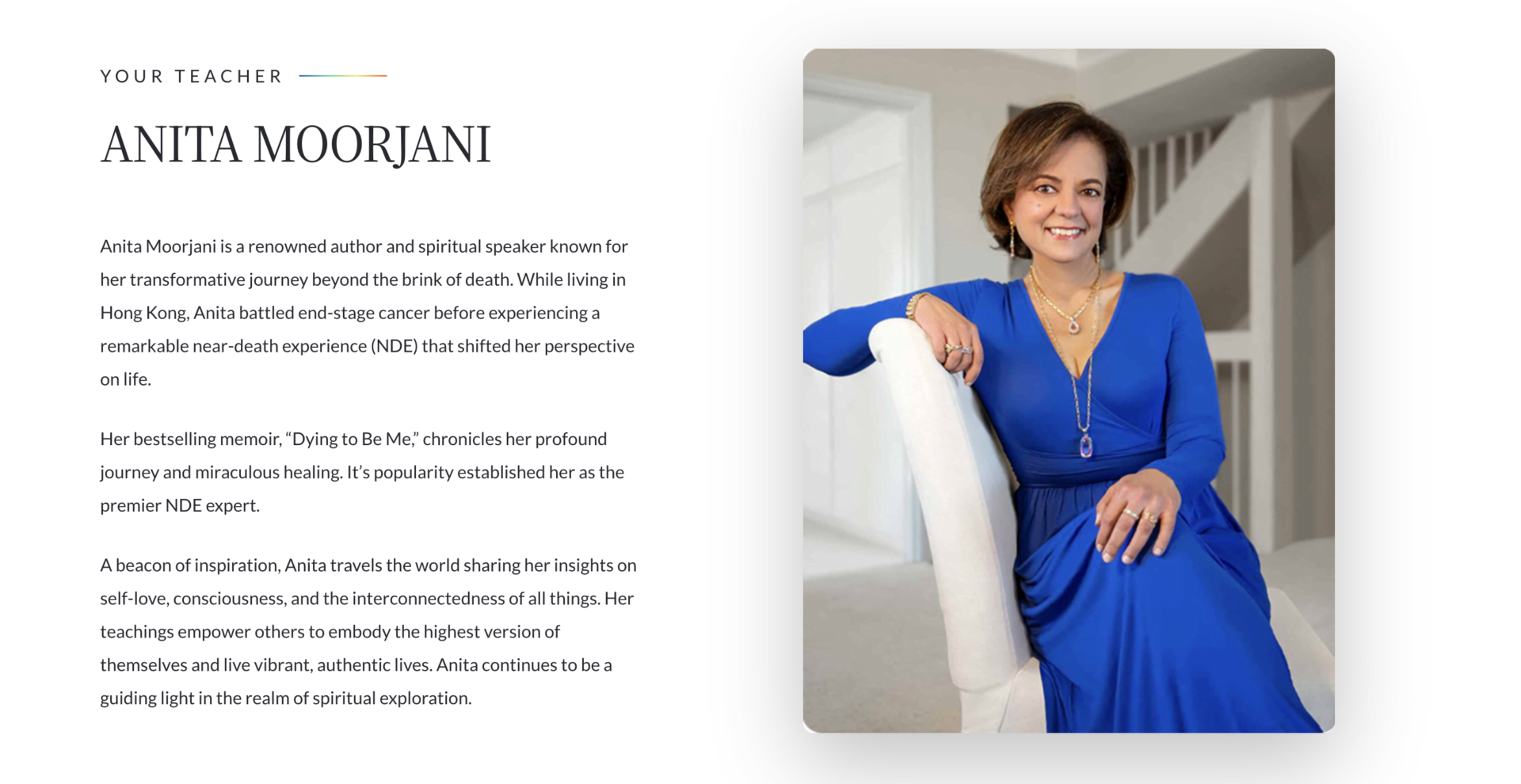

Anita Moorjani's life divides neatly into before and after: before February 2006, when she lay in a Hong Kong hospital in the final stages of Hodgkin's lymphoma, her organs failing, her family gathered to say goodbye—and after, when she emerged from a coma that doctors expected to be her last hours and, within weeks, was declared cancer-free. Born in Singapore to Indian parents and raised in Hong Kong, Moorjani occupied a hyphenated space culturally long before her near-death experience gave her a teaching platform that would reach audiences across six continents. But it was that liminal moment—hovering between life and death, she says, in an expanded state of consciousness—that became the singular event upon which her entire career would be built.
What makes Moorjani unusual in the crowded field of personal development teachers is not that she claims spiritual authority, but where that authority originates. She doesn't cite formal study, advanced degrees, or transmission from established lineages. Her credential is firsthand encounter with what she describes as the afterlife—a direct knowing that arrived not through meditation or mentorship but through the collapse of her physical body. That experiential claim has proven both her greatest asset and the lens through which all her subsequent work must be understood.
Moorjani's core contribution lies in translating what she says she learned while clinically near death into a framework for living. Her teachings circle around several interrelated themes: the corrosive effects of fear on health and well-being, the centrality of self-worth to healing, and the particular challenges faced by empaths—highly sensitive individuals she believes are especially vulnerable to absorbing cultural and familial fear. Her message is both metaphysical and practical, blending esoteric concepts of energy and consciousness with actionable guidance on boundaries, intuition, and embodiment.
Unlike teachers who position the spiritual path as one of discipline and transcendence, Moorjani's work emphasizes permission and acceptance. Her near-death experience, as she recounts it, revealed that she had been living in a state of deep self-rejection, shaped by cultural conditioning and the pressure to conform. The insight she claims to have received was not about becoming better or more enlightened, but about recognizing inherent worthiness. This message—you are already enough—resonates particularly with audiences navigating chronic illness, burnout, and the pressures of high-sensitivity in a world that often rewards stoicism over emotional attunement.
Moorjani's first book, Dying to Be Me, published in 2012, became a New York Times bestseller and has been translated into more than forty-five languages. The memoir recounts her illness, her near-death experience, and her rapid recovery in straightforward, accessible prose. It's a narrative that could easily veer into triumphalism, but Moorjani grounds it in vulnerability—her fear, her confusion, her struggle to make sense of what happened to her. The book's appeal lies partly in its improbability: a woman at death's door, organs shut down, suddenly and inexplicably healed. But it also speaks to a broader hunger for stories that challenge materialist assumptions about consciousness, death, and the limits of the body.
Her follow-up, What If This Is Heaven?, applied the insights from her near-death experience to everyday life, asking readers to reconsider their relationship with fear, judgment, and the pursuit of external validation. Later, Sensitive Is the New Strong narrowed her focus to empaths, offering a guide specifically for those who feel overwhelmed by the emotional atmosphere around them. Across her body of work, Moorjani positions herself less as a guru than as a witness—someone who stumbled into knowledge and is now reporting back.
Moorjani's teaching style is deeply narrative. She returns again and again to her own story, using it as a case study in transformation, a proof-of-concept for the principles she espouses. This approach has limitations—it can feel repetitive to those already familiar with her narrative—but it also makes her work emotionally resonant. She doesn't ask readers to trust abstract concepts; she asks them to consider her lived experience as evidence.
Her books have sold hundreds of thousands of copies and are frequently assigned in holistic health training programs, a testament to her influence in integrative and alternative medicine communities. She has built a following that spans continents, drawn largely from people seeking alternatives to conventional models of healing and meaning-making. With over 4,000 followers on Spotify, her reach extends into audio formats, suggesting an audience that consumes her teachings in multiple modes—reading, listening, attending live events.
Moorjani's cultural significance lies in her ability to speak to a particular kind of contemporary disillusionment. In an era marked by chronic illness, mental health crises, and widespread alienation, her message that fear—not inadequacy—is the root of suffering offers both explanation and hope. She reaches people who feel failed by conventional medicine, who are looking for frameworks that honor the body's complexity and the mind's role in healing.
Her emphasis on empaths, too, taps into a growing discourse around sensitivity as strength rather than weakness, a reframing that resonates in a culture increasingly attuned to neurodiversity and emotional labor. Moorjani doesn't promise easy answers, but she offers a cosmology in which suffering has meaning and healing is possible—not through striving, but through self-acceptance. In that sense, her legacy may be less about the specifics of her near-death experience and more about the permission she gives others to trust their own inner knowing.