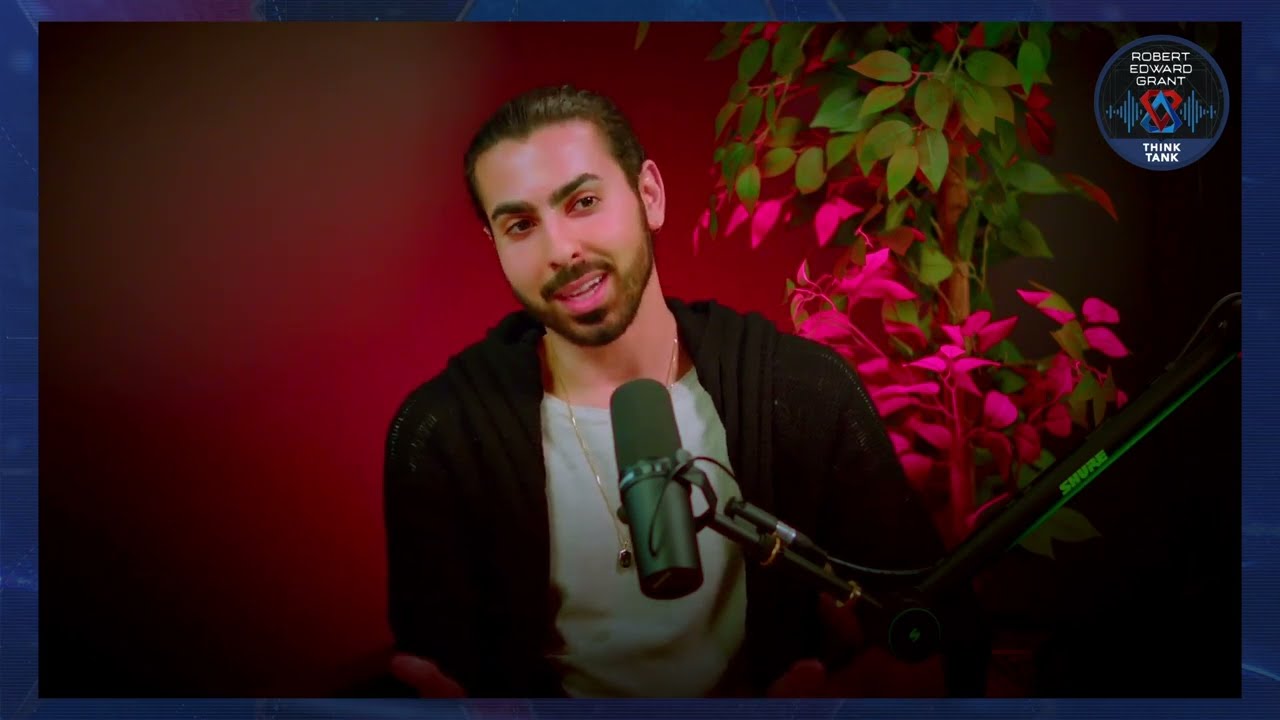

André Duqum—who goes by Dre—occupies an unusual position in contemporary wisdom culture. He is neither guru nor academic, neither therapist nor philosopher by training, but rather a careful curator of ideas in an age drowning in information. Through the Know Thyself Podcast, Duqum has built something increasingly rare: a sustained space for slow thinking, devoted to what he describes as "the dismantling of psychological illusion." In a media landscape optimized for virality and algorithmic engagement, his work moves in the opposite direction—toward depth, nuance, and the kind of patient investigation that resists summarization.
At the center of Duqum's inquiry sits a single, persistent question: where are we not free, and how do we liberate ourselves from the stories and identities that keep us bound? This is not self-help in the conventional sense. Duqum is not interested in optimization, productivity, or the renovation of the ego. Instead, his work is organized around what he calls "the love of wisdom and the wisdom of love"—a reciprocal commitment that frames personal transformation not as self-improvement but as a kind of philosophical and spiritual liberation.
This framing sets him apart from much of the wellness industrial complex. Where others promise better sleep, improved focus, or enhanced performance, Duqum asks his listeners to examine the fundamental assumptions that structure their experience—about identity, suffering, attachment, and the nature of consciousness itself. It's a harder sell, but one that has quietly built a devoted audience willing to sit with complexity and uncertainty.
The podcast itself is structured as a series of long-form conversations, typically running ninety minutes to two hours. Guests span a wide range: meditation instructors, somatic therapists, scholars of perennial philosophy, explorers of non-dual awareness, psychologists, and practitioners across traditions both ancient and contemporary. Duqum's interview style has been described as Socratic—patient, probing, genuinely curious. He does not rush toward conclusions or sound bites. Instead, he allows ideas to unfold at their own pace, often circling back to earlier points, testing concepts against lived experience, and drawing out subtleties that would be flattened in shorter formats.
The podcast refuses allegiance to any single lineage or system. Duqum draws on Western philosophy, Eastern contemplative traditions, depth psychology, and the emerging currents of contemporary wisdom culture. This eclecticism is deliberate. He has stated that his purpose is not to transmit a singular teaching but to curate people, ideas, and tools that support listeners in their own process of awakening—whatever form that might take. The work is exploratory rather than prescriptive, an ongoing investigation rather than a codified doctrine.
Duqum does not position himself as a teacher or guru. He speaks openly about his work as an inquiry in progress, shaped by years of personal study in philosophy and spirituality but grounded in questions rather than certainties. This stance—humble, transparent, genuinely uncertain—lends credibility in a space often dominated by charismatic authority figures promising enlightenment or breakthrough.
It also reflects a broader sensibility in his work: the sense that the podcast is not a platform for performance but a shared space of exploration. Duqum's questions often feel like they're being asked as much for himself as for the audience. He returns frequently to themes of self-inquiry, the nature of identity, and the relationship between suffering and attachment—not because he has mastered these territories, but because they remain alive for him as sites of investigation.
In a moment characterized by spiritual bypassing, commodified mindfulness, and the reduction of wisdom traditions to life hacks, Duqum's work offers something different: intellectual rigor married to genuine seeking. His audience tends toward those dissatisfied with surface-level solutions—people who have tried the apps, read the bestsellers, and found themselves still restless, still asking deeper questions about meaning, freedom, and the nature of self.
The podcast reaches a particular demographic: educated seekers who value both heart and mind, who want contemplative depth but also philosophical grounding, who are suspicious of easy answers but hungry for authentic conversation. These are listeners willing to engage with difficult ideas, to sit with paradox, and to accept that transformation may be slower and stranger than the culture of instant gratification suggests.
Duqum continues to evolve the podcast, expanding its reach while maintaining the core integrity that has defined it from the beginning. He remains committed to long-form dialogue, to intellectual honesty, and to the belief that genuine liberation requires not just technique or practice but a fundamental shift in how we understand ourselves and our relationship to experience.
What distinguishes his work now, as it has from the start, is its refusal to simplify. In an age of quick fixes and packaged enlightenment, Duqum reminds us that wisdom is not a commodity to be consumed but a territory to be explored—slowly, carefully, and with more questions than answers. His legacy, still being written, may ultimately be this: the creation of space where complexity is honored, where not-knowing is respected, and where the ancient imperative to know thyself remains as urgent and mysterious as ever.