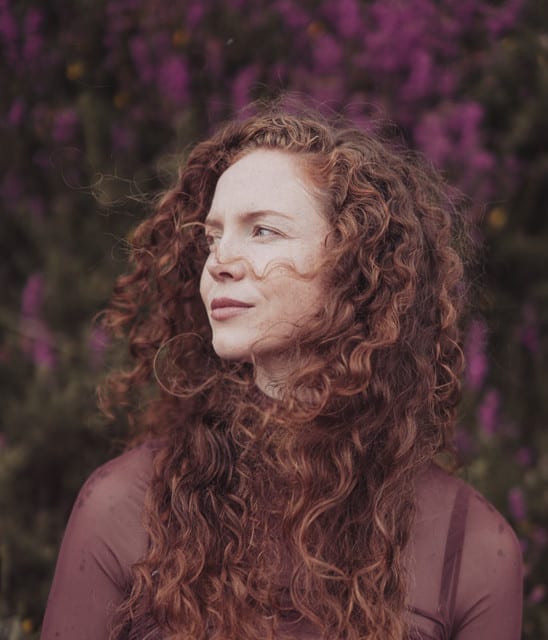
Healing Song is a single, one track released on November 10, 2023. It is a small object in a catalog that has moved over a decade from mantra-based albums to something more personal and rooted in place. This guide treats it as a one-song album, because that is how it asks to be heard: whole, unhurried, and once through before anything else.
Ajeet began with records built around mantra. Sacred Waters (2013) holds music for Kundalini Yoga meditations, and At The Temple Door (2014) weaves songs and mantras over Todd Boston's guitar, with harmonies from Snatam Kaur. Darshan (2015) was recorded in Bali, and Haseya (2016) took its title from the Diné for "she rises." Shuniya and Indigo Sea followed in 2018, then the LUNAR EP in 2020 and the live album Voices Like Rain, recorded on her 2019 European tour.
In 2020 she moved back to Ireland and began working from her home studio. Healing Song arrives in 2023, after Let It Breathe (2022), and well after that homecoming. The same song later opens Slánú, the album she released in October 2026, and the album closes with a live version recorded in Poland in 2024. So this single can be heard as an early public form of a song that stayed with her, a piece she returned to and placed inside a larger body of work.
The single credits Ajeet alone, and the larger picture of her music is the best guide: it draws on the folk traditions of her Irish background and moves toward mystical, meditative soundscapes. Her live album Voices Like Rain features layered harmonies, acoustic and electric guitars, hand percussion and Celtic harp, and her band brings together musicians from Spain, Ireland and the United States.
Listen for those threads as you play it. Notice whether the voice sits close and intimate or opens into harmony. Notice how the pacing behaves: whether the song is content to stay in one place, as a meditation might, or whether it travels the way a folk song does. Her work tends to sit where those two impulses meet.
There is only one track, and it carries the whole release.
"Healing Song" is the title and the entire argument. Where her earlier records leaned on the repetition of mantra, a song named for its purpose suggests something plainer and more direct: music offered as care. What makes it land is that directness. A title like this makes no claim to spectacle. It asks the listener to receive something, and her catalog suggests she is practiced at making that kind of space. Listen for how the song builds its stillness, and whether it resolves or simply lets you go.
Ajeet's work belongs to the broad world of devotional and meditative music. Her early records sat close to the Kundalini Yoga mantra tradition, which is why Snatam Kaur, a prominent mantra singer, appears among her collaborators. Since then she has increasingly drawn on Irish folk, with its habit of carrying story, folklore, dream images and myth.
Healing Song sits in the overlap. It is not kirtan in the call-and-response sense. It is better understood as a contemporary devotional song shaped by folk storytelling, in the company of the ambient, meditative end of world music. Her own retreats, which combine yoga, meditation, songs and stories, show the setting such music belongs to: gatherings where listening is a practice.
This single is for the listener who is tired, tender, or in transition. It suits someone coming to her music for the first time who wants a gentle entry point, since it takes only a few minutes of attention. It also suits long-time listeners who followed her from the mantra records and want to hear where she has arrived since moving home to Ireland.
It will mean most in a moment that needs softening: after a hard week, during grief or recovery, or at the end of a day when the mind will not settle. Those who come to her through yoga or meditation practice will find a familiar spirit in a simpler form.
Choose an evening, and choose to hear it from beginning to end without interruption. Headphones will serve the song best, since layered voices and instruments are easier to follow close up. Dim the room, put the phone face down, and let the track play without looking at the screen.
Then, if you are willing, play it a second time, and do something with it: sit in stillness, breathe slowly, or simply lie down. Because it is a single, there is no sequence to move through. The invitation is to stay with one song a little longer than usual, and to notice what changes.