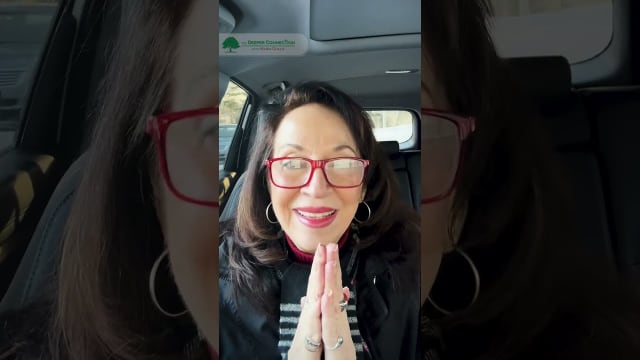
Maria Gullo is not in her usual room. In a January 2018 video, the spiritual director, ordained minister and hospice chaplain opens from a friend's house in Pennsylvania, apologizing for her quieter voice, squinting without her glasses, and pointing the camera at a window full of bare trees, snow and birds darting past in front of the glass. It is a small, unscripted scene, and it sets the tone for a half-hour talk about one of the most ordinary and most stubborn problems in the contemplative life: we want to change, and we want it yesterday. Gullo's argument is that transformation does not come from forcing it. It comes when we stop running from whatever triggers our fear, anxiety or doubt, begin each day in stillness, and rest inside that difficulty with Christ, trusting God to do the work beneath our awareness. Drawing on Psalm 37:7 and a daily reader compiled from the writings of Thomas Keating, she makes a case for patience not as passive waiting but as the posture in which inner healing becomes possible.
Gullo starts with a confession that her audience recognizes at once. "You want to change," she tells the viewers who have gathered for the session, "you don't have the patience, none of us do to wait and allow that change to happen." She asks who agrees, watches the hands go up on the screen, and answers for everyone: "I want change and I want it now, in fact I want it yesterday. That's all of us." (Gullo, video, 1:18 and 1:42)
That impatience is the central obstacle in her teaching, and she is careful about where she locates it. Life, she argues, is already working in the believer's favor. Illness arrives out of nowhere, a loss happens to someone else, a routine day goes smoothly or falls apart, and in every case she says the circumstances are "here to draw us further into our true selves and into Christ." What decides whether that pull succeeds is not the event itself but "primarily our response to whatever is happening." Impatience is one response. It tries to make the change happen on our own schedule, and in doing so it crowds out the very interior work it wants.
The distinction matters because it reframes the spiritual problem. The question is not how to get God to act faster. It is whether we are available for the action that is already underway. Gullo's emphasis on response places the work of the contemplative life less in effort and more in receptivity, a theme that runs through every part of the session.
Gullo's answer to impatience is a particular order of operations. Before the day begins, before the phone is checked and the to-do list is opened, she asks listeners to come away and rest. She draws the image from the Gospel, quoting Jesus's invitation to his apostles to "come away and rest with me a while," and she hears that same invitation addressed to her audience "this morning through the spirit." (Gullo, video, 4:49)
She is specific about sequence. "The important thing," she says, "is that we come away to the rest first, that we be still, as Psalm 37:7 says, to be still before the Lord and wait patiently." Only after that stillness does one move "out into our day into our lives and see how it's all designed to transform us into Christlikeness." (Gullo, video, 6:00) The rest is not a break from transformation. It is the starting point from which the day is approached, so that whatever rises later is met from a settled place rather than a reactive one.
For Gullo, that stillness is most often centering prayer. She describes it as the practice by which, "as we are drawn into the silence, into being still," we can recognize the things in our lives that are "operating for our good." It is a daily discipline rather than an occasional retreat, and she frames it as the way God invites people into a rhythm: rest with Christ, then carry that rest into the hours that follow.
This is the most practical and the most demanding part of the talk. Gullo asks listeners to look honestly at what is hindering their rest in Christ or their transformation into him. Her key insight is that the obstacle often points to the very place where Christ is working. "Whatever it is that you think is doing the exact opposite, drawing you away, making you more impatient, making you more anxious," she says, "that very thing is exactly where Christ is and exactly where Christ is inviting you into the rest." (Gullo, video, 7:42)
The instruction that follows is counterintuitive. Instead of resisting the trigger or moving away from it, she asks people to remain with it. "When something pulls us in, when something triggers us, when something ignites our fear, ignites our anxiety, ignites our doubt, right there, don't run from it. Stay with it. Invite God into that with you. Rest in it and be patient and see how God is working in you and through you." Her wording is precise: the response is not to fix the feeling or argue it away, but to invite God into it and wait.
Gullo's own spiritual vocabulary, shaped by her work as a hospice chaplain and director, is consistently about presence rather than solutions. A fear that gets company from God is a different experience from a fear that gets suppressed. The practice she describes is a way of letting the difficult moment become the place where God's transformation takes place, rather than a detour from it.
Gullo grounds her argument in a book she has used for years. It is a daily reader that gathers excerpts from Thomas Keating's books into short readings. She describes it as "all marked up and written in," and says that God keeps speaking through it: "I can do this book for 10 years literally and yet every time when I go back to the beginning something different speaks to me." She uses it to begin her rest time with Christ, and in this session she reads the entry for the following day. (Gullo, video, 9:20)
The reading begins with the claim that "in contemplative prayer the spirit places us in a position where we are at rest and disinclined to fight." Gullo lingers on the phrase "disinclined to fight," noting that when we are in that state of rest we are not then working against what the Spirit is doing in us. The passage continues that the Spirit "heals the wounds of our fragile human nature at a level beyond our psychological perception." (Thomas Keating, as excerpted in the daily reader Gullo reads aloud, video, 10:35 and 11:20)
The image of anesthesia in that passage is one of the most striking in the video. A person under anesthesia, the reading says, "has no idea of how the operation is going until after it is over." The analogy does real work. It explains why contemplative patience can feel like nothing is happening. The healing is occurring at a depth that our ordinary self-observation cannot track, and we are asked to trust the surgeon rather than narrate the procedure.
The reading moves from the surgery image to a seed. "Interior silence is the perfect seedbed for divine love to take root," the passage says, and it points to the Gospel image of the mustard seed as a symbol of divine love, "the smallest of all seeds" with "an enormous capacity for growth." Divine love, the reading concludes, "has the power to grow and to transform us." (Thomas Keating, as excerpted in the daily reader, video, 11:48)
Together the two images answer Gullo's opening complaint. The impatient listener wants visible results on a visible timeline. The seed does not grow when it is dug up to check its progress, and the patient on the table cannot speed up the operation by monitoring it. Gullo defines the purpose of contemplative prayer in these terms: "to facilitate the process of our inner transformation," which happens "through this divine love." (Gullo, video, 12:07)
The passage also offers a promise that Gullo returns to near the close. Drawing on the line "I will restore you to health and heal your wounds, declares the Lord," she ties the healing directly to the practice she has been describing. The wound is not a reason to withdraw from prayer. It is the place where God's restoration is already at work.
Gullo's closing section turns the teaching into a short guided practice. She asks listeners to notice their breathing, to acknowledge what they feel, and then to hear Christ speak to them. As the reading she chooses continues, the emphasis falls on identity rather than performance. She reads a passage about not having received "a spirit that" enslaves, and about being an heir "along with Christ," and she asks listeners to let those words land in the stillness rather than analyze them. (Gullo, video, 19:30 and 20:12)
The practical shape of the approach is simple enough to carry into any day. Begin with centering prayer or a passage of Scripture, the way Gullo does each morning. Keep a reading nearby that can be returned to over years. When fear, anxiety or doubt rises, do not treat it as an emergency or an error. Name it, stay with it, invite God into it, and wait. Then go into the day from that resting place and see what arises.
Gullo never promises that the waiting will be pleasant. Her own opening admits that patience is hard, that "none of us" has it naturally. What she offers is a reason to keep practicing: the conviction that God is using everything that happens, including the impatience itself, to form us more fully into Christ's likeness.
Gullo's teaching is best read alongside its source. Watch the full 30-minute video from The Deeper Connection, where she prays the session in the Lectio Divina manner and speaks directly to the viewers who gather with her. The daily reader she recommends, compiled from Thomas Keating's writings, is worth finding for a year of morning readings, and her emphasis on centering prayer and the sequence of rest before action is a useful framework to test in a single week of practice. Start small: one morning of stillness, one trigger noticed and not run from, and one reading returned to with fresh attention. Gullo's point is that the change you want is already moving. The discipline is learning to wait inside it.