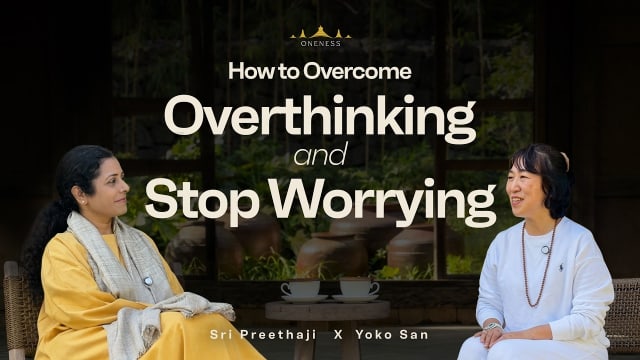
Lie down, close your eyes, and the body is ready: limbs heavy, the room quiet, nothing left to do. Then the mind starts up. A to-do list surfaces, then an old conversation, then a hypothetical about next week that has no business being examined at one in the morning. The harder you push to shut it off, the louder it seems to get. In a 90-second clip published on the Sri Preethaji & Sri Krishnaji channel on November 9, 2026, Preethaji takes up exactly this problem, and the answer runs against the instinct most people bring to it. The way to quiet the mind, Preethaji says, is not to fight it, not to reduce the number of thoughts, and not to try to change the thinking. What helps instead is stepping back to watch each thought arise and cease, without clinging to it, pushing it away, or judging it. Overthinking, the teaching suggests, loses its grip once it is observed rather than argued with.
The clip opens with a question that many people have asked themselves at night: even when the body is tired and ready to rest, why does the mind keep thinking, making it hard to fall asleep, and what is happening inside at that moment? The question is put to Preethaji at about the 0:14 mark. The answer begins at 0:29, and it is direct: this happens for most people who have given in to overthinking.
The distinction matters. Tiredness is a bodily state, and the body can be fully ready while attention keeps moving. Sleep does not arrive simply because the body wants it. It arrives when the mind stops producing the material that keeps the system alert, and overthinking is precisely the habit of producing that material on a loop.
One of the more useful observations in the clip is about motive. At around 0:29 to 0:44, Preethaji notes that people sometimes come to believe overthinking helps them cope with a danger, with something that is going to hurt them. The logic feels reasonable from the inside: if I keep turning the problem over, I will eventually find the angle that saves me. Thinking more, in this belief, is a way of staying in control.
The teaching's answer is that this belief does not hold up. As Preethaji puts it at about 0:49, overthinking in itself is such a drain. The mind keeps reaching for a solution it cannot reach through repetition alone, and each pass through the same material leaves the nervous system a little more worked up and no closer to resolution. What felt like protection turns out to be a cost that keeps being paid.
The most striking claim in the clip is about how overthinking reinforces itself. The more you get into the groove of overthinking, Preethaji says, the more you tend to think even more. Then comes the line that reverses the usual approach: even if you are trying to stop it, it is going to become more. Even if you try to make it less, you will see it becoming more.
This is the paradox at the centre of the teaching. A thought that is fought becomes a thought that is attended to, and attention is exactly what keeps a thought alive. The channel's own description puts it plainly: the more you fight your thoughts, the more attention you give them. Every act of resistance, every silent command to stop, is one more mental event feeding the loop. The mind, trying to control itself, becomes its own most engaged audience.
The alternative in the clip is a change of posture rather than a technique for suppression. At about 1:06, Preethaji says:
"For the first time you need to find courage and step back and begin to observe the thinking."
The instruction is to go back, sit back, and observe every thought that is arising and ceasing. The phrase arising and ceasing carries most of the weight. A thought is not a permanent fixture of the self; it appears, it holds the stage for a moment, and it passes. When you watch that process rather than being absorbed into the content, the thought loses its air of urgency. It becomes an event you are witnessing, not a command you must obey.
This is why the stance is sometimes described as stepping back. You are not required to win an argument with the mind. You are asked to notice that the argument is happening, and to let it run without climbing into the ring.
The clip names three things to avoid, spoken at about 1:17 to 1:24: do not cling to a thought, do not try to shove it off, and do not try to judge it. Each one is a different way of staying entangled.
- Clinging gives a thought more authority. Holding onto a worry as though it deserves your full attention confirms that it matters, and the mind reads that confirmation as a reason to bring it back.
- Pushing away looks like the opposite of clinging but is the same movement in reverse. You still have to keep track of the thought in order to push it away, so it remains at the center of your attention.
- Judging adds a second layer of commentary. A thought about a thought, such as "I shouldn't be thinking this," becomes one more item for the loop to chew on.
Taken together, these three describe the usual habits of a restless mind. The teaching asks you to drop all three and simply watch, which is harder than it sounds, and which is why the clip calls it a matter of finding courage.
The clip's final promise is measured rather than dramatic. If you observe in this way, Preethaji says at about 1:29, you will begin to see that your thoughts, the overthinking, the flood of thinking, slows, slowly quietens down, and then you really think what is needed. Three words in that sentence matter: slows, slowly, and then. The change is gradual, and it ends not in blankness but in clear, purposeful thinking.
That is a useful expectation to bring to bedtime. The clip does not claim that one observed thought will send you straight to sleep. It describes a process in which the flood thins over time, and the mind returns to a state where it can think what is needed rather than everything at once.
The clip is brief and does not lay out a detailed method, so anything beyond its core instruction is an interpretation. Still, the logic points in a clear direction. When a thought arrives in the dark, you can notice it as a thought rather than as a fact about tomorrow. You can let it be there without grabbing it, without shoving it away, and without scolding yourself for having it. Then you can gently return attention to something neutral, such as the breath or the sensations of the body. Each time a thought surfaces, you repeat the stepping back. The aim is not to produce silence on demand, which the teaching explicitly says will not work, but to stop feeding the loop.
If sleep trouble is persistent or distressing, it is worth speaking with a doctor or sleep specialist as well. A short clip about attention and overthinking is not a substitute for that kind of care.
The central idea of this clip fits in a sentence: the mind does not quiet because you forced it to, but because you stopped feeding it. If you want to explore it further, watch the full range of teachings on the Sri Preethaji & Sri Krishnaji channel, where the subject of the mind and awareness is taken up in more depth than a ninety-second excerpt allows. For the next few nights, try one small experiment: when you notice yourself deep in a thought at bedtime, name it simply as thinking, watch it arise and cease, and see whether the flood begins to slow. The teaching makes no promises about speed. It asks only that you look.