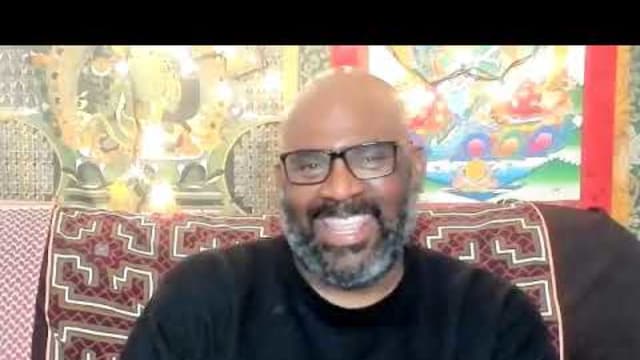
Close your eyes and the room changes shape. For nearly twenty minutes, Tara Brach's guided vipassana meditation asks you to do something most of us almost never do on purpose: arrive in the body you already have. She begins with a scan, not a mantra. She asks you to find the brow, the jaw, the small half-smile at the corner of the mouth, and to let the tension there loosen before anything else happens. The breath is the ground the whole session rests on, the steady low note under everything else, and the practice keeps returning to it. Vipassana, the insight tradition this recording is framed within (the video description calls it "insight meditation"), is less about achieving a special state than about seeing what is already happening, moment by moment, with a softer and more receptive kind of attention. Brach's instructions are simple to follow and quietly demanding to live inside: notice, soften, let the breath be the home base, and when the mind drifts, come back with friendliness rather than force. Read as a guide to the practice rather than a passive listen, the recording offers a clear map of how attention can widen, settle, and open to whatever is arising, including the parts of experience we would rather keep at arm's length.
Brach is explicit about where she thinks presence starts. "The primary entry to presence is through this living body," she says early on (0:26). The instruction is not to think about the body or to analyze it. It is to let awareness move slowly through it and notice where it is tight. That distinction matters. A lot of people arrive at meditation trying to get rid of thoughts, and when that fails they assume they are doing it wrong. Brach starts somewhere else entirely, with sensation, which is harder to argue with because it is simply there.
The scan she leads moves from the face down through the chest, shoulders, hands, belly, legs and feet. At each stop the language is consistent: a "soft attention," a sense of "the possibility of relaxing a bit, loosening, softening." She does not ask you to force anything open. She asks you to sense whether opening is possible. That word, possibility, carries much of the practice. It leaves room for the body to respond on its own schedule.
The facial note is worth lingering on. Brach suggests letting the brow go smooth, the eyes soft, the jaw release, and then sensing "a half smile at the mouth. Slight but real smile." At 1:49 she gives the reason: "Sometimes described as smile yoga cuz it sends a message to the whole nervous system to just relax the fight flight to come into more of a sense of ease." Whatever you think of the phrase, the logic is the same one that runs through the whole session. Small, specific sensations are used as doorways into a more general state of settling.
About four minutes in, the practice shifts. The attention that has been moving part by part is invited to widen. "Notice what happens if you widen the attention to feel this whole body as a field of sensation," Brach says at 4:13. Then she names what might be there: "Tingling and vibrating, heat or cool, tightness or flow. Just letting this life live through you."
This is the core move of vipassana as it is presented here. Instead of a spotlight that lands on one object at a time, the attention becomes more like a room that holds everything at once. Tingling, warmth, pressure, and emptiness are all allowed in without being sorted into good and bad. The instruction is not to fix any of it. It is to notice the texture of experience as it changes, which it always does. Anyone who has tried to hold a steady physical sensation for more than a few seconds knows that it does not stay the same. Brach is pointing directly at that fact.
Within that field, the breath becomes the anchor. Brach does not insist on one place to feel it. She lists several options: "the inflow, outflow at the nostrils," "a rising, falling sensation at the chest," "an expanding and then the settling at the belly." For some people, she says, the breath is felt "as an expanding through the whole body, even on a cellular level." The point is not to find the correct location. It is to find the place where the breath is most easily felt right now, and to let that be the reference point.
She uses a precise phrase for this at 6:36: "Wherever your attention is, letting this breath be a home base." The image of a home base is useful. It implies that you will leave it, wander, and come back. It also implies that the breath is always available, even when nothing else feels stable. The breath is never absent from the body, which is why it works as a steady return point in a practice otherwise made of shifting sensations.
"Your anchor to presence, your home base." (Tara Brach, guided meditation, approx. 6:36)
The mind will wander. Brach expects it and builds the response into the instructions. "When you notice the mind has drifted into thoughts, perhaps the future or the past, commentary, judgement," she says at 7:35, "simply pause. Recognize the fact of thinking and allow the mind to widen open again." Notice the verbs: pause, recognize, widen. There is no step that says criticize yourself or start again from zero.
The return she describes is concrete. You notice "the sounds around you that are right here," you feel "the aliveness of sensation in the body," and then you rest again in the inflow and outflow of the breath. The thinking is acknowledged as thinking, not argued with and not treated as an enemy. In practical terms, this is the difference between a meditation that quietly teaches you to fail and one that teaches you to come back. Brach's language makes the return itself the practice.
This is where the recording gets most interesting, because it refuses to treat the breath as an absolute rule. Brach says that if "some other strong experience arises and asks for your attention," you let the breath move to the background. Her examples are deliberately mixed: "a strong sensation of pain or unpleasantness in the back or perhaps some tingling that's very pleasant somewhere else." At 9:13 she gives the instruction plainly: "we let go of the breath as our primary focus. And open the attention to what's arising. Feeling it directly, receptively, allowing it to be there, to change as it does."
The same logic applies to emotion, which she takes up at 10:09. "If a strong emotion arises, sadness or fear, excitement, strong happiness," she says, "to let go of the breath and open to the emotion as a constellation of sensations in the body. A felt sense in the body. Saying yes to what arises, moment to moment." Pleasant and unpleasant states are treated the same way. Excitement gets the same respect as grief. The aim is to meet an emotion as a bodily event first, a pattern of heat, pressure, or contraction, rather than as a story about why it is happening.
Brach is careful to frame this as a way of staying present with difficulty, not of getting lost in it. When nothing is calling strongly, you return to the breath. When something is, you turn toward it. And when it "no longer calls the attention," you settle back down. The movement is fluid in both directions, which is the point. The practice is not a fixed path but a responsive one.
Near the 13-minute mark, Brach offers a simple reset: "You can start fresh in any moment." This matters for anyone who has ever decided a session was ruined. There is no need to wait for a good meditation before you can be present. "It's helpful to re-relax if you notice the body's tightened up," she says at 13:21. Softening the shoulders, the hands, the belly, the heart. The reset is available at any point, and each one is a new beginning.
The tone she brings to this is the emotional center of the whole recording. "If what you connect with in the moment is difficult, you might explore feeling it as sensations and see what happens if you really say yes." And then, at 14:09: "The key to presence is bringing interest and friendliness to what unfolds." The phrase interest and friendliness is doing a lot of work. It is not detachment. It is curiosity held with warmth, which is a very different thing from grim endurance.
The meditation does not end with a bell or a sudden return to normal life. Brach closes with a blessing, first for your own heart and then for the wider world. "Just take a moment to whisper with sincerity some message or blessing to your own heart," she says at 18:18. Then the attention widens again, to "this whole living world," and you are invited to offer a blessing to "the life that's within and around you," again as a mental whisper.
The sequence is worth noticing. Having spent the session learning to meet sensation, emotion, and thought with openness, the practice ends by directing that same openness outward and toward kindness. It is a gentle close that keeps the friendliness from the body scan intact and turns it into a wish. For many listeners, that is the part that stays after the recording ends.
The best way to understand this recording is to use it. Try the full twenty minutes once with no expectations, then try just the first three or four minutes: the brow, the eyes, the jaw, the half-smile. Notice where the tension sits and whether it can soften even a little. On another day, let the attention widen into the field of sensation and find the breath in whichever place it is easiest to feel. When the mind wanders, which it will, practice the three moves Brach describes: pause, recognize, widen. When something strong arrives, try the harder part, which is to say yes to it as a felt sense in the body, without adding a story.
If you want to go further with the teachings behind this practice, Tara Brach's website is tarabrach.com, and her YouTube channel is @tarabrach. The recording itself is short, but its instructions are precise enough to repeat for years. Start with the breath, come back when you drift, and keep the attitude Brach names as the key: interest and friendliness toward whatever unfolds.