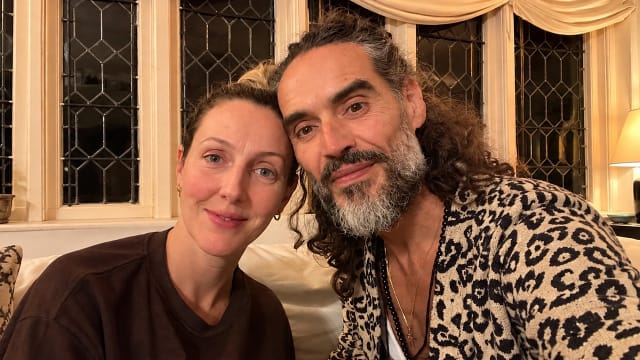
In a clip barely longer than three and a half minutes, Russell Brand and his wife Laura talk about the strain of a legal ordeal they cannot discuss in detail, and reach for a passage most people know only from church: the armor of God in Ephesians chapter 6. What makes the video worth a careful read is the way Brand treats that old list of gear, the belt, breastplate, shield, helmet and sword, as working equipment for a real, physical ritual, the drive toward a courthouse. Read as a discipline of attention rather than a devotional poster, the passage becomes a way of thinking about fear, self-regard, and what a person can honestly claim as their own when the stakes stop being abstract.
Brand begins with the approach, not the courtroom. He says he gets nervous "already driving around the corner," and that the moment he sees the name of the street, "Battle Bridge Road, SE1," he starts to think, "Okay, this is it now." Then comes the sentence that gives the piece its spine: "you don your armor. That's what I feel." Around 0:34 he describes the mental preparation in plain, physical terms: get into shape, get into your strength, because there will be police presence and a lot of people.
The detail matters. For Brand the armor is not a metaphor he reaches for after the fact. It is a cue, a sensory trigger tied to a particular corner of a particular road, the moment the day shifts gear. Anyone who has built a ritual around a stressful commute, a hospital entrance or a difficult meeting will recognize the mechanism: a place becomes a signal, and the signal becomes a chance to prepare.
Around 1:06 the couple turn to the text itself. The passage, as read aloud in the clip, is addressed to "all of us that feel like we're in the midst of spiritual warfare or battle." It tells the reader to "put on the full armor of God so that when the day of evil comes, you may be able to stand your ground." The verbs are worth noticing. The instruction is less about charging into conflict than about standing, having done everything, and remaining in place.
The pieces, in the order the clip reads them, are the belt of truth, the breastplate of righteousness, feet fitted with readiness from the gospel of peace, the shield of faith able to extinguish "all the flaming arrows of the evil one," the helmet of salvation, and the sword of the Spirit, "which is the word of God." Most of the list is defensive covering. The sword is the one piece meant for striking, and even it is a word rather than a blade. Brand's reading keeps returning to that defensive posture: a person under attack needs to be covered before they need to win anything.
This is where the clip sharpens. At around 1:48 Brand says, "I love it," and frames the helmet as protection for thought itself, a guard against a mind that runs wild with what he calls too much self-obsession. His core claim follows quickly: "The gateway into sin is self."
His reasoning is worth following slowly. When a person treats their own feelings and preferences as a kind of personal religion, which he says the culture is "very adept at" encouraging, they become trapped. The helmet, in his reading, helps with exactly that: it keeps the self from setting itself up as the final authority over what is true. It is a discipline of the thought life more than a shield against outside enemies, and it fits the rest of the passage. The enemy in this reading does not have to come from a crowd outside the courthouse. It can come in through the inner monologue.
Here Brand makes his most counterintuitive move. Around 2:19 he says that the breastplate of righteousness is not something a person can get for themselves: "That's given to you by grace." He attributes the understanding to a friend who explained it to him, and he presents it as a reversal of the usual logic of self-improvement. You do not manufacture righteousness through effort and then wear it into a fight. It arrives as a gift, and the wearer's job is to accept it.
For readers who think of spiritual life as a project of self-building, this is the hardest sentence in the clip. It also explains why the armor is described in the passive. Each piece is something you are fitted with or take up, not something you forge.
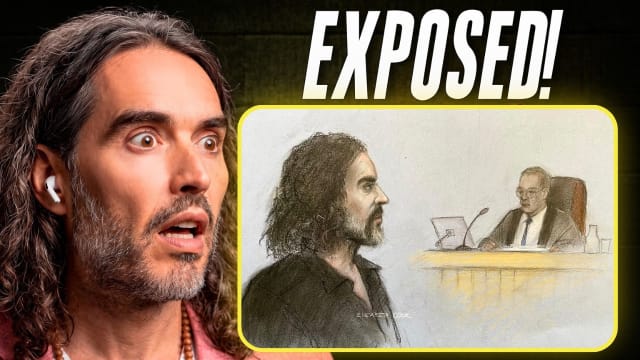
The emotional center of the video comes around 2:32, when Brand describes sitting in the dock, which he calls "that aquarium dock," and refusing to talk about the particulars of the case. What he does instead is take an inventory. "I didn't give myself my life. My life doesn't belong to me. I don't own the breath in my lungs. I didn't invent the English language." The list is deliberately small and ordinary. Breath and language are the kinds of things nobody authors, and that is the point. Then comes the turn: "It belongs to you, Lord. It belongs to you, God."
He follows that with a claim about justice that runs against intuition. In a situation like his, he says, the ideas of truth and justice "don't become less important, they become more important." He describes the dock as a kind of prison and gives voice to the stance it demands: "Truth and justice are the only things that can save me, and I believe in you, God. I believe in your truth and justice." This is his personal testimony about where he turns under pressure. It is not a legal argument, and the clip does not attempt to make one.
The video opens, at 0:00, with a disclaimer of sorts. Brand refers to "a very very unusual time in our marriage" and to "legal reasons," and says the family will be "extremely cautious" in referring to events in the trial, "so that truth and justice is served for everyone involved." He also contrasts what he calls old media, or "empire media," with the authenticity he says the situation requires.
That restraint is worth noticing, because it is itself a form of the armor logic. Refusing to turn a trial into a spectacle, and keeping the focus on what is true and what is fair to everyone involved, is a choice about how to stand your ground. The clip does not supply the details of the case, and this piece will not invent them.
Read Ephesians chapter 6, verses 10 through 18, in full rather than the excerpt Brand reads, and notice how much of it concerns standing and holding rather than attacking. Then try Brand's own test on your own life: when do you feel the cue that tells you a hard day has begun, and what do you reach for in that moment? The video itself runs under four minutes and was published on October 21, 2026. Brand points viewers to his book, How to Become a Christian in 7 Days, and to a free audiobook edition, both linked in the video description, for anyone who wants to go deeper into the faith he describes here.