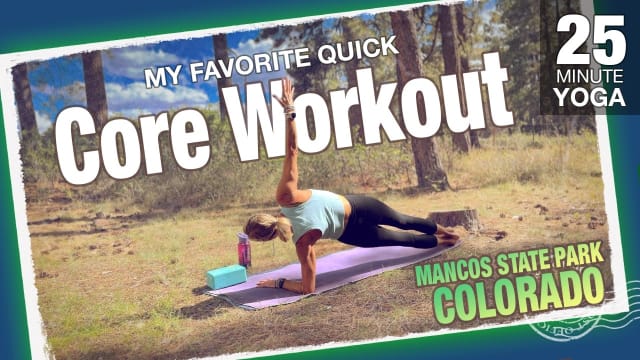
Erin Sampson of Five Parks Yoga built a 20-minute class around one stubborn problem: the muscles that are supposed to hold the shoulders back are the first to quit when a day is spent at a desk, behind a steering wheel or over a phone. In this session, filmed outdoors at Hovenweep National Monument in Utah, she moves from seated breathwork into scapula push-ups, a forearm plank, prone and cobra-style back work, broken wing, a standing sequence of crescent lunge, warrior two and humble warrior, and a closing savasana. The method is less about stretching for its own sake than about waking the muscles around the shoulder blades so the chest and upper back can do their share of holding the body upright. What follows explains the logic behind each stage, so the class works as a resource whether or not you press play.
Because the first job is attention, not effort. Erin begins in a seated position with the hips back toward the heels, hands resting on the thighs, and asks for a deliberate, slow breath before anything else happens. She also gives the spine a short set of directions: draw the belly button back toward the spine, reach up through the crown of the head, lift the shoulders toward the ears and then roll them down the back. In the class she describes the aim plainly: "We have a tendency to round and roll forward, so we're going to activate the postural muscles and get us back into alignment."
That sequence matters. Rounding is rarely a single bad moment; it is a habit the body settles into. Starting with the spine long and the breath slow gives the rest of the practice a neutral reference point, so the later work has something to return to.
The first active movement is the one that gives the class its shape. Arms go straight overhead, fists close, elbows pull down and in toward the ribs, and the shoulder blades squeeze together to form a W. Erin counts it out and uses a precise image for the squeeze: "Imagine you could hold a pencil between your shoulder blades. Squeeze them." That cue is worth borrowing outside the room. Many people, asked to "pull the shoulders back," shrug or arch the low back. A pencil between the blades points the effort at the mid-back, where the rhomboids and lower trapezius do their work.
From there the class moves into eagle arms, with one forearm wrapped over the other and the elbows lifted, then a deep rounding curl that Erin describes as "a super duper deep stretch for your upper back, expanding through the scapula." The pattern teaches a useful principle. Strength and mobility are being trained in the same range, so the body learns to hold the shoulder blade in position while it is free to move.
Scapula push-ups are one of the most underrated tools for the upper back. From tabletop, the chest drops toward the floor between the hands, then the arms press away and the upper back rounds, lifting the body slightly. The movement is small and easy to do wrong: it is about the shoulder blades sliding, not about bending the elbows. Erin cues the sequence with a steady rhythm, then counts it down from five.
The class offers three options, and the choice of version is itself a lesson in working to your own strength. The first is tabletop, with knees on the floor. The second, in her words, is to "come to bear," tucking the toes and lifting the knees so the same chest-up-and-down motion happens with a little more load. The third walks the feet back into high plank. She keeps the rhythm open: "Down and up, whatever rhythm you're at." Scapula push-ups are a good example of how a single pattern can scale from gentle to demanding without changing its shape.
The plank comes straight after the push-ups, while the upper back is still switched on. Forearms go down, either parallel or in a triangle with fingers released, and knees can rest on the mat at any point. The cues are about the back as much as the core: broaden through the chest, keep the gaze forward, keep the chin away from the chest, press through the forearms to broaden the upper back, and keep the belly drawn in. The hold is short, counted down to one, followed by a half circle of the head that releases the neck. The description for the class states the purpose directly: the plank "keeps the heat in the upper back while everything is still awake."
Once the front of the body has been worked, the class turns face down. Arms extend into a capital Y and then a capital T, with thumbs and pinkies spun toward the ceiling, lifting the chest and arms off the floor for short counted lifts. The Y and T are a classic way to engage the middle and lower trapezius without straining the neck, because the gaze stays down and the lift comes from the back of the body. A W shape then returns, with elbows pulled back and in for a counted set.
The class description highlights its cobra variations as "hands-free," and says this is where "you find out how much your upper back has actually been doing." That is a useful test. Without hands pressing, the back has to lift the chest entirely through its own musculature, and many people discover that the effort is coming from the low back or the neck instead. A hands-free cobra is best approached as a question about where the effort is landing, not as a depth goal.
Broken wing is the chest-opening counterpart to all the squeezing that came before. Erin extends one arm out to the side, palm down, while the other hand rests beneath the opposite shoulder. The torso rolls toward the extended arm, the foot plants, and the ear comes down toward the mat. The movement lengthens the front of the chest and the side body while the upper back keeps its work. Erin does both sides, returns to center and moves on, so the chest opening is never allowed to become the only story. Strength is still being asked for while the front of the body opens.
The flow moves into downward dog, where Erin asks for the heels to press toward the floor and for all ten finger pads to press into the mat, and then spins the triceps down and in to broaden through the upper back. Cross-body taps follow, with a knee drawn toward the opposite elbow from a high plank to build rotation and stability at the same time.
The standing sequence begins with low lunge and crescent lunge, where the W returns overhead. Warrior two adds archer's arms: fists at the front, thumbs on top, then pulled back and released on counts. The pattern builds the posture work into a stance, asking the upper back to hold the same structure while the legs carry the body. Humble warrior follows as a variation: hands behind the back for chest expansion, then the torso folding toward the front thigh with the head hanging. Erin releases from the chest expansion, places the hands down and returns to vinyasa, so that the upright work and the floor work trade places several times.
After the stretches and the final flow, Erin brings the class to rest with a few cues that are easy to skip: relax the cheeks, soften the face, open the mouth and exhale slowly. The savasana is not a reward tacked onto the end. For a posture class, it is where the nervous system gets a chance to register that the shoulders are not braced anymore. The class description calls it "a well earned Savasana," and that line lands because the preceding twenty minutes asked real things of the upper body.
"Posture is not something you fix once. It is something you keep taking back."
That sentence is the honest core of the practice. A single session will not change how a day at a desk shapes the body. What it can do is give the postural muscles a deliberate, repeatable reminder of where they belong.
If this class is the first Five Parks Yoga session you have tried, the channel holds more than 400 free classes, which the description says can be found at fiveparksyoga.com. For a more intensive route, the site also lists yoga teacher training in Costa Rica from May 3 to 17, 2027, with a waitlist sign-up. To see how the team films its classes on location, the Five Parks Life project, found at FiveParksLife.com, follows Erin and Matt as they film yoga around the world. For this particular practice, a reasonable approach is to repeat the W-shape squeeze and the scapula push-ups on their own a few times a week, choose the easiest version that still challenges the upper back, and let the longer class build from there.