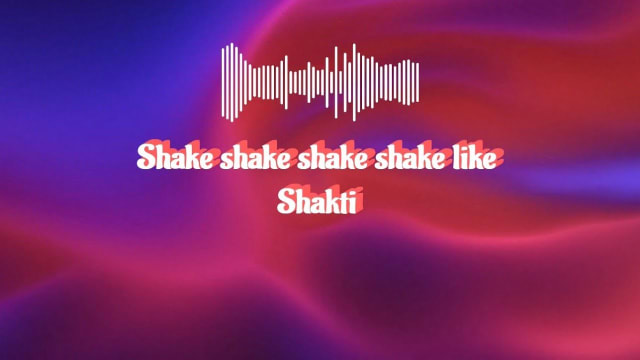
Shanin Blake's “Shakti Shake” is a three-minute chant built on a single, insistent instruction: shake like Shakti. Over a pulse that grew out of the drum circles of her youth, Blake calls and answers with her own voice, whoops, and the word “Baraka,” while the phrase slowly changes shape until it is asking to shake like Shanti instead. The song is a music video, a piece of devotional-leaning dance music, and, in Blake's own account, a container for a stretch of grief she needed to move through with her body rather than only her thoughts. Read closely, it is also a compact map of how one artist's love of rhythm met a set of Hindu ideas about power, destruction and renewal.
The video opens with its title phrase already in motion. “Shakti, shakti, shakti,” Blake sings, and within seconds the words collapse into a rhythmic mantra: “Shake, shake, shake, shake like shakti.” The first half-minute carries no story at all. It is pure invocation, a chant that tells the listener what the record is for before any context arrives.
That context lives in the video's YouTube description, where Blake lays out the lineage in her own words. She writes that she “found my soul in drum circles at the park, at festivals,” and that she learned who she was while playing djembe in the woods around a fire, dancing and hula hooping for hours. “I'm a drummer at heart,” she wrote. The description names handpan, cajón and djembe as the instruments she loves, and it frames the whole project as built from “the drums I grew up with, my love of dancing, movement, freedom.”
That detail matters because it explains the song's architecture. “Shakti Shake,” she writes, came from a wish to return to those roots and bring more of that rhythm and movement into her music and live performance. The track is not a sermon set to a beat. It is a dance floor memory turned into a recorded object, and the call-and-response of the vocal is the closest thing to what a drum circle actually sounds like when everyone in it is answering the lead.
Blake's description gives a plain definition. “In Hindu tradition, Shakti means power and represents divine feminine energy, the sacred power of creation, movement, & transformation.” Those three words, creation, movement and transformation, are the hinges of the whole track. The chant is literally about movement, the shaking of the body, but Blake is pointing at the older idea that movement is the way creative power expresses itself in the world.
Her path to that idea ran through places most listeners would not expect a pop-leaning music video to come from. She describes some of her earliest memories of dance and movement as taking place at ecstatic dances held in a Hindu temple, “where images of Shiva & Shakti were always on the walls.” Those evenings, she says, “stayed with me” and became part of the way she connected music, movement and spirituality. Years later, a yoga teacher training with a teacher named Santosha, who she describes as having grown up in India “immersed in yoga from childhood,” gave her a fuller vocabulary. He “taught us so much about Shiva, Shakti, & the traditions & philosophy they come from,” and those concepts, she writes, “always deeply resonated with” her.
So the song's first meaning is simple and bodily. Shakti is the force that moves things. The chant asks the listener to be moved by it.
The video's most striking image is a line in the transcript that reads, in effect, “Kali tongue out.” That is not an accident. Blake's description identifies Kali as “one of the fierce expressions of Shakti, carrying this duality of destruction & renewal, fierceness & protection.” The phrase “duality of destruction and renewal” is the important one. Kali is not a figure of soft comfort, and Blake does not present her that way.
This is where the song's personal stakes become legible. Blake writes that “this song & its meaning felt especially relevant to the chapter of life I have been going through,” and she names it directly: “After coming out of all of the difficult heartbreak in 2025&2026.” She describes the project as a way of “learning how to stand in my own power again” and of “working with Shakti & Kali Ma energy to reconnect with a part of my femininity that had gotten lost in the pain.”
Read that way, the wildness in the video is not decoration. It is the material the song was made to hold. In her words: “I needed to create a container for the wildness and Shakti Shake became that container for me.” A container is an apt word for a chant. It is repetitive on purpose, so that a feeling too large for a verse can be held in a loop until it can be lived in.
“I needed to create a container for the wildness and Shakti Shake became that container for me. I poured my blood sweat & tears into this music video.”
Listen to the track as a sequence of moves, not a single idea, and the structure becomes clearer. The opening minute is establishing: the title phrase, a whoop, a surprised “Wow” and a “Yay” that sound unscripted. Around the minute mark the shake-shake-shake chant locks into a hypnotic groove, and the repetition does the work a bridge would do in a conventional pop song. There is no sudden key change. The change is in the meaning of the words, carried by the same pulse.
The moment of “Kali tongue out” arrives around the one-and-a-half-minute mark. It is the most theatrical gesture on the record, a vocal cue that points straight at the figure Blake describes as holding destruction and renewal together. From there the track moves into a stretch of “Baraka” calls and low, affirming “Mhm” responses, the kind of answering voice a circle provides when someone is leading and the group is with them.
Then the pivot. Around the two-minute mark the phrase begins to read “like Shanti” instead of “like Shakti.” The sound barely changes, but the word does. The chant that began as a call to power starts landing on peace, and in the final stretch the shouted “SHAKE SHAKE SHAKE LIKE SHANTI” comes back again and again, a last set of calls that ends the record on that word.
That shift is the most interesting thing in the song, and the description does not explain it outright. It is worth taking seriously anyway. Shakti is power in motion. Shanti is peace. A track that moves from one to the other across three minutes is describing something a lot of people who have come through heartbreak know well: the energy has to be fully felt before it can settle. The video does not claim to have resolved anything. It gives the listener a loop in which power and calm are both still shaking.
It is easy to hear “Shakti Shake” as simple, and simplicity is part of its power. But the craft is in the restraint. A chant this repetitive lives or dies on whether the pulse feels alive, and whether the vocal can sound spontaneous while still landing exactly where it needs to. The whoops and laughs that land in the first half-minute read as happening in the moment rather than being layered on afterward, which is exactly the effect a drum circle produces when the energy in the room is real.
Blake's own description makes the same point about process. She describes the video as the place where she put everything in: “I poured my blood sweat & tears into this music video.” For a listener, the result is a record that does not feel finished in the way a polished single does. It feels like a session that has been captured at the point where the group found its groove.
“Shakti Shake” asks very little intellectually and a great deal physically. You do not need to know the Hindu traditions Blake describes to be moved by the chant. But if you do know them, or if you come to them after hearing the song, the record opens up. The Shakti of creation and transformation, the Kali who carries destruction alongside protection, the Shanti of peace that the chant finally reaches for: these are old ideas, and Blake has put them into a form that a dance floor, a drum circle or a bedroom can use.
That is the quiet argument of the piece. A song can be a container for something that does not fit in a sentence. Blake found her container in a loop, a few words and a set of drums she has played since she was young. The result is three minutes that ask you to shake like Shakti first, and then, by the last call, to shake like Shanti.
To hear the source material for yourself, watch “Shakti Shake” on Shanin Blake's channel and read the full description, where she tells the story of the drum circles, the temple dances and the heartbreak behind the record in her own words. Listen for the moment the chant turns from Shakti to Shanti, and then listen again with the description open. If the track sends you toward the traditions it draws on, start with the two ideas Blake returns to most: Shakti as the sacred power of creation, movement and transformation, and Kali as the fierce face of that power that holds destruction and renewal together. Both are older than any music video, and this one gives them a body to move in.
If you play any of the instruments Blake names, whether djembe, cajón or handpan, the track is also a useful study in how a repeated pattern can carry an entire emotional arc. Put on the record, let the first call land, and see where your own shaking takes you.