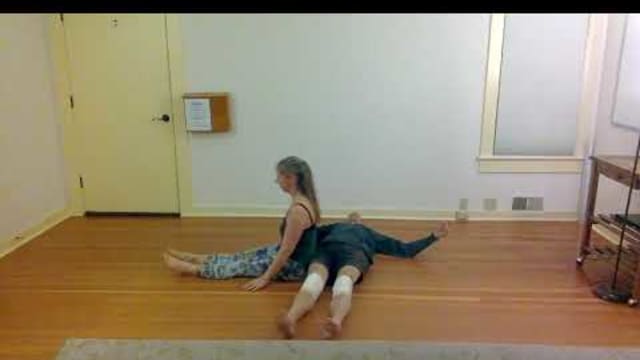
Start standing, and start with the knees. In a short instructional video posted to YouTube in September 2021, Nando Raynolds opens a warmup by asking the viewer to step into a cross crawl: right hand to left knee, then left hand to right knee, lifting each knee as high as is comfortable. It is the kind of opening that looks almost too simple to matter, and yet the whole routine is built on the same premise. Before you stretch, get the body moving through every joint, slowly and on purpose, with the breath leading. The sequence he walks through runs from the knees up through the hips, spine, shoulders, neck, arms, wrists and fingers, with roughly ten repetitions per movement and a deliberate pause between blocks. This is a guide to what he actually does, why the order makes sense, and how to read the cues he gives while he moves.
The video's title calls the routine "Mindful Movement," and the word is earned. Nothing in the sequence is aggressive. There are no ballistic swings or deep end-range holds. Each movement is repeated with attention to a specific part of the body, and the presenter keeps returning to the same instructions: breathe, relax, and let the joints move. The cross crawl comes first because it asks the whole body to coordinate. Opposite arm and leg work together, which wakes up both sides of the body and gets the heart rate up gently without tiring the legs.
After the cross crawl comes an "elbow" version, which brings the opposite elbow toward the rising knee, and then a "cross" version counted out in even numbers. The count is worth noticing. Raynolds calls out "elbow one two three four five six seven eight nine ten" and then "cross one two four six eight ten," a small detail that tells you the routine is meant to be counted, not rushed. Each rep is a breath-sized unit of motion, and the counting keeps the pace steady.
Next is a descending figure eight. The hand moves down the outside of the rising knee and then reverses up the inside, about ten times in each direction. This is the first hint of a theme that recurs through the whole routine: the same shape traced in both directions. Raynolds returns to that idea with the arm circles and the figure eights later on, because changing direction is one of the simplest ways to change how a joint feels.
Around the one-minute mark the routine moves up the body. Shoulder rolls come next, with the shoulder rolling "from the front to the back," about ten times, followed by a pause to "catch your breath a little bit." That pause is not filler. It is a reset built into the structure, and it recurs at the end of nearly every block. A warmup that never stops to breathe becomes a workout, and Raynolds is clearly aiming for something else.
The twist that follows is where the knee cue becomes important. The video's instruction is specific: bend the knees, brace the legs, and do not allow the knees to twist. The rotation is supposed to come from the torso and the head, with the legs acting as a stable base. He looks behind himself, then makes a frame with his arms and looks behind again, then leads with the fingertips over the shoulders, then the elbows, holding an imaginary ball. Each variation adds a different point of contact but keeps the same rule. The spine turns while the knees stay quiet. For anyone who has ever felt a twinge in the knee during a rotational stretch, that single instruction is the key.
"Don't twist your knees looking behind yourself." (Nando Raynolds, in his September 2021 warmup video, around 2:00)
Hip rotations come next, and they illustrate how Raynolds thinks about joints. He describes rotating the whole body "as if moving from the belt," then reversing direction, and then narrowing the stance to a smaller, more internal rotation he calls "sort of a bedroom hip rotation." The change in stance changes the movement. A wider base gives the big circle; a narrower base brings the motion inward. He is not asking for a single hip motion. He is asking for several, so the joint gets its full range rather than one repeated arc.
The neck work follows the same logic. The cues here are about relaxation and length. He asks the viewer to move the ear toward the shoulder, to extend the neck and look up at the ceiling, to twist and look behind over each shoulder, and to move the head forward and back in small "jut" and "retract" movements. His instruction while doing this is a short one: "ankles knees hip joints relaxed, don't lock your knees." The neck is not being pushed. It is being taken through a gentle range, and the rest of the body is asked to stay soft so that the neck is not forced to do all the work.
The upper body gets a set of movements that look playful but do a lot of work. Arms swing overhead and down in an "axe chop." Then the "teacup" movement brings the arm across the body in a turn led by the elbow, repeated about five times per side. Raynolds is specific about the lead: the elbow is the point that moves the arm, and the hand follows it. This is a small but useful correction for anyone who tends to reach with the hand alone and lose the connection to the rest of the arm.
Spinal undulation is the centerpiece of the upper half. Raynolds asks the viewer to imagine a swimming motion, and to let the whole spine ripple. He says the attention should be "mostly" on the movement of the spine, and that the arms can be dropped or kept in a breaststroke shape, depending on what feels better. A butterfly variation follows, slightly different in its undulation. The core teaching here is that the spine should move as a wave, one segment after another, not as a single block. That is harder than it sounds, and it is the reason the arms are optional. The arms are scenery. The spine is the subject.
The routine shifts from loose mobility to something closer to balance training in the second half. The figure eights on the floor, traced as a circle in front and a circle behind in each direction, are described as bringing "a lot of motion into your hip joint" while also challenging balance. He suggests holding onto a chair or wall if needed. The ankle, knee and hip of the standing leg are asked to stay relaxed and absorb the change, a concept that comes up often in his cues.
Then the ankles. The viewer lifts one knee and rotates the ankle about ten times in each direction, then switches sides. The standing knee should stay bent, and he is clear about that. The exercise is simultaneously a flexibility drill for the ankle and a balance challenge for the rest of the leg. It is one of the few moments in the video where the instruction is about staying steady rather than moving freely.
The closing section moves down the arms. A circle travels up the inside of the arm, and then back down, about ten times. The elbow version adds an image: Raynolds describes spreading hand lotion on his elbow with the opposite hand, a cue that gives the viewer something concrete to picture while the joint rotates. Wrist rotations come along the same path.
The fingers are last. He opens and closes the hand one finger at a time, starting with the little finger and moving toward the index, then closing the whole hand and opening it again. A later shape focuses on the first knuckle, with the angle of the finger bending only at that joint, about ten times. The routine ends on the instruction "focus on opening, open, open, open." It is a deliberate final cue. After the big movements of the body, the smallest joints get the last word.
"If you do this on a regular basis you're going to be just limber and more free in your movement and all of your joints." (Nando Raynolds, September 2021 video, near the end of the routine)
There is a small discrepancy worth naming. The video is titled a "14 minute warmup," and the runtime is about fourteen minutes. But in the opening lines, Raynolds introduces it as a "10 minute warm-up sequence." Both can be true in practice. The routine is built to be done in full or in part, and the description tells viewers to "use some or all of this sequence." If you only have ten minutes, pick the sections that matter most to you. If you have the full fourteen, the sequence is designed to take you through every joint.
Raynolds is direct on frequency. He says the routine is worth doing "at least once a week," and that doing it daily is "awesome." His promise is simple and modest: do the warmup, and "feel better all day long." He does not promise transformation or a particular fitness outcome. What he offers is a regular practice of moving every joint through its range before you stretch or start the day. In a world where most people sit for hours, that is a reasonable goal.
If you want to try this, start with the first three movements, the cross crawl, the knee-and-elbow version, and the descending figure eight, and then add one block at a time until you can follow the full sequence. Keep the knees soft, count the reps, and take the pauses. Watch the original video for the exact pacing, and let the presenter's cues guide the feel of each movement. The routine is simple on paper, but it rewards attention. The movements do not need to be big. They need to be complete.